






More than a vaccine: A mass vaccination campaign in Burkina Faso transformed survival, schooling, and livelihoods for a generation.
Why measles vaccination matters now more than ever
The world is facing a worrying resurgence of vaccine hesitancy. Misinformation and mistrust have led to a decline in vaccination rates for both COVID-19 and routine childhood immunisations. In 2022 alone, nearly 22 million children globally missed their first dose of the measles vaccine, reversing years of progress (WHO 2023). Low-income countries are especially susceptible to these crises given their relatively weak healthcare systems.
Measles is a highly contagious viral disease and remains a leading cause of death among children under five worldwide. The virus can significantly deplete the body’s immune memory, making recovery more challenging and increasing vulnerability to other diseases (Mina et al. 2015, 2019). This immunosuppression may persist for months or even years after recovery.
In contrast, measles vaccine provides safe and effective immunity without triggering this immune reset. It protects against measles and helps preserve the broader immunity that children acquire through previous infections or vaccines. Measles vaccination effectively offers a double defence, preventing a deadly disease while shielding the immune system from a cascade of future vulnerabilities.
In this context, understanding the full returns to measles vaccination—especially in resource-constrained settings—is crucial. We evaluate the long-term impact of the 1984 National Vaccination Commando Program (VCP) in Burkina Faso, finding improvements in child survival, alongside meaningful gains in school attainment, formal sector employment, and even agricultural productivity decades later (Daramola et al. 2025). These findings underscore the importance of routine immunisation as a cornerstone of both public health and economic development policy.
Studying the long-term effects of a mass vaccination campaign in Burkina Faso
In 1984, Burkina Faso launched an extraordinary campaign to rescue its failing routine immunisation programme. With strong political backing from the Sankara government and support from international partners, the country implemented the VCP. This two-week national effort vaccinated over one million children against measles, meningitis, and yellow fever.
The programme’s success was dramatic: national vaccination coverage surged from a dismal 17% to an impressive 77% in just over two weeks. The VCP mobilised military and paramilitary resources, reassigned health staff, and rapidly distributed vaccines through a centralised push. The government also invested heavily in generating demand—using radio, posters, and local performances to raise awareness. These efforts helped overcome both supply- and demand-side constraints that had plagued previous efforts.
Children aged nine months to six years were eligible for measles vaccination. Because campaign intensity varied across provinces, and age determined eligibility, the rollout created sharp differences in vaccination exposure across geography and age cohorts. This rollout—where some children were exposed purely because of when and where they were born—forms the basis of our empirical strategy. Although the VCP included vaccinations against yellow fever and meningitis in addition to measles, the marginal variation in coverage due to eligibility is primarily driven by measles. Both eligible and non-eligible cohorts had similar access to the other two vaccines. Moreover, placebo analyses comparing older (1966–1971) and partially exposed (1972–1977) birth cohorts reveal no meaningful differences, further supporting that the long-term effects we document are attributable to measles vaccination.
To estimate the long-term effects of measles vaccination, we use a difference-in-differences strategy, following Duflo (2001). Specifically, we compare individuals born in eligible age cohorts (1978–1983) to slightly older, ineligible cohorts (1966–1977), across provinces with high versus low measles vaccination intensity. The approach allows us to isolate the causal effects of vaccination from broader secular trends or regional characteristics.
We bring together multiple nationally representative data sources: child mortality from the Demographic and Health Survey, education and labour market outcomes from population censuses, and farm productivity from the Permanent Agricultural Survey. These rich datasets allow us to trace the effect of early-life vaccination from infancy to adulthood—capturing health, schooling, labour market, and agricultural productivity outcomes decades later.
Measles vaccination: A lasting investment in human capital
Our findings, summarised in Figure 1, demonstrate that the benefits of measles vaccination extend far beyond immediate survival, shaping long-term opportunities.
Health and survival: In provinces with high vaccination intensity, the under-five mortality rate declined by 16%, corresponding to 47 fewer child deaths per 1,000 live births. This reduction highlights the powerful and life-saving effect of measles vaccine.
Educational attainment: Vaccinated children were not only more likely to survive, but also more likely to have higher educational attainment. Exposure to measles vaccine increased primary school enrolment and completion rates by 12% and 14%, respectively. Beyond improved physical health, they suggest a shift in long-term educational trajectories. By improving health, vaccination likely enabled children to start school on time, miss fewer days due to sickness, and continue progressing without disruption.
Formal labour market success: The benefits extended into adulthood, with vaccinated individuals 11% more likely to work in the formal sector. In a context where formal jobs offer better wages, working conditions, and social protections, vaccination effectively opened doors to superior economic opportunities.
Agricultural productivity—an unexpected economic engine: What stands out in our context is the breadth of outcomes. Many studies focus narrowly on earnings or schooling. We document gains not only in formal sector employment but also in agriculture—an area that remains central to the livelihoods of many in the developing world. Vaccinated individuals achieved agricultural yields 6–9% higher than their unvaccinated counterparts. Noticeably, this productivity gain did not result from farming smaller plots, using more inputs, or working longer hours. Instead, the evidence suggests improved labour efficiency—healthier farmers working more effectively throughout the farming season. This aligns with long-standing economic models linking physical health to labour efficiency (Bliss and Stern 1978, Strauss 1986). In our data, vaccination did not increase the number of hours worked, rather it improved the value of those hours.
Figure 1: Effect of measles vaccination on treatment and placebo groups
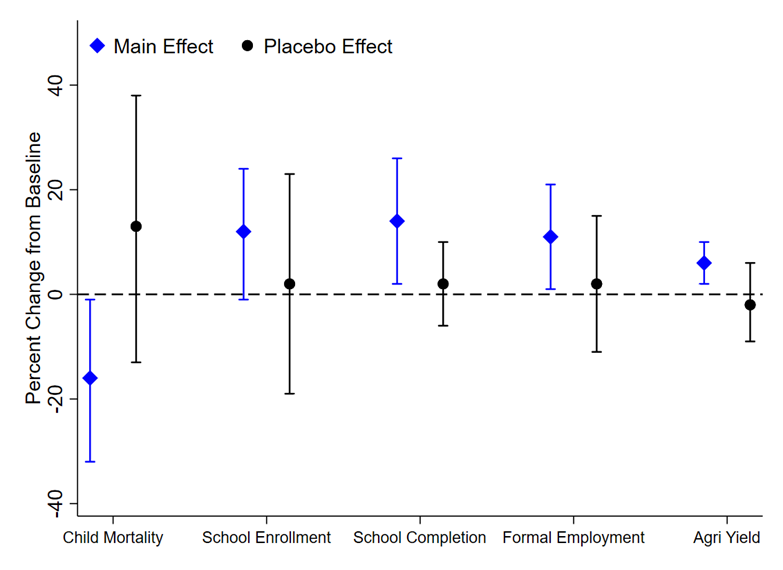
Note: This figure shows the treatment effects and corresponding 95% confidence intervals, relative to the baseline.
By and large, these long-term effects reinforce a core idea in development economics: early-life health interventions can shape a lifetime trajectory of opportunities.
Vaccinations as a highly cost-effective intervention
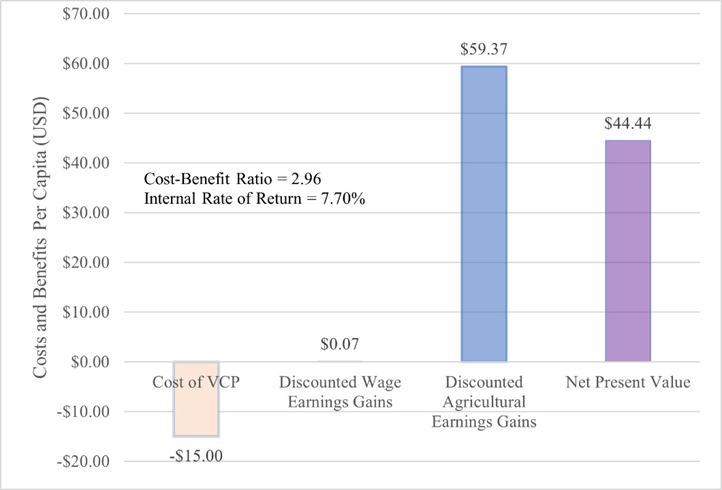
To quantify these returns, we conducted a cost-benefit analysis of the campaign, comparing programme costs with monetised gains in formal earnings and agricultural output. The results displayed in Figure 2 are striking:
- Cost-benefit ratios range from 3:1 to 82:1, based on most conservative to most optimistic (but still plausible) assumptions about the programme costs and discount rates.
- Internal rates of return between 9% and 43%.
- Even under the most conservative assumptions, each dollar spent yields at least three dollars in economic value.
These figures are conservative, as they exclude other plausible benefits such as lower healthcare spending, improved adult health, and intergenerational gains.
These results highlight that even modest early childhood health interventions, when delivered effectively, can generate substantial economic dividends. In this case, measles vaccination led to long-lasting improvements in income and productivity—particularly valuable in settings where other forms of capital investment are limited. While the campaign’s primary goal was to improve public health, its downstream effects underscore the broader developmental returns of investing in early-life health.
Figure 2: Cost-benefit analysis of the vaccination campaign
Implications for global health and vaccine policy
Our research adds to the growing body of evidence on the lasting returns to early childhood health investments, but it also offers distinct insights. First, unlike most prior work focused on high-income settings or localised programmes, our analysis draws on a nationwide campaign in a low-income country. Second, we extend the lens beyond formal education and wage employment to document gains in agriculture—a critical and underexamined sector in development.
The evidence points to a simple but powerful conclusion: delivering vaccines at scale can transform lives, economies, and futures. As vaccine hesitancy grows and fiscal pressures mount, this historical case offers a timely reminder of what is at stake—and what can be gained—when governments and donors prioritise early-life health interventions.
References
Bliss, C and N Stern (1978a), “Productivity, wages and nutrition: Part I: The theory,” Journal of Development Economics, 5(4): 331–362.
Bliss, C and N Stern (1978b), “Productivity, wages and nutrition: Part II: Some observations,” Journal of Development Economics, 5(4): 363–398.
Daramola, R, S M Hossain, H Kazianga and K Ncharé (2025), “The lasting effects of early childhood interventions: The National Vaccination Commando Program in Burkina Faso,” Unpublished manuscript.
Duflo, E (2001), “Schooling and labor market consequences of school construction in Indonesia: Evidence from an unusual policy experiment,” American Economic Review, 91(4): 795–813.
Mina, M J, C J E Metcalf, R L De Swart, A D M E Osterhaus and B T Grenfell (2015), “Long-term measles-induced immunomodulation increases overall childhood infectious disease mortality,” Science, 348(6235): 694–699.
Mina, M J, T Kula, Y Leng, M Li, R D De Vries, M Knip, H Siljander, M Rewers, D F Choy, M S Wilson and H B Larman (2019), “Measles virus infection diminishes preexisting antibodies that offer protection from other pathogens,” Science, 366(6465): 599–606.
Strauss, J (1986), “Does better nutrition raise farm productivity?” Journal of Political Economy, 94(2): 297–320.
World Health Organization (WHO) (2023), "Measles".