




A cost-effective at-scale preschool construction programme in Mozambique improved development outcomes of primary-school age children living in extreme deprivation.
99 million children live in extreme poverty worldwide (World Bank and UNICEF 2023, Salmeron-Gomez et al. 2023). These children often lack access to services addressing basic needs—nutritious meals, education, and healthcare—which hinders their physical, cognitive, and emotional development. The consequences extend far beyond childhood: children who grow up with less opportunities to develop their social and cognitive skills have fewer opportunities to generate income as adults—either because they are less attractive to employers or have fewer means to start and grow their own business.
Without effective interventions, these children will most likely fall into a poverty trap, whereby early disadvantages compound over time and persist across generations. This underscores the urgency of scalable interventions that can disrupt this cycle and expand opportunities from the start.
One of the most effective ways to improve children’s human capital is through early childhood interventions (Kabay and Smith 2024, Attanasio et al. 2018, Nasgowitz et al. 2025, Behrman et al. 2024). Among these, expanding access to preschool education has proven successful in low-income contexts (Attanasio et al. 2022). However, we know little about the impacts of preschool education in contexts of extreme poverty.
Studying the impact of a preschool construction programme in Mozambique
In Bassi et al. (2025), we evaluate the National Strategy for Early Childhood Development Project (DICIPE) preschool construction programme in Mozambique. While previous preschool construction interventions targeted poverty in some form (Berlinski et al. 2009, Berkes et al. 2024, Bouguen et al. 2018, Blimpo et al. 2022, Martinez et al. 2017, Berlinski et al. 2008, Castro and da Cruz 2024, Donald et al. 2023), the DICIPE was implemented in a context of much higher vulnerability. For example, Mozambique is the fifth poorest country in the world (World Bank 2025), and while preschool attendance in low-income countries averages around 20%, in Mozambique only 3% of children are enrolled.
The DICIPE programme, initiated in 2016, addressed this gap by constructing 350 preschool buildings (escolinhas) within walking-distance of existing primary schools and staffing them with local instructors (four in each escolinha). The programme’s pedagogical activities relied on locally available, often recycled materials, such as bottle caps, rice sacks, sticks, and handmade educational materials. Figure 1 shows an example of the facilities and the instructional materials used. The programme ran every weekday for three hours. In addition, the intervention included regular parenting education sessions held with caregivers. Between 2016 and 2020, more than 50,000 children attended the DICIPE escolinhas.
Although the programme was managed by the government, activities at the escolinhas were initially implemented by a third-party provider, an NGO with strong community engagement and previous experience in preschool programmes. This close partnership between the local government and implementing agency has been identified as fundamental for the success of early learning interventions in low-income settings (Piper 2025, Attanasio et al. 2017), and indeed in our context helped strengthen capacity within the Ministry of Education and Human Development (MINEDH) in the preschool subsector.
Figure 1: The building, playground, and instructional materials of the escolinhas
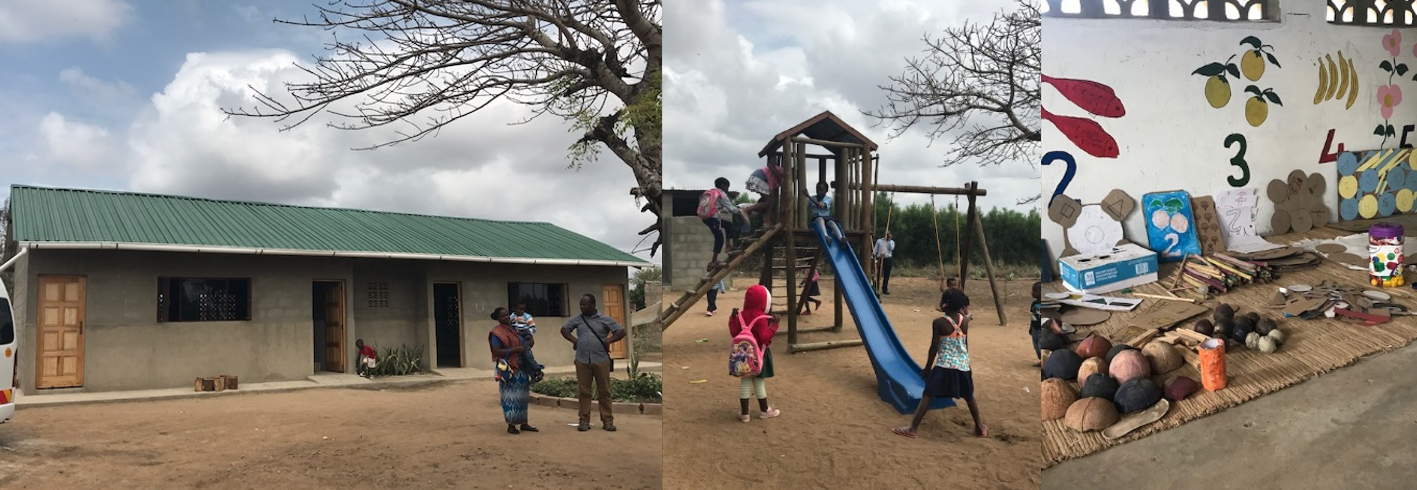
Source: DICIPE evaluation team, World Bank.
Our evaluation focused on 218 rural communities across three provinces in Mozambique (Cabo Delgado, Nampula, and Tete) that had no access to preschool services before DICIPE, either formal or informal. These communities were selected based on development markers, including (i) rural location, (ii) presence of a primary school, (iii) more than 30 children aged 3 to 5, and (iv) no exposure to other preschool interventions in the five years prior to baseline. Due to budget and capacity constraints, only a subset of these communities could receive the programme in its first phase. Thus, the DICIPE programme was implemented as a randomised control trial in 108 communities, while the remaining 110 communities served as control group. The sample for the evaluation included a total of 4,687 households with at least one child aged 3 to 5 years. Baseline characteristics depict high levels of deprivation among children and families. The average child in sample is stunted, and 81% of the caregivers are illiterate.
Preschool construction led to large gains in primary school enrolment and skills
Children in programme communities experienced substantial cognitive and non-cognitive gains. As shown in Figure 2, preschool enrolment surged from just 2% in control areas to 73% in treated communities, indicating high take-up of the intervention. The programme also led to an increase of 6 percentage points in primary school enrolment, and improved grade progression—with repetition rates falling by 3 percentage points among treated children.
Figure 2: DICIPE improves preschool enrolment and primary-school-age outcomes
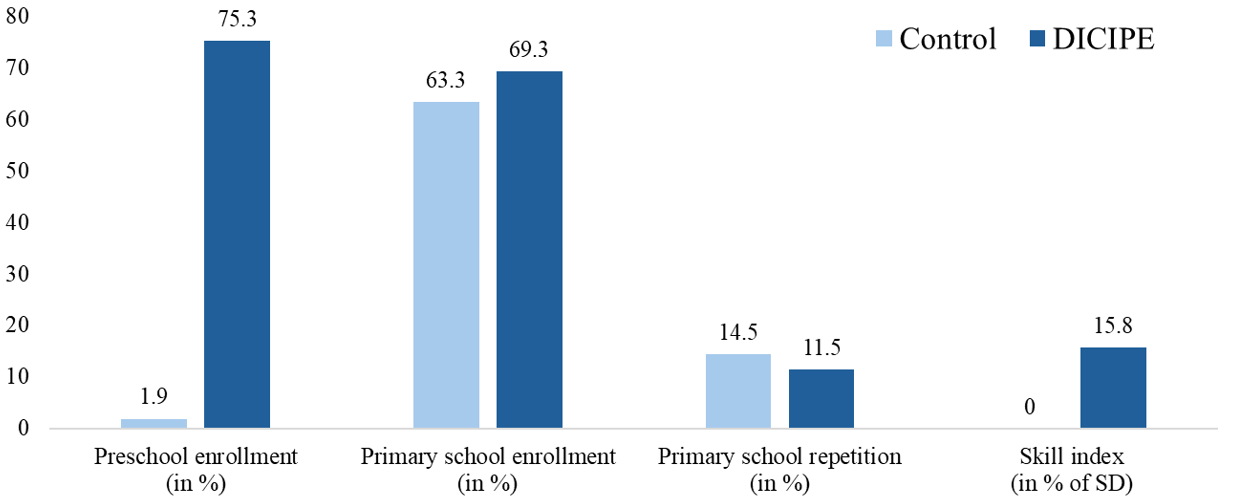
In addition, children who received the preschool intervention performed better on standardised tests of early literacy, math, and fine motor skills. An overall skill index shows that treated children scores 0.158 standard deviations (SD) better than control children. Specifically looking at the index components, we find gains of 0.17 SD in early literacy, 0.11 SD in math, and 0.14 SD in fine motor skills related to writing. Treated children also showed a 0.10 SD increase in interest in literacy.
Interestingly, the intervention had positive spillovers within families. Parents in communities that received preschools reported higher-quality interactions with their children. For example, were more likely to play with their children, engage in conversations, and support learning activities such as helping with homework.
Who benefits most from preschool construction—and why?
To better understand what drove the gains from the DICIPE programme, we explored who benefited most and which components of the programme mattered. We find that children living closer to the new preschools, from relatively wealthier households, and with illiterate caregivers experienced the largest improvements. These patterns are consistent with past research showing that children in somewhat less disadvantaged households may be better positioned to benefit from early learning opportunities, while children of less educated caregivers may gain more from structured instruction outside the home.
We also conducted a mediation analysis to assess the relative importance of the programme’s two key components: preschool instruction and parental education sessions. Our results point to preschool enrolment as the primary driver of the observed gains, particularly in terms of children’s performance in primary school. We find no evidence that the parental education component alone contributed to improvements in child development outcomes—an insight echoed by qualitative interviews suggesting implementation challenges and engagement barriers on that front.
A scalable preschool construction model for low-income settings
The DICIPE programme proved cost-effective: the cost per child per year was approximately US$77, covering preschool construction, teacher training, materials, and administrative expenses. To estimate long-term benefits, we projected the expected increase in lifetime earnings based on gains in education, assumptions from existing literature and wage levels in Mozambique. Even under conservative scenarios, we estimate a lifetime income gain of $493, with an upper-bound of $2,598—implying a benefit-cost ratio ranging from 6:1 to 34:1. These estimates do not account for potential spillovers to siblings or broader household effects, suggesting the returns may be even higher.
From a policy perspective, DICIPE’s success in Mozambique highlights the transformative potential of early childhood investments to improve development and educational outcomes in early primary schooling and potentially disrupt intergenerational poverty. Our research contributes to the growing evidence demonstrating that preschool programmes can be delivered effectively and affordably at scale in low-income contexts—with benefits that extend well beyond the classroom and founding cohort.
References
Attanasio, O, H Baker-Henningham, R Bernal, C Meghir, D Pineda, and M Rubio-Codina (2022), “Early stimulation and nutrition: The impacts of a scalable intervention,” Journal of the European Economic Association, 20(4): 1395–1432.
Attanasio, O, H Baker-Henningham, R Bernal, C Meghir, D Pineda, and M Rubio-Codina (2018), “Scaling an early childhood development programme in Colombia,” VoxDev.
Attanasio, O, S Cattan, and S Krutikova (2017), “Early childhood development policies: The evidence and the research agenda,” VoxDev.
Bassi, M, B Besbas, L I D Diaz, S Ravindran, and A Reynoso (2025), “From access to achievement: The primary school-age impacts of an at-scale preschool construction program in highly deprived communities,” Unpublished manuscript.
Behrman, J, R Gomez-Carrera, S W Parker, P Todd, and W Zhang (2024), “Mexico’s preschool mandate set children up to succeed,” VoxDev.
Berkes, J, A Bouguen, D Filmer, and T Fukao (2024), “Improving preschool provision and encouraging demand: Evidence from a large-scale construction program,” Journal of Public Economics, 230: 105050.
Berlinski, S, S Galiani, and P Gertler (2009), “The effect of pre-primary education on primary school performance,” Journal of Public Economics, 93(1): 219–234.
Berlinski, S, S Galiani, and M Manacorda (2008), “Giving children a better start: Preschool attendance and school-age profiles,” Journal of Public Economics, 92(5): 1416–1440.
Blimpo, M P, P Carneiro, P Jervis, and T Pugatch (2022), “Improving access and quality in early childhood development programs: Experimental evidence from the Gambia,” Economic Development and Cultural Change, 70(4): 1479–1529.
Bouguen, A, D Filmer, K Macours, and S Naudeau (2018), “Preschool and parental response in a second best world,” Journal of Human Resources, 53(2): 474–512.
Brinkman, S A, A Hasan, H Jung, A Kinnell, and M Pradhan (2017), “The impact of expanding access to early childhood education services in rural Indonesia,” Journal of Labor Economics, 35(S1): S305–S335.
Castro, M and B da Cruz (2024), “Effects of a large-scale program for the construction of daycare and preschool centers on cognitive skills and female employment,” Education Economics, 23(6): 786–811.
Donald, A, S Lowes, and J Vaillant (2023), “Experimental evidence on rural childcare provision,” Unpublished manuscript.
Kabay, S and R Smith (2024), “Realising childcare’s full potential in low- and middle-income countries,” VoxDev.
Martinez, S, S Naudeau, and V A Pereira (2017), “Preschool and child development under extreme poverty: Evidence from a randomized experiment in rural Mozambique,” World Bank.
Nasgowitz, A, D Ferris, K Bjorvatn, L Vandewalle, S Gulesci, and V Somville (2025), “Preschool subsidies and cash transfers have long-term health benefits for children,” VoxDev.
Piper, B (2025), “Why we need to invest in foundational learning,” VoxDev.
Salmeron-Gomez, D, S Engilbertsdottir, J A Cuesta Leiva, D Newhouse, and D Stewart (2023), “Global trends in child monetary poverty according to international poverty lines,” World Bank.
World Bank and UNICEF (2023), "Global trends in child monetary poverty according to international poverty lines."
World Bank (2025), “GDP per capita, PPP (current international $).”