




Commodity booms are often seen as development opportunities, but new evidence from Brazil shows they can deepen inequality and reshape consumption in unexpected ways.
Editor’s note: For a broader synthesis of themes covered in this article, check out Issue 2 of our VoxDevLit on International Trade.
A growing body of research shows that trade integration can reshape labour markets and the spatial distribution of economic activity, often with significant consequences for inequality within countries (Goldberg and Pavcnik 2007, Dix-Carneiro and Kovak 2023). These dynamics are especially salient in commodity-exporting economies, where global increases in demand frequently generate large income gains. Such booms are commonly viewed as opportunities to broaden prosperity. Yet whether they do so depends crucially on who captures the new income. Distributional patterns can strengthen the local impact of an export boom (or weaken it) by shaping how households adjust their spending and how local economies absorb the shock.
Brazil’s experience in the early 2000s illustrates this point clearly. As China became a major buyer of soybeans, iron ore, and other primary goods, Brazilian exports to China surged. For regions specialised in these sectors, China’s accession to the WTO in 2001 produced one of the largest external demand shocks in recent decades (Costa et al. 2016). Local incomes rose, but the gains were far from evenly distributed – a fact that proves central for understanding how the boom reshaped consumption patterns and demand for imported goods across the country.
In recent work (Cícero and Heras-Recuero forthcoming), we examine how the China boom affected income, inequality, and import behaviour across Brazilian regions. The evidence points to a mechanism often overlooked in discussions of trade shocks: where income gains accrued disproportionately to higher-income households, local demand shifted sharply towards luxury goods and technologically sophisticated imports – categories with few domestic substitutes. These consumption responses reveal not only who benefitted from the boom but also how external shocks can reshape patterns of global integration.
China’s demand boom and uneven exposure
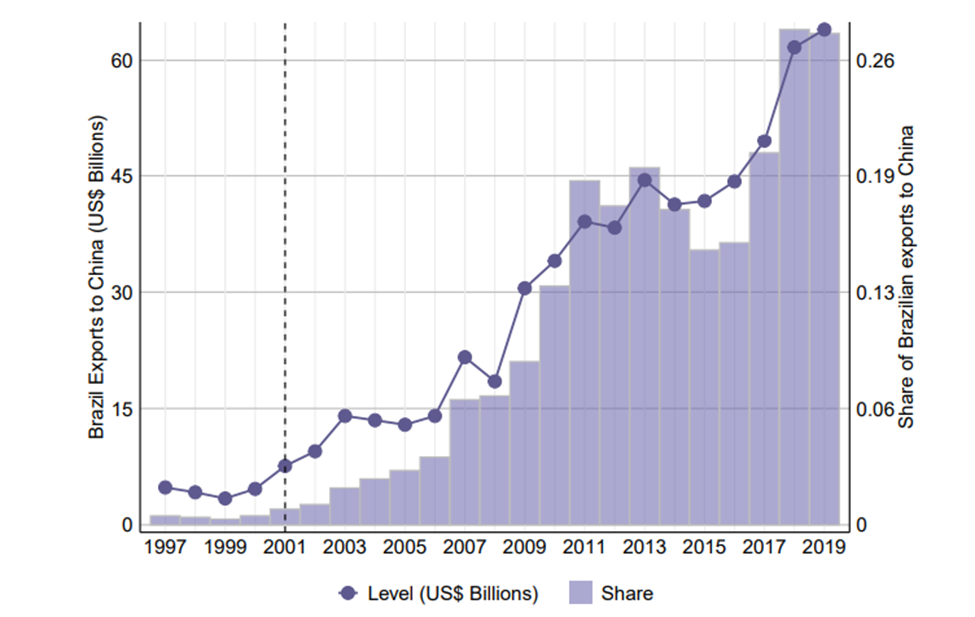
China’s integration into global markets reshaped world demand for primary goods, and Brazil was one of the countries most affected (Carreira et al. 2024). Between 2001 and 2019, Brazilian exports to China rose sharply – in both total value and as a share of national exports (Figure 1) – driven largely by soybeans, iron ore, and other commodities in which Brazil holds a strong comparative advantage.
Figure 1: Brazil's exports to China – Total value and share of total exports
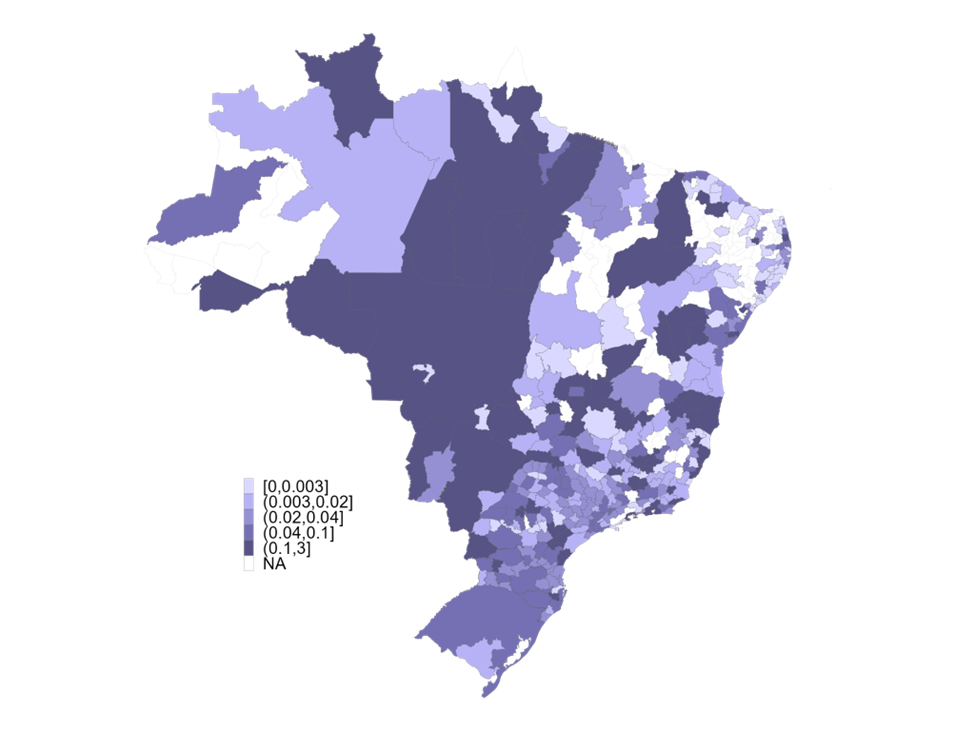
Beneath this national trend, exposure varied markedly across regions. Parts of the Centre-West and North were deeply specialised in the commodities China bought, while many coastal and historically manufacturing-oriented regions had little direct exposure. As a result, China’s rise generated very different local shocks across Brazil.
Figure 2 illustrates this heterogeneity: areas with high exposure, shown in darker tones, cluster in Brazil’s agricultural and mineral-exporting belts. This variation allows us to trace how the boom played out across distinct regional economies and to assess its consequences for income, inequality, and consumption.
Figure 2: Regional exposure to China’s export demand
Income gains were real – but highly concentrated at the top
China’s demand boom translated into faster income growth in regions more exposed to the surge in commodity exports. Both exposed and less-exposed areas looked similar before 2001, but diverged sharply after China’s WTO accession (Figure 3), with the largest gains during the commodity super-cycle. A shift from the 25th to the 75th percentile of exposure corresponds to roughly a 2% increase in regional income per capita.
Figure 3: Effects of the trade shock on regional income per capita
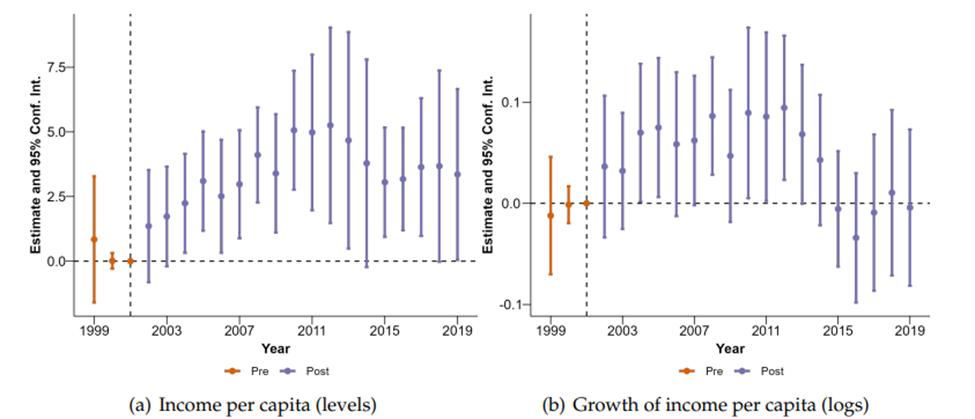
But averages conceal how uneven these gains were. In the regions most tied to China’s demand, median incomes barely moved. Instead, the increase in per capita income reflects sharp gains among households at the top of the distribution. This is evident in rising 90/50 ratios – comparing richer households to those in the middle – while the 50/10 ratio, comparing the middle to the poorest, remained flat. Inequality widened because the rich pulled ahead, not because the poor fell behind. The Gini coefficient rose, and these shifts persisted over time.
Taken together, the China shock functioned as both an income boost and inequality shock. Regions that benefitted most from expanding commodity exports became more unequal relative to the rest of Brazil – a top-heavy pattern that would prove central for understanding subsequent changes in consumption.
Rising inequality reshaped what regions imported
The unequal distribution of income gains also shaped how regions engaged with global markets. To study these effects, we draw on detailed customs records for all Brazilian regions and classify imports by economic use, technological sophistication, and luxury status. Luxury goods are identified using two complementary approaches – one based on expenditure elasticities from Brazilian household surveys, and another using spending patterns of high-income households in the US, echoing a long tradition linking inequality to the emulation of high-status consumption (Veblen 1899, Duesenberry 1949, Nurkse 1952, Furtado 1965).
Across these measures, a consistent pattern emerges. Regions more exposed to the China shock increased their imports more than less-exposed local economies, with the largest gains in consumption goods. Moving from the 25th to the 75th percentile of exposure is associated with an increase in total imports equivalent to roughly 15% of average regional import growth, and close to 20% for consumption goods alone. These effects were stronger in regions that were already more unequal at baseline or where inequality rose most after the shock, indicating that distributional dynamics amplified the overall import response. The increases were concentrated in medium- and high-tech manufactured products – categories with limited domestic production and where imported varieties offer higher quality or technological sophistication.
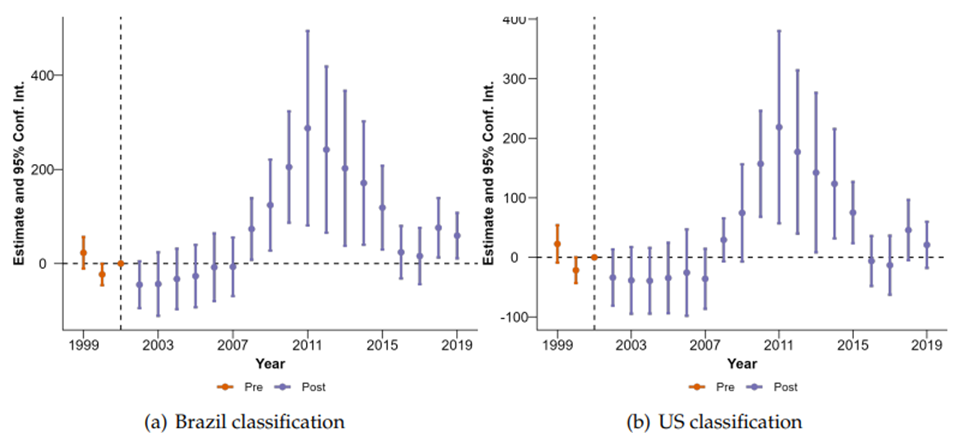
These patterns are especially pronounced for luxury goods. Figure 4 shows a sharp rise in luxury imports in highly exposed regions, closely tracking the timing of the income gains and peaking during the commodity super-cycle. These effects are largest in places that were already more unequal or experienced sizable post-shock increases in inequality, suggesting that pre-existing disparities magnified the shift toward high-end and status-oriented goods.
Figure 4: Effects of the trade shock on regional luxury imports
Policy implications: Trade shocks and consumption
The findings highlight inequality as a key channel through which trade shocks shape consumption. The uneven distribution of income gains produced demand shifts consistent with non-homothetic preferences, in which higher-income households devote a larger share of resources to high-end, often imported goods. The concentration of import growth in goods typically consumed by affluent households in advanced economies also resonates with long-standing discussions of status-driven consumption and demonstration effects in unequal societies.
These dynamics carry important implications for commodity-dependent developing economies. When trade booms reinforce within-region inequality, the resulting consumption structure – increasingly concentrated in luxury goods with high income elasticities – can heighten exposure to external shocks and contribute to external imbalances. Our results suggest that trade shocks associated with positive income gains may nonetheless warrant distributional policies to broaden the base of beneficiaries and strengthen domestic demand for locally produced goods. In a global environment marked by shifting demand and recurrent commodity cycles, incorporating distributional channels into the assessment of trade shocks is essential for understanding external vulnerability and long-run development trajectories.
References
Carreira, I, F Costa, and J P Pessoa (2024), “The deforestation effects of trade and agricultural productivity in Brazil,” Journal of Development Economics, 167: 103217.
Cícero, V, and L Heras-Recuero (2026), “The consumption side of trade shocks: Inequality dynamics and luxury imports,” Journal of Development Economics, 103663.
Costa, F, J Garred, and J P Pessoa (2016), “Winners and losers from a commodities-for-manufactures trade boom,” Journal of International Economics, 102: 50–69.
Dix-Carneiro, R, and B Kovak (2023), “Globalization and inequality in Latin America,” Unpublished manuscript.
Duesenberry, J S (1949), Income, saving, and the theory of consumer behavior, Harvard University Press.
Furtado, C (1965), “Development and stagnation in Latin America: A structuralist approach,” Studies in Comparative International Development, 1(11).
Goldberg, P, and N Pavcnik (2007), “Distributional effects of globalization in developing countries,” Journal of Economic Literature, 45: 39–82.
Nurkse, R (1952), “Some international aspects of the problem of economic development,” American Economic Review, 42: 571–583.
Veblen, T (1899), The theory of the leisure class: An economic study of institutions, Macmillan.