

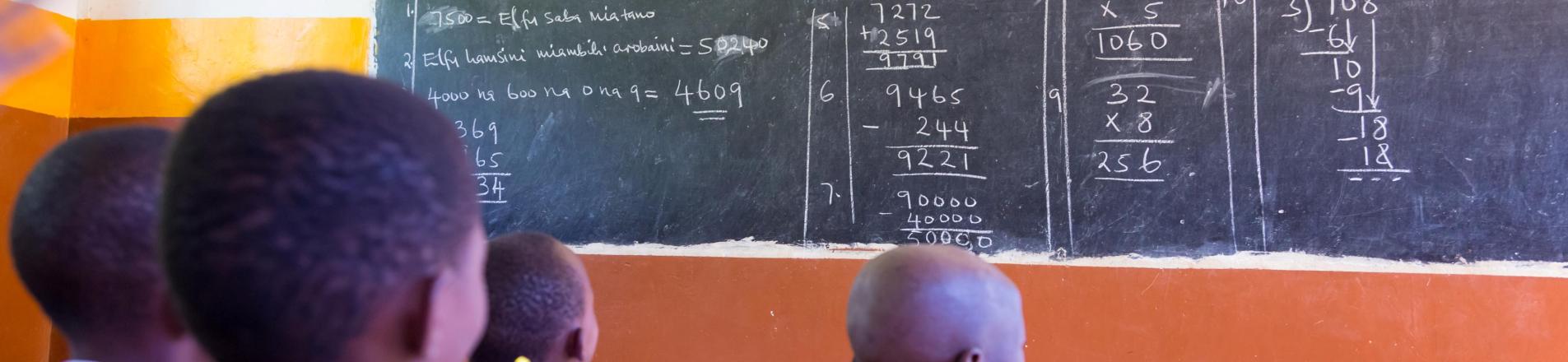

Despite decades of success in expanding school enrolment, global education systems have failed to deliver real learning. Solving the learning crisis requires deep, home-grown system reform that focuses on improving learning itself rather than inputs, access, or short-term interventions.
Editor's note: This episode of VoxDevTalks is available on Spotify and Apple Podcasts.
In this episode of VoxDevTalks, Lant Pritchett discusses one of the most pressing challenges in global development today, the learning crisis, and why we need to rethink education policy for low- and middle-income countries after decades of mixed results.
The central message is stark but clear. While governments and donors have been remarkably successful at getting children into school, they have been far less successful at ensuring that children actually learn. As Pritchett puts it,
“We have to distinguish between school and education: school is a means, education is an outcome”.
Time spent in classrooms does not automatically translate into skills, knowledge, or capabilities that matter for adult life.
Over several decades, global policy focused heavily on expanding access to schooling. This delivered impressive enrolment gains, but it also created an illusion: that building schools and increasing attendance was equivalent to investing in human capital. According to Pritchett, this assumption lies at the heart of today’s learning crisis.
The limits of enrolment-focused policy
Pritchett situates the learning crisis within the legacy of the Washington Consensus and the Millennium Development Goals. These agendas prioritised measurable, easily communicable targets such as enrolment rates and years of schooling. While politically and administratively convenient, this approach oversimplified development.
Reflecting on the Millennium Development Goals, Pritchett is characteristically blunt:
“The Millennium Development Goals were stupid, in a way that the Washington consensus was stupid”.
In his view, complex processes of development were reduced to narrow indicators that failed to capture what truly mattered.
By the time universal primary education became a global target, many countries had already achieved near-universal enrolment. Yet learning outcomes remained deeply unequal and often alarmingly poor. The mistake, Pritchett argues, was treating schooling as both necessary and sufficient.
“The illusion that it’s a sufficient condition was the problem”.
The result is a world in which most children are now in school, but millions leave without basic skills. The policy challenge has shifted fundamentally: expanding access no longer addresses the core problem.
Schooled but not educated
To explain why schooling has failed to deliver education, Pritchett introduces the idea of a ‘learning profile’. This describes how much learning children gain for each year they spend in school. In many countries, this profile is worryingly flat.
“The only way that you can produce more kids that are educated is to steepen the learning profile”.
In other words, children must gain far more knowledge and skills per year of schooling than they currently do.
The evidence is sobering. Today, most of the global deficit in education is not due to children being out of school, but to children attending school for years without learning much at all. Pritchett notes that in many systems, children would need to remain in school well into adulthood to reach acceptable learning levels – an obviously impossible solution.
This perspective reframes the learning crisis as a problem of productivity within education systems, rather than one of access or infrastructure.
Foundational learning and why rote education fails children
A major theme of the episode is the importance of foundational learning – not memorisation, but genuine conceptual understanding that can be applied to real-world situations. Pritchett stresses that learning should enable children to use knowledge, not just repeat it in exams.
“The skills and competencies we’re trying to create is the ability to apply knowledge to situations that you’re going to encounter”.
This distinction matters because many education systems reward rote learning rather than mastery.
He illustrates this with a vivid example from India, where students are taught to measure length by memorising where an object ends on a ruler, without understanding that length is independent of position. When the object is moved, students confidently give different answers – revealing that they have learned a rule, not a concept.
This kind of schooling produces children who appear educated on paper but lack practical understanding. Without strong foundations, future learning becomes harder, and systems end up compounding failure year after year.
Measuring what is easy instead of what matters
Why has this problem persisted for so long? One reason, Pritchett argues, is that education systems tend to measure what is easiest to count rather than what is hardest to achieve. Enrolment figures, buildings, textbooks, and teacher numbers are all legible to the state and easy to report.
Drawing on James Scott’s idea of “seeing like a state”, Pritchett explains that governments often “define [themselves] into success” by focusing on inputs rather than outcomes. Measuring real learning is harder, and producing it is harder still.
This creates a dangerous dynamic. Systems optimise for compliance with administrative targets rather than for student learning. Even when learning is measured, teachers and institutions may lack the training, incentives, or autonomy needed to improve it. As a result, reforms often fail to change classroom realities.
Why Vietnam succeeds and simple fixes do not
The episode challenges the idea that there are simple interventions that can fix the learning crisis. Drawing on the RISE research programme, Pritchett highlights Vietnam as a rare success story. Despite low per-student spending, Vietnamese students perform at levels comparable to those in OECD countries.
Crucially, this success cannot be explained by standard inputs. Equalising class sizes, teacher qualifications, or spending between Vietnam and countries like India would explain ‘zero’ of the learning gap. Instead, Vietnam’s advantage comes from how its system functions as a whole.
Even more striking is historical evidence showing that countries like Zambia have actually gone backwards.
“You are less likely to be able to read as an adult from having completed five years of schooling now than 50 years ago”.
This is not a problem of ignorance about pedagogy, but of systems that have adapted to failure rather than improvement.
System reform, not shortcuts or silver bullets
Throughout the conversation, Pritchett warns against the search for shortcuts. Targeted interventions may generate short-term gains, but without systemic change they tend to be fleeting. He likens such reforms to bubbles in a shaken fizzy drink:
“It looks very dynamic… because look at all the bubbles and these things are shooting off, but the level of the fluid hasn't changed at all, and eventually the effervescence goes away”.
Real progress requires systems that are under constant pressure to improve – from governments, communities, parents, and society at large. Vietnam’s success, he argues, came not from a neat blueprint but from “a hard, messy struggle” in which performance mattered.
This also explains why copying policies from high-performing countries rarely works. “Success… has to be homegrown”, Pritchett insists. Education reform must be rooted in local institutions, politics, and social expectations.
The role of the state, NGOs, and the private sector
The episode closes by examining the roles of non-state actors. While private schools and NGOs can help individual children, Pritchett is sceptical that they can drive system-wide transformation on their own. Often, private provision merely offers a slightly better alternative without raising overall standards.
NGOs, however, can play a powerful role by creating pressure for accountability. In India, organisations like Pratham not only developed effective teaching methods but also exposed the gap between schooling and learning, helping society recognise the scale of the crisis.
Ultimately, Pritchett argues, only the state – embedded within a broader social movement – can deliver lasting change. The learning crisis is not a technical puzzle with a quick fix, but an organisational and political challenge that demands sustained commitment.
As this episode makes clear, there are “no shortcuts to the learning crisis”, but understanding its true nature is the first step towards solving it.