



Children are ubiquitous in African cities but largely absent from development economics research. Here’s what we know about children’s schooling once they’ve moved to the city.
Children make up a large share of the urban population in the developing world. In African cities alone, over 40% of residents are under 18. Yet despite their prominence, we know surprisingly little about how growing up in cities shapes children’s educational outcomes.
Historically, researchers have been somewhat wary of African cities as engines of opportunity. Marx et al. (2013), for instance, warned that cities may act as poverty traps for migrating households due to the high densities, overcrowding, and existence of slums. This concern has been more widely echoed in policy reports on the experiences of urban migrants in Africa and has become particularly pressing given that African cities are expected to add a further 700 million residents by 2050 (UN 2022).
Children in cities do better than children in the countryside
Despite these concerns, the data tells a story about urban success. Figure 1 shows the likelihood that children complete primary school by age 15–16, for all African countries with available census data. Children in cities outperform children in the countryside in every single country for which data is available. On average, children in urban areas are around 25 percentage points more likely to complete primary school by age 15–16. Similar urban-rural differences are visible in the most basic educational outcomes, such as literacy rates, as well as more advanced outcomes, such as secondary school enrolment.
Figure 1: Urban-rural gap in primary school completion among 15–16 year olds
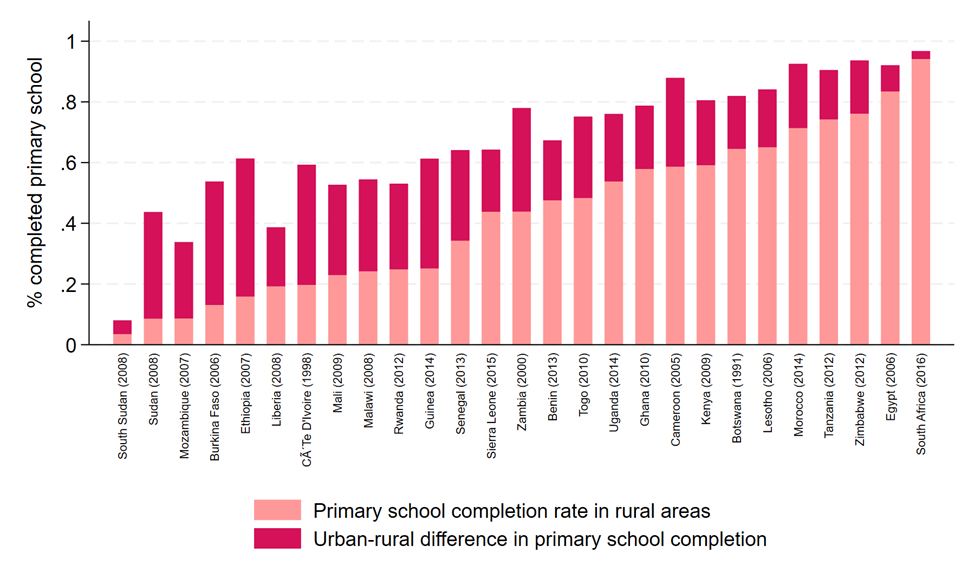
At the same time, the evidence in Figure 1 is based on a comparison of all children. This may not necessarily be informative of the gains for children when households move to the city, since households in cities may be differently selected from rural households. Furthermore, even if the households were the same, the experiences of permanent urban households may substantially differ from those of new migrants.
Spending childhood in the city improves educational outcomes
In recent research, I shed more light on how urban migration in practice affects the outcomes of children in African cities using data that is representative of 2.1 million childhood migration events across 14 different African countries (van Maarseveen 2026). To obtain the effects of spending childhood in an urban environment, I compare children who migrated between rural and urban locations at different ages in childhood and who thus spent different parts of their childhood in urban and rural places.
Figure 2 shows the relationship between moving from a rural area to a large city at various points during childhood and the likelihood that children complete primary school. On the one hand, there is clear evidence of positive selection in cities. Children who move later into their teenage years are unlikely to experience a causal effect of the migration event on primary school completion. At the same time, there is also clear evidence that the age of migration is related to the primary school completion rates. Children who move from the countryside to a city in early childhood, between ages 1–5, are about 8 percentage points more likely to complete primary school compared to children who make the same move after the age of 10.
Figure 2: Relationship between urban migration and primary school completion by age
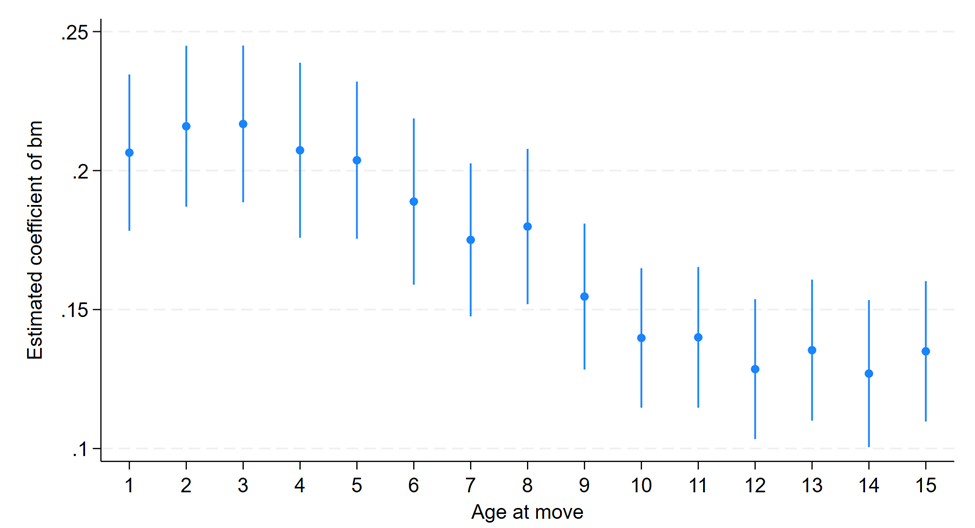
Note: The estimates reflect the effect of moving to a city, instead of the countryside, on primary school completion at the various ages.
Importantly, I find the same effect when comparing siblings within the same household, who were at different ages at the time of the move, and thus spent different parts of childhood in urban and rural areas. As such, the positive effects of spending more of childhood in a city are visible both between and within families. Furthermore, this positive effect is visible among low- and high-income families, boys and girls, and in virtually all African countries.
The evidence that children do better when they grow up in cities is also in line with other contemporary evidence. For instance, Alesina et al. (2021) and Milsom (2023) both study intergenerational mobility in Africa and find that the degree of upward intergenerational mobility in a region is positively correlated with the level of urbanisation. More recently, Chiovelli et al. (2025) study children who were displaced during the Mozambican civil war, and show that children displaced to cities have higher educational levels compared to their siblings who were displaced to the countryside. As such, the evidence suggests more generally that African cities improve the educational outcomes of children compared to those who grow up in the countryside.
Why do children in cities do better? Evidence from Guinea
The next question is why children in cities do better. I find little evidence that the effects are driven by a ‘striking it rich in the city’ type of explanation, since even children in households that end up in relatively poor areas of the city and children in households who live in slum-like conditions show substantial improvements in educational attainment.
Since detailed data at the granular neighbourhood level is lacking in many African contexts, it is difficult to make progress on the potential explanations based on a large sample of countries. Instead, I focus on one context, Guinea, to provide more insights into why children in cities invest more in education and remain in schools for longer. The 2014 Guinean census is unique in the sense that it documents the school attendance of children, and the reason why children dropped out of school, in the case that they no longer attend. While this does not necessarily provide a definitive answer, since multiple constraints may be at play, it does reveal the most important reason perceived by households for why children in rural areas are less likely to continue attending school.
Table 1: School participation and the reasons for not attending school in Guinea
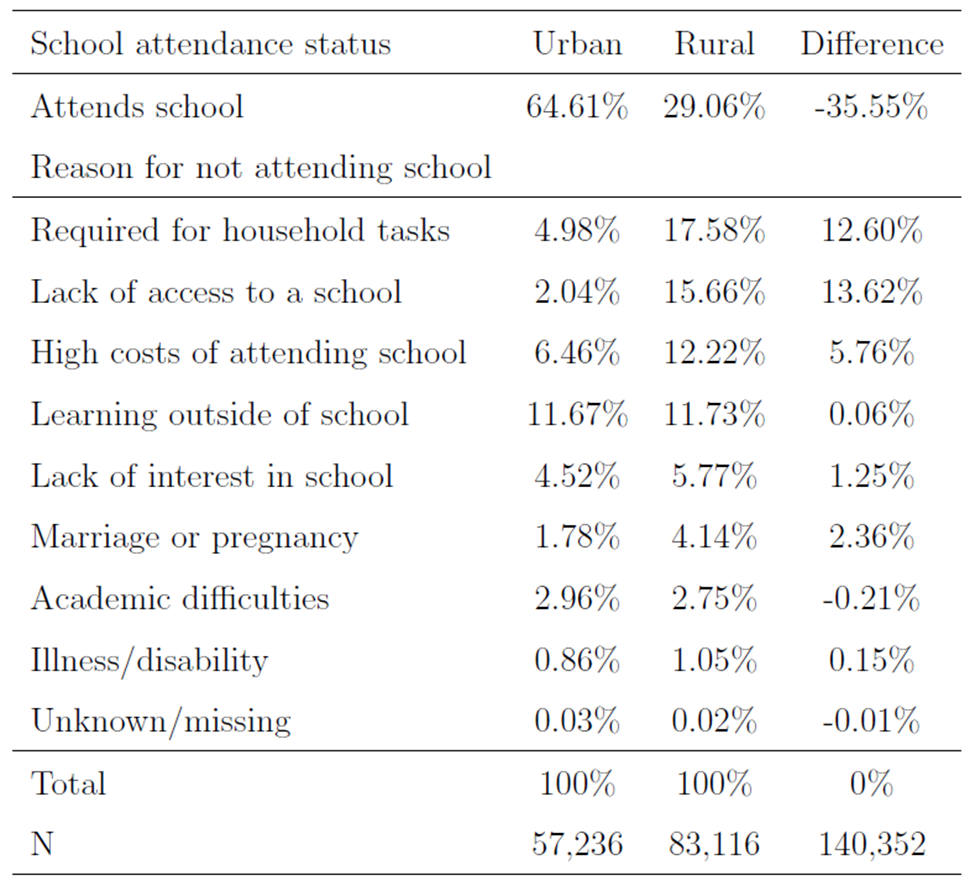
Table 1 shows the school attendance and reasons for dropping out of school for children between the ages of 13–18. In line with the general urban-rural educational differences in Africa documented above, 64% of children in urban areas report attending school between ages 13–18, against just 29% of children in rural areas.
Regarding the reasons why children report dropping out of school, the two most common reasons are (1) the lack of access to schools, and (2) that children in rural households are required to assist with tasks in the household. Interestingly, a similar gap in children who do not attend school is already visible as early as age 6, which highlights that it is a general lack of access to educational opportunities, rather than a lack of access specifically to secondary educational institutions, that causes children to discontinue or never even start their education.
On the other hand, explicit demand factors appear to play a smaller role. The share of children who opt to learn outside of schools, are not interested in learning, or experience academic difficulties, is virtually the same between urban and rural areas. As such, the key drivers appear to be access to schools, as well as the opportunity costs of schooling.
Implications for policy: Urbanisation and education
Taken together, my results have a few key implications. First of all, concerns about cities in Africa acting as poverty traps for children are not supported by the data. Children in urban communities generally have better educational outcomes, and urban migration is associated with an improvement in educational attainment compared to rural alternatives. These are not just driven by signalling, since urban migration and residency also improve basic educational outcomes such as literacy. As such, recent research highlights a key success story about African cities that may have been somewhat overlooked in both the academic and policy debates around urbanisation in Africa.
However, our results also call into question why children in rural communities exhibit far lower rates of educational attainment across Africa, and what can be done to improve educational outcomes in rural settings, given that it’s neither feasible nor desirable to move every child to a city. The evidence in Guinea highlights the lack of access to schools as a key factor, which is also in line with historical evidence from Indonesia, as highlighted by Duflo (2001).
At the same time, school access appears to be only part of the story, as highlighted by the evidence from Guinea. Whether it is the lower (perceived) returns to education, higher opportunity costs of education, or purely household income effects that prevent households from sending children to school in rural settings and instead use them in domestic home production is an important question for future research. This question is particularly pressing in light of the global push towards universal primary school completion, relative to which rural regions in Africa continue to lag far behind.
References
Alesina, A, S Hohmann, S Michalopoulos, and E Papaioannou (2021), “Intergenerational mobility in Africa,” Econometrica, 89: 1–35.
Chiovelli, G, S Michalopoulos, E Papaioannou, and S Sequeira (2025), “Civil war-induced displacement and human capital,” Unpublished manuscript.
Duflo, E (2001), “Schooling and labor market consequences of school construction in Indonesia: Evidence from an unusual policy experiment,” American Economic Review, 91: 795–813.
Marx, B, T Stoker, and T Suri (2013), “The economics of slums in the developing world,” Journal of Economic Perspectives, 27: 187–210.
Milsom, L H (2023), “Spatial inequality of opportunity in West Africa,” Journal of Public Economics, 225: 104944.
van Maarseveen, R (2026), “Urbanization and educational attainment: Evidence from Africa,” Journal of Development Economics, 103654.
United Nations Population Division (2022), "World urbanization prospects: 2018 revision."