

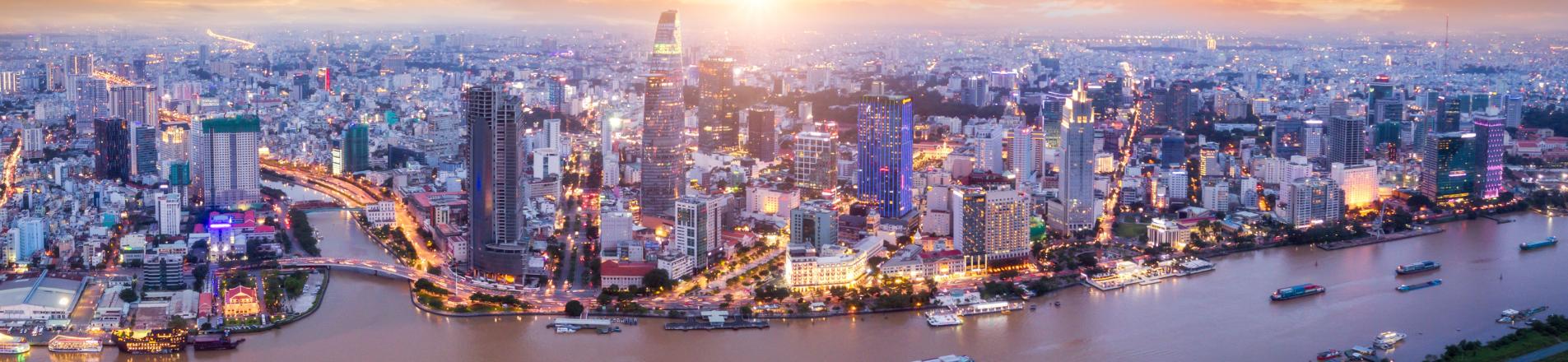



Vietnam’s economic transformation is one of the most dramatic in recent history. Economist and Advisor Pham Chi Lan saw it all and tells us how it happened.
You can listen to this podcast on Spotify, Apple Podcasts, or wherever else you get your podcasts. Or you can watch this conversation on YouTube.
Vietnam’s economic transformation is one of the defining development stories of the last 50 years. A country that endured decades of conflict, severe food shortages, and high levels of absolute poverty is now among the world’s most trade‑open economies, with absolute poverty rates collapsing to near zero.
But these headline numbers hide the hard part: how reforms were actually designed, fought for, and implemented over past decades.
In this episode of Ideas in Development, Kartik Akileswaran (co‑founder of Growth Teams) and Oliver Hanney speak with Madame Pham Chi Lan, former Secretary General of the Vietnam Chamber of Commerce and Industry, and long‑time economic adviser to Vietnam’s leadership during key reform years.
This episode covers how Vietnam built a market economy from scratch. We cover the hardships caused by decades of conflict and isolation, the Doi Moi reforms, and the other key legal and institutional changes that allowed private enterprise to flourish. We conclude by discussing new challenges that Vietnam faces today as it tries to move up global value chains.
Vietnam before Doi Moi: War, isolation, and a failed economic system
Pham Chi Lan’s personal story is intertwined with Vietnam’s economic history. She describes being encouraged to study economics in the early 1960s, when the country was beginning a new five‑year plan and young people were urged to study subjects that could help rebuild a war‑torn country.
After graduating in foreign trade and economics, she joined the Chamber of Commerce and Industry, where she could work on relations with non‑socialist markets, learn English, and deepen her understanding of international trade.
Her account of the pre‑reform economy makes clear why change became unavoidable. The end of the American war in 1975 did not bring uninterrupted peace: Vietnam faced conflict on its borders soon after, while also having to deal with the accumulation of physical and economic devastation from 30 continuous years of war. Meanwhile, the US embargo and regional isolation shut off trade and finance. But, in her telling, the decisive factor pushing Vietnam into crisis was the economic model imposed after reunification, particularly the decision to extend the centrally planned system into the South.
She explains that private business in the South was not recognised as a legitimate engine of growth, and agriculture was forced into collective structures that many farmers resisted. The results were dramatic. Vietnam, which had been able to export rice even under colonial rule, became short of basic food grains and was forced to import large quantities each year.
The Doi Moi Reforms: Markets, sectors, and openness
“1986 was really a year that people like me and those who lived in such years could never forget.”
When Vietnam launched Doi Moi in late 1986, Pham Chi Lan describes three core pillars: moving from central planning towards markets (with state supervision), developing a multi‑sector economy rather than relying on state enterprises and co‑operatives alone, and opening Vietnam to the world.
At every stage of the process, decisions were contested and reform had to be fought for. Many senior leaders had deep faith in socialism as the guarantor of equality, reinforced by long years of revolutionary struggle. Pham Chi Lan describes the discussions and debates between leaders, academics, businesses, and wider society, which focused on whether Vietnam should persist with central planning or embrace a market system,
She also emphasises the role of the “voice of the people in the grassroots”, and the courageous local experimentation by provincial leaders who relaxed controls and gave farmers and small producers more autonomy. This generated visible improvements in output and availability, which helped persuade national leaders that reform could work at scale.
Early wins and the long road to a private sector
Madam Pham Chi Lan points to agriculture as the clearest early example of the reforms successes: once farmers had greater freedom and incentives, output responded quickly.
“In 1988, we could have already the first one million tons of rice surplus for export.”
Yet, Vietnam’s path was uneven. The state moved swiftly to welcome foreign capital, recognising that foreign firms could bring resources, markets, and examples of how to run modern businesses. Vietnam introduced a foreign direct investment law as early as December 1987, and she notes how open it was for its time, allowing 100% foreign ownership in many cases. But domestic private enterprise did not receive a comparable legal foundation for years.
Vietnam found itself in the strange position of encouraging foreign investors before it even had a private sector of its own. Company and enterprise laws in the early 90s meant that private business still required permission and faced significant administrative hurdles. Pham Chi Lan describes a system where small firms needed approvals from many agencies, faced long delays, and were required to meet capital thresholds that made little sense in a country with an underdeveloped banking system.
From her vantage point at the Chamber, where she worked directly with firms, she saw how these barriers stifled growth. The turning point came through sustained evidence‑gathering, critique, and political backing from reform‑minded leaders, particularly Prime Minister Võ Văn Kiệt, who listened directly to business’s frustrations and pushed for a new approach.
That new principle, of free enterprise by default, became the foundation for the 1999 Enterprise Law (implemented from 2000). Madam Pham Chi Lan presents it as a pivotal institutional reform that reshaped the business environment, accelerated private sector formation, and triggered wider legal changes across trade, banking, land, and other critical areas.
Trade integration and building new institutions
Domestic reforms and external integration reinforced each other. Pham Chi Lan links legal change to Vietnam’s ability to engage fully with regional and global partners. She points to Vietnam’s accession to ASEAN, the strengthening of ties with the EU through a framework for economic cooperation, and the normalisation of relations with the United States, which all happened in the 90s. These led to clearer rules for business, investment, and markets, which made deeper integration feasible. And then integration itself increased pressure to keep reforming.
FDI, global value chains, and the risk of getting stuck
Madam Pham Chi Lan is candid about the double-edged nature of FDI. She credits foreign investment with helping Vietnam to grow faster, integrate into global value chains, and learn from global business practices. But she also warns that Vietnam has often captured too little value, especially when foreign firms operate as enclaves with limited technology transfer or local linkages.
Her concern is that Vietnam could remain on “a low rung in global value chains” if it relies too heavily on cheap labour as the main draw and fails to build domestic capability. She highlights the continuing imbalance where a large share of exports comes from foreign manufacturers rather than Vietnamese firms, framing this as both a challenge and a call to action. Vietnam still needs FDI, but it must be more selective, encourage joint ventures and supply-chain development, and upgrade standards, management, and skills so domestic firms can absorb more value.
Domestic champions and the ‘second stage’ of Vietnam’s development
Looking forward, Pham Chi Lan argues Vietnam is entering a new phase beyond just growth. This deeper form of development will be reflected in better institutions, higher productivity, and stronger domestic enterprise. She places human capital at the centre, stressing that Vietnam can no longer depend on low-cost labour but must build a workforce capable of continuous learning and adapting to new technologies.
“human resource development will be the key for our future development.”
A major case study here is VinFast. She describes the story of its founder, Pham Nhat Vuong, who was a returning entrepreneur with ambition to build national industrial capability, first in real estate and later in automobiles and then electric vehicles. She also sketches the government’s enabling role, from land and infrastructure facilitation to a more favourable policy stance.
How change happens
Policy reform in Vietnam was built on grounded evidence, comparison, and honest feedback loops between state and society. Pham Chi Lan describes her advisory role as bridging what businesses experience on the ground with what leaders need to hear.
This period of rapid transformation sheds light both on what is possible, and why it’s so hard. Vietnam’s rise came from bold reform, which was won through political argument, and required continual institutional tinkering. The next chapter will depend on whether it can deepen those reforms, cultivate domestic champions, and convert openness into higher-value, more broadly shared prosperity.