






Investments in early education can generate strong long-run human-capital and demographic gains in middle-income countries. New evidence shows that Argentina’s large-scale expansion of pre-primary education in the 1990s substantially increased completed schooling, reduced fertility, and delivered high economic returns.
Expanding access to pre-primary education is increasingly viewed as a critical investment in children's futures (Bassi et al. forthcoming). Globally, pre-primary enrolment has more than doubled since 1990, rising from 29% to 61% by 2019 (UNESCO 2024). This growth has been especially rapid in developing countries, where governments see early education as a pathway to improved cognitive development, better school outcomes, and ultimately a more productive workforce. Yet an important question remains: do these investments pay off in the long term?
Research on small-scale, intensive programmes in high-income countries – such as Perry Preschool in the US – has documented substantial long-run benefits (Heckman et al. 2013). While evidence on large-scale, universal expansions in middle-income settings has been limited, Argentina's experience in the 1990s provides a rare opportunity to assess whether at-scale pre-primary expansions can generate meaningful improvements in educational attainment and demographic outcomes.
Argentina's classroom construction programme
In 1993, Argentina enacted the Federal Education Law, which made the final year of pre-primary education compulsory and aimed to universalise access to the first two years. To meet the resulting demand, the federal government launched a major infrastructure programme, constructing 3,724 new preschool classrooms between 1993 and 1999. Each classroom accommodated roughly 50 children across two daily shifts, creating approximately 186,000 additional places.
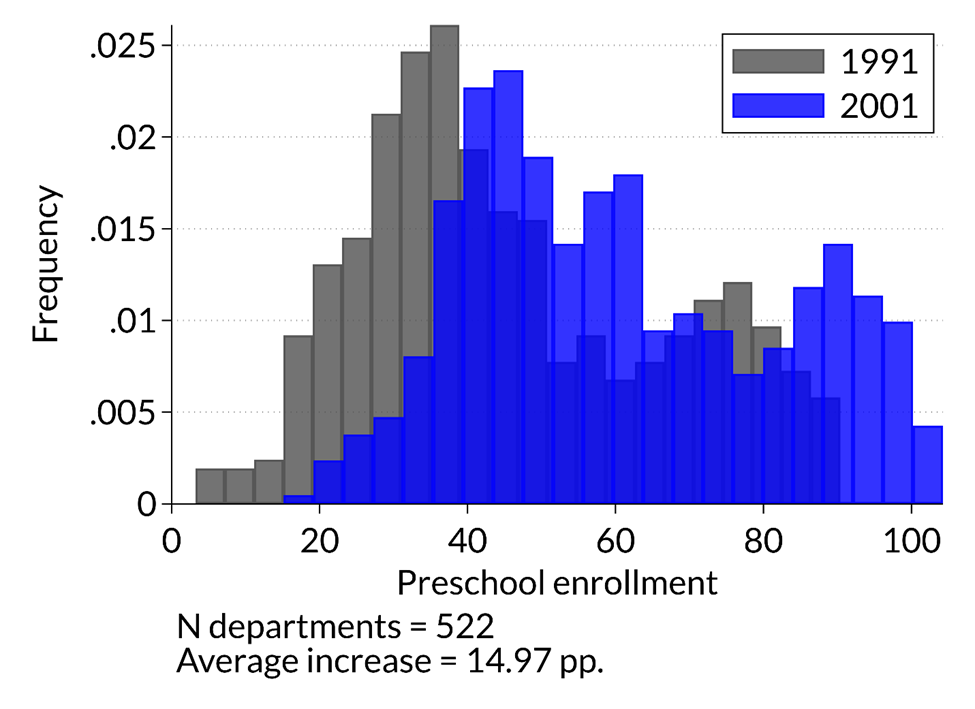
The programme was strategically targeted. Using an Unsatisfied Basic Needs index constructed from the 1991 census, the government directed construction to departments – administrative units roughly equivalent to US counties – with low baseline enrolment and high poverty. Using census data, we plot in Figure 1 the distribution of gross pre-primary enrolment rates at the department level, for the years 1991 (pre-treatment) and 2001 (post-treatment). The distribution shows a substantial shift to the right, indicating an increase in pre-primary enrolment. The average increase in departmental pre-primary enrolment was about 15 percentage points, contributing to a national increase from 49% to 78% over the decade.
Figure 1: Gross pre-primary enrolment by department, 1991-2001
Measuring long-run effects of preschool expansion
We study the long-run effects of this expansion using data from Argentina's 2010 census (Berlinski, Cruces, Galiani, Gertler, and Gonzalez 2025). By 2010, many children who benefited from the programme had reached adulthood, allowing us to observe completed schooling and early fertility decisions. Our analysis links administrative records on where and when classrooms were built to individual outcomes for different birth cohorts across high- and low-construction departments.
Our identification strategy exploits two dimensions of variation. First, the programme rolled out between 1993 and 1999, meaning that children born in 1989 or later could benefit during their preschool years (ages 3–5), whilst older cohorts could not. Second, construction intensity varied sharply across departments based on pre-existing enrolment and poverty levels. We compare outcomes for treated cohorts (born 1989 onwards) in high-construction departments to those in low-construction areas, whilst controlling for province-specific trends and baseline enrolment levels.
This approach – known as difference-in-differences – isolates the causal effect of the expansion by comparing how outcomes changed over time in areas that received many new classrooms versus those that received few. Because the targeting was based on pre-existing need rather than being randomly assigned, we include controls for initial conditions and test extensively for pre-trends. Reassuringly, we find no evidence that outcomes were trending differently across high- and low-construction areas before the programme began.
Preschool expansion led to substantial gains in educational attainment
The results reveal sizeable improvements in schooling. Figure 2 illustrates our findings. It plots the estimates of the intent-to-treat effect for each year of education from 0 to 12, covering the primary and secondary cycles. We find no effect for the first six post-kindergarten years – consistent with historically high primary completion in Argentina – and positive, statistically significant effects from seven years onward, corresponding mainly to secondary schooling.
Figure 2: Difference-in-differences in the cumulative distribution function of post kindergarten years of school
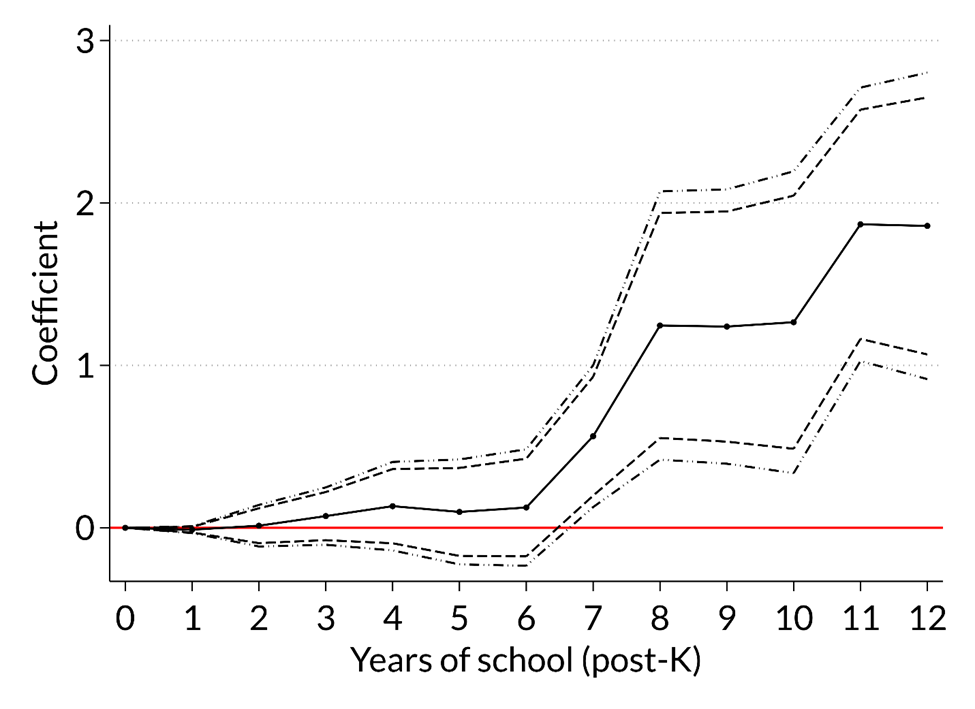
We show that an additional preschool seat per child increased post-kindergarten education by approximately 0.5 years. This translated into an 11.9 percentage point increase in the probability of completing secondary school and a 7.1 percentage point increase in enrolment in post-secondary education. Given that roughly 42% of the baseline cohort completed secondary school in low-construction areas, these effects represent a 28% relative increase.
These findings align with gains documented in other contexts. For instance, Gray-Lobe et al. (2022) study Boston's universal pre-kindergarten lottery and find similarly large effects on high school graduation. By contrast, at-scale expansions in other middle-income countries have shown more modest effects (Behrman et al. 2024).
Preschool expansion led to lower fertility rates
A well-documented link exists between schooling and fertility: more education typically delays childbearing and reduces completed family size (Black et al. 2008). Given the substantial gains in secondary completion, we might expect the preschool expansion to influence fertility decisions as well.
Indeed, we find that an additional preschool seat reduced the number of live births per woman by 0.18 – a 15% decline relative to the baseline average. The probability of becoming a mother fell by 10.6 percentage points. These effects are concentrated among women who were induced to complete secondary school by the programme, consistent with education operating as the key mechanism.
Interestingly, we do not find statistically significant effects on teenage motherhood specifically, suggesting that the fertility reductions occurred across the full childbearing years rather than being concentrated in adolescence. This pattern is consistent with higher educational attainment shifting women's life trajectories more broadly, delaying family formation and reducing total fertility.
No immediate labour market effects – yet
At the time of the 2010 census, we find little evidence of impacts on employment or formal sector participation. This may seem surprising given the schooling gains, but it is consistent with the timing of observation. Many beneficiaries were still in post-secondary education or in the early stages of their careers, having only recently entered the labour market.
Moreover, in a standard labour market model, additional schooling primarily raises productivity and wages rather than employment probabilities per se. If workers with more schooling are close substitutes for those with less, the main adjustment occurs through earnings rather than through the extensive margin of employment. Without detailed wage data, we cannot test this mechanism directly, but our benefit–cost analysis maps the schooling gains into expected earnings premia using standard returns to education.
A cost-effective investment
To assess whether the programme represented a sound public investment, we conducted a benefit–cost analysis. We valued benefits as the present value of lifetime earnings gains resulting from the estimated 0.5 additional years of schooling, applying a standard Mincer return of approximately 9% per year of education. Costs included construction expenses (roughly $15,000 per classroom, annualised over 25 years), recurrent operating costs (teacher salaries and materials), and indirect costs such as forgone youth earnings and additional public spending on later schooling.
The results are striking. The benefit–cost ratio is approximately 11, meaning that every dollar spent on the programme generated roughly $11 in present-value benefits. The internal rate of return stands at 13.4%, well above typical discount rates used in public policy evaluation. These high returns reflect three factors: relatively low per-seat construction costs (about $213 per seat-year), material impacts on completed schooling, and a persistent earnings gradient with education throughout the lifecycle.
These estimates are conservative. We exclude non-pecuniary benefits such as improved health, reduced crime, and enhanced civic participation. We also omit potential intergenerational effects: more educated mothers may invest more in their own children's development. Even without these spillovers, the programme appears highly cost-effective by standard economic criteria.
Policy implications for education
Our findings carry several lessons for policymakers in middle-income countries considering further investments in early childhood education.
- Universal pre-primary expansions can generate sizable long-run gains in human capital. The 0.5-year increase in completed schooling we document is economically meaningful and translates into substantial improvements in secondary completion and post-secondary enrolment. Whilst these effects are somewhat smaller than those found for intensive, targeted programmes in wealthier countries, they are achieved at scale and at relatively low fiscal cost.
- Strategic targeting matters. Argentina directed construction to high-poverty, low-enrolment areas, ensuring that marginal investments reached children most likely to benefit. This approach maximised both equity and efficiency.
- Early education investments can influence demographic outcomes alongside schooling. The fertility reductions we observe suggest that pre-primary programmes may have broader societal effects, reshaping family formation patterns and potentially contributing to the demographic transition. Policymakers seeking to address rapid population growth might consider early education as part of a comprehensive strategy.
- The high benefit–cost ratio we estimate implies that pre-primary expansions can be attractive even from a narrow fiscal perspective. With a 25% income tax rate, the programme generates enough additional tax revenue over beneficiaries' lifetimes to more than offset the initial public expenditure, placing it in the 'win–win' region where both beneficiaries and the government gain.
Argentina's preschool expansion demonstrates that universal at-scale investments in early education can yield substantial long-run returns in middle-income settings. The programme raised educational attainment, reduced fertility, and did so at relatively low fiscal cost. Whilst implementation quality and complementary policies undoubtedly matter, our findings support the case for continued expansion of pre-primary education as a strategic investment in human capital and long-term economic development.
References
Behrman, J R, R Gomez-Carrera, S W Parker, P E Todd, and W Zhang (2024), “Starting strong: Medium- and longer-run benefits of Mexico’s universal preschool mandate,” Unpublished manuscript.
Bassi, M, B Besbas, L I D Diaz, S Ravindran, and A Reynoso (forthcoming), “From access to achievement: The primary school-age impacts of an at-scale preschool construction program in highly deprived communities,” American Economic Journal: Applied Economics.
Berlinski, S, G Cruces, S Galiani, P Gertler, and F E Gonzalez (2025), “Long-run effects of universal pre-primary education expansion: Evidence from Argentina,” Unpublished manuscript.
Black, S E, P J Devereux, and K G Salvanes (2008), “Staying in the classroom and out of the maternity ward? The effect of compulsory schooling laws on teenage births,” Economic Journal, 118(530): 1025–1054.
Gray-Lobe, G, P A Pathak, and C R Walters (2022), “The long-term effects of universal preschool in Boston,” Quarterly Journal of Economics, 138(1): 363–411.
Heckman, J, R Pinto, and P Savelyev (2013), “Understanding the mechanisms through which an influential early childhood program boosted adult outcomes,” American Economic Review, 103(6): 2052–2086.
UNESCO (2024), “UIS.Stat bulk data download service.”