





The leading global early warning system for acute food insecurity systematically underestimates the scale of crisis-level hunger, missing around one in five people affected. As a result, global assessments significantly understate the scope of global humanitarian need, with serious consequences for the timing and adequacy of aid to vulnerable populations.
Clear and trusted estimates of how many people are experiencing acute food insecurity support the global system of humanitarian aid (Balashankar et al. 2023). These estimates help guide how much funding is allocated and identify where it is most needed. Averting and addressing food crises for the world’s poorest reduces the incidence and severity of suffering (Hoddinott et al. 2008, Lowcock 2018, Hsiao et al. 2024, Swinnen and Menon 2025, Bruni and Sterck 2025).
Over the last 20 years, the Integrated Food Security Phase Classification (IPC) System and its many partners have iteratively developed an early warning system for acute food insecurity and potential famine. The IPC currently guides allocation of more than US$6 billion in humanitarian aid annually (2023). Even so, apart from recent coverage related to famine declarations in Gaza and South Sudan, most people have never heard of it.
A consortium of 21 partner organisations, the IPC uses a five-phase scale (from ‘Minimal’, designated as ‘Phase 1’ to ‘Famine’, designated as ‘Phase 5’) to classify the severity of food insecurity at subnational level for more than 30 countries around the world. Some of these countries, like Malawi, face occasional crises that occur in a broader condition of chronic hunger; in others, including Haiti, Yemen, and South Sudan, these crises are prolonged. The IPC conducts food security assessments semi-annually or quarterly, deploying carefully trained country-specific technical working groups with local contextual expertise.
Assessing the accuracy of global food security systems
Our research team has now completed the first assessment of the accuracy of IPC’s global food security estimates. Our work (Lentz, Baylis, Michelson, and Kim 2025) finds that the IPC’s estimates undercount populations experiencing acute food insecurity (Phase 3), or worse, missing approximately one in five. This finding implies that the scope of global food crises is considerably larger than current methodologies suggest.
Our analysis draws on nearly 10,000 subnational Integrated Food Security Phase Classification (IPC) analyses conducted between 2017 and 2023, covering 33 countries and approximately 917 million unique individuals (2.8 billion person-round observations). IPC technical working groups classify populations into five phases of food insecurity. The working groups rely on consensus-based processes for these classifications, drawing on food security indicators from household and individual surveys and other complementary data collected by governments and non-governmental organisations, and following protocols that serve as guidance and guardrails for these assessments. The system is built to function in sometimes fragile and generally under-resourced contexts in which data can be out-of-date, contradictory, or missing.
Evidence of systematic undercounting in IPC classifications
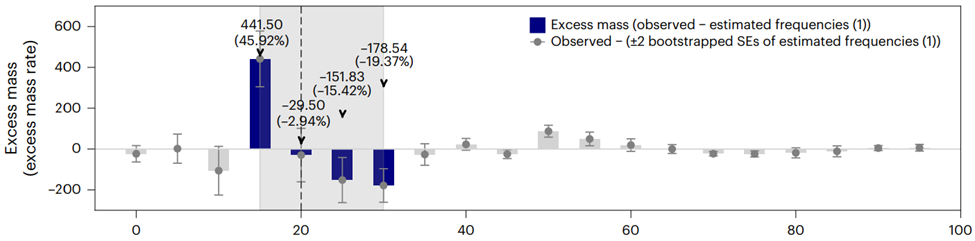
We find that IPC classifications systematically understate acute food insecurity. Examining how population shares are assigned across all phases, we find a discontinuity at the administratively important threshold between Phases 2 and 3 with a steep drop-off in the percent of areas classified in Phase 3 compared to Phase 2 (in technical terms, we test for ‘bunching’ of IPC classifications just below the 20% population threshold separating Phase 2 (‘Stressed’) from Phase 3 (‘Crisis’), which would indicate systematic under-classification). Phase 3 is associated with a need for urgent action while Phase 2 is not. Because the threshold between Phases 2 and 3 is used to trigger humanitarian response, it is a natural place to look for evidence of possible under- or over-counting.
Figure 1 presents one of our three analytical approaches. It shows the difference between the actual IPC outcomes and our estimates of those outcomes based on the underlying data. The x-axis shows the percent of the population in an area experiencing at least Phase 3 levels of food insecurity. For an area to be classified in Phase 3, at least 20% of the population in that area must be in Phase 3. The dashed line at 20% means that a classification of 3 is warranted and indicates an urgent need for assistance for that area. What we see is that there are many more IPC classifications to the left of the 20% cut-off and many fewer IPC classifications to the right of the cut-off compared to our counterfactual estimates. In fact, we find 46% more subnational IPC analyses just under the cut-off than the counterfactual, indicating undercounting of those in need.
Figure 1: Excess mass
We use two other complementary approaches to further assess potential bias in IPC analyses. For a large subset of IPC analyses where underlying household survey data are available, we construct counterfactual estimates of acute hunger using the same food security indicators that inform IPC deliberations, comparing IPC consensus outcomes to two different estimates, one based on the average of these indicators and one using the most severe indicator respectively. These counterfactuals allow us to assess how IPC classifications differ from what the underlying data alone would suggest.
Across all three methods, we consistently find that IPC analyses assign fewer people to crisis-level food insecurity than are implied by the data, indicating substantial underestimation of acute hunger. In the data we analysed, IPC classified 226.9 million people in Phase 3 (crisis level) or above. Our analysis suggests that the estimated population in crisis should be closer to 293 million. Around 66 million people are missing from the crisis classifications, about 20% of people who, based on our estimates, are experiencing food insecurity at crisis levels or worse.
Challenging perceptions of overestimation
Our results come as a surprise, given that a common perception among humanitarian agencies is that IPC tends to overstate, rather than understate, this level of need. Before beginning the empirical analyses, we conducted qualitative interviews with a range of humanitarian practitioners – people whose organisations use IPC classifications to make decisions about where and when to send assistance. We learned from those interviews that actors in the humanitarian space tend to think the opposite about the IPC – that it overestimates the magnitude and severity of need, especially for Phases 3 and 4, classifications which may crowd in funding (Maxwell and Hailey 2021). Because governments and agencies that receive and distribute humanitarian assistance are often a part of technical working groups, interviewees expressed concern that these groups have a vested interest in inflating the population numbers, and consequently the classification levels. Our analysis, however, does not support this concern. Rather than finding that IPC estimates are inflated, we find that a pattern of conservative assessments frequently understates the number of people facing crisis-level food insecurity.
Why do we think this is happening? Our analysis suggests that IPC technical working groups are more conservative in their assessments when underlying indicators are inconsistent. Measures of food security status available for an assessment can point to very different severity levels. These inconsistencies can relate to measurement error but also to the multidimensional and contextual nature of food insecurity. When indicators conflict, IPC technical working groups tend to assign lower phase designations, implicitly treating discordant evidence as uncertain. This tendency will systematically bias assessments downward in settings where data is noisy or imperfect. However, other factors may also be at play, including that working group members may overcorrect in response to beliefs that IPC overstates food insecurity, or that contextual factors unobservable to us but observable to the working group (e.g. seasonality, direction of price changes, or other contributing factors) lead to downward bias in estimates. Future research would help disentangle this further.
Implications for humanitarian policy and practice
Our results have two important implications for policy. First, the scope of global humanitarian need is larger than current estimates suggest. Second, the challenges of food insecurity measurement contribute to the systematic under-estimation of food insecurity. In a worrying global international context characterised by increased scarcity and reduced commitment to helping the world’s poorest, our findings are all the more important. We now have a better understanding of the magnitude of the problem of acute food insecurity – and it is worse than we thought.
Food insecure households are falling through the cracks in the humanitarian system, and rather than look away, we urge the global community to commit to a world without hunger. These households need more resources, and humanitarian agencies need more and better data to support them. Improving food crisis assessment is not merely a technical exercise, but necessary for timely and targeted humanitarian response.
References
Balashankar, A, L Subramanian, and S P Fraiberger (2023), “Predicting food crises using news streams,” Science Advances, 9(9): eabm3449.
Bruni, V, and O Sterck (2025), “What happens when humanitarian aid is cut or delayed?” VoxDev.
Hoddinott, J, J A Maluccio, J R Behrman, R Flores, and R Martorell (2008), “Effect of a nutrition intervention during early childhood on economic productivity in Guatemalan adults,” Lancet, 371: 411–416.
Hsiao, A, J Moscona, and K Sastry (2024), “Food policy in a warming world,” Unpublished manuscript.
Lentz, E, K Baylis, H Michelson, and C Kim (2025), “Official estimates of global food insecurity undercount acute hunger,” Nature Food, 6: 1196–1208.
Lowcock, M (2018), “Toward a better system for humanitarian financing,” Unpublished manuscript.
Swinnen, J, and P Menon (2025), “Food policy: Lessons and priorities for a changing world,” VoxDev.