



Eradicating malaria could deliver much larger economic gains in sub-Saharan Africa than previously believed. The new generation of malaria vaccines provides a highly cost-effective way to realise these benefits.
Malaria kills more than 600,000 people each year, disproportionately children under five in sub-Saharan Africa (World Health Organization 2021). But the toll extends beyond mortality. Children who survive malaria infections suffer lasting cognitive impairments, reduced classroom attention, and higher school absenteeism (Fernando et al. 2010, Chen et al. 2016). These effects weaken educational outcomes and ultimately lower labour productivity in adulthood. Policymakers must ask: how much richer would malaria-endemic countries be if the disease were eliminated? Macroeconomic research suggests the answer is ‘not much’.
For instance, Ashraf et al. (2008) estimate that eradicating malaria in Zambia would raise GDP per capita by only about 2%. These estimates, however, rely on accounting frameworks that ignore an important household behavioural response: when disease risk falls, parents change their preferences for how many children they will have and how much they will invest in each child's education.
Accounting for behavioural responses
In new research (Kim 2026), I build a general equilibrium model calibrated to Tanzania that accounts for these behavioural responses. The model captures two distinct channels through which malaria affects development:
- Child mortality: malaria is the biggest killer of children under age five.
- Morbidity: the cognitive damage that malaria inflicts on surviving children, reducing how much they learn from schooling.
Epidemiological research has documented that malaria reduces learning capacity for affected children (Fernando et al. 2003), and the model incorporates this quality dimension directly. Recent research in macro-development has emphasised that the quality of human capital acquired per year of schooling matters more for economic outcomes than years of schooling alone (Lagakos and Schoellman 2026).
These two channels, mortality and morbidity, push parents in opposite directions. When fewer children die from malaria, parents have fewer children, but each child they do have is now more likely to survive and need support. At the same time, when cognitive damage from malaria decreases, children get more out of every year in the classroom. Schooling becomes a better investment, and parents have a stronger reason to concentrate resources on fewer children and keep each one in school longer. The interaction between these two channels is the core feature of the quantity-quality trade-off (Barro and Becker 1989), which is incorporated in the model.
Which of these forces dominates? I test the model against evidence from the Roll Back Malaria (RBM) campaign, a large-scale bed net distribution programme launched across sub-Saharan Africa in the early 2000s (Kuecken et al. 2021). The model closely reproduces the patterns observed during RBM: women had fewer children, and those children stayed in school longer. This provides confidence that the model captures how families would actually respond to a less malarious environment. But a single campaign cannot tell us what nationwide vaccination would do to aggregate income. For that, we need a model that can add up these household-level responses into macroeconomic outcomes.
Economic gains are five times larger than prior estimates
Using the calibrated model, I simulate the impact of a nationwide malaria vaccination programme with 75% efficacy, the level demonstrated by the recently developed R21/Matrix-M vaccine.
The model predicts that in the short run, within a single generation, per-capita income would rise by 5.2%. The long-run impact is larger still. Healthier children grow up to become parents who further reduce fertility and increase educational investment in their own children. Once these intergenerational dynamics play out, per-capita income rises by 6.7% with the 75% effective vaccine, and by 9.5% under complete eradication (equivalent to assuming 100% vaccine efficacy). These figures are roughly five times larger than previous estimates.
The key driver is improved learning in school. Improved learning capacity and the resulting increase in human capital account for 70% of the total income gain. When the model shuts down the learning-quality channel and allows only schooling years to increase, the income gain drops to just 2.1%, close to what earlier accounting exercises predict. The fertility channel reinforces these gains: when fertility is held fixed and only education adjusts, the income gain is cut in half, to 3.1%. Parents' decision to have fewer children and concentrate resources on each child is central to the overall effect.
Malaria vaccines are cost-effective
Figure 1: Vaccine efficacy and the cost of vaccination
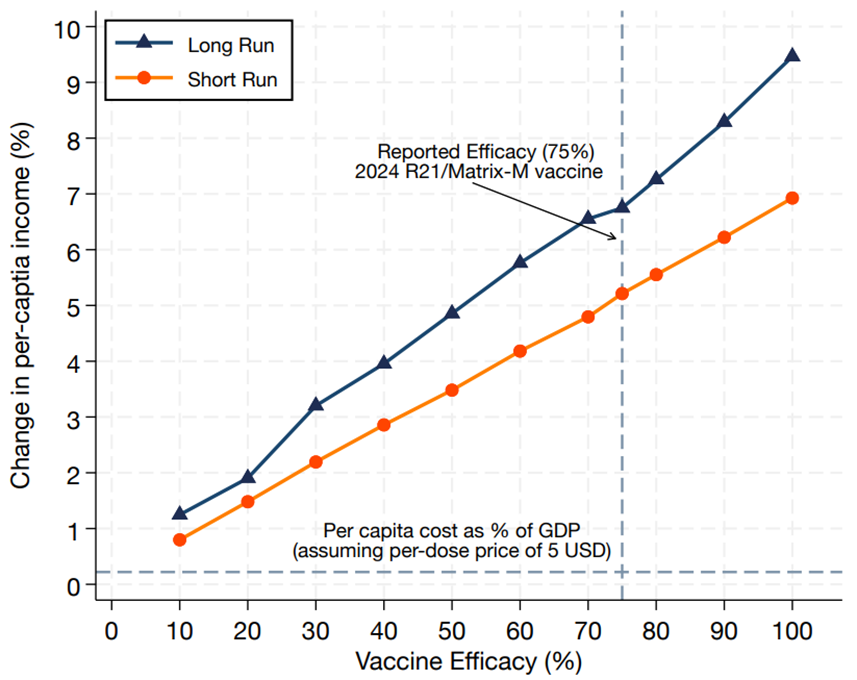
Notes: This figure compares the per-capita income gains from malaria vaccination (vertical axis) against the cost of a nationwide vaccination programme (dashed horizontal line, approximately 0.18% of GDP per year). At the R21/Matrix-M vaccine's reported 75% efficacy, both short- and long-run income gains vastly exceed annual costs.
At a per-dose cost of US$5 and total vaccination cost of approximately US$25 per child (Sicuri et al. 2019), a nationwide programme would cost roughly 0.18% of GDP annually. The model predicts short-run income gains more than 5% and long-run gains approaching 7% with the current vaccine, more than 35 times the annual cost. Even at substantially lower efficacy levels, vaccination remains cost-effective.
Yet vaccine rollout continues to face delays. At the current funding pace, universal coverage for children under three will not be achieved until around 2035, resulting in approximately 2.5 million preventable child deaths in the interim (Duncombe et al. 2024). These findings suggest that delayed rollout forgoes not only lives saved but also substantial macroeconomic gains.
Figure 2: Post-vaccine changes in per capita income across locations
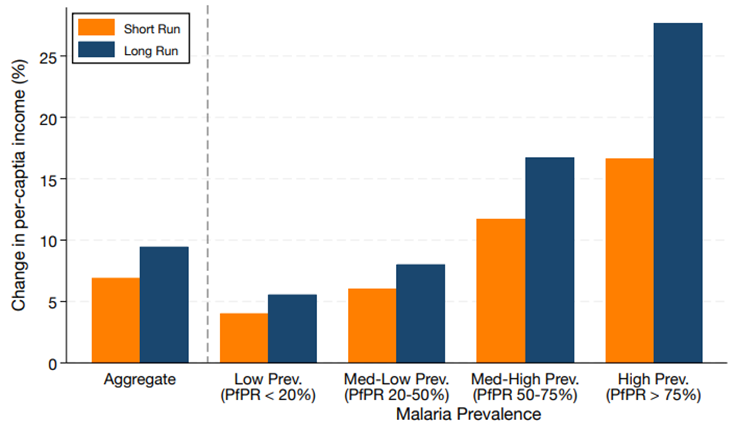
Notes: Income gains from vaccination are largest in high-prevalence regions, where long-run per-capita income rises by up to 28%. Vaccination is cost-effective in all regions, but geographically targeted deployment in moderate-to-high prevalence areas yields the greatest returns.
Implications for vaccine policy
What do these results mean for policy? The economic case for malaria vaccination is substantially stronger than previously recognised. Accounting for how families adjust fertility and education in response to reduced disease risk reveals income gains that are five times larger than standard estimates. Health interventions that reduce child morbidity, not just mortality, generate large economic returns.
Accelerating the rollout of malaria vaccines is not just a matter of saving children's lives. It is an investment in the human capital and economic future of sub-Saharan Africa.
References
Ashraf, Q H, A Lester, and D N Weil (2008), “When does improving health raise GDP?,” NBER Macroeconomics Annual, 23: 157–204.
Barro, R J, and G S Becker (1989), “Fertility choice in a model of economic growth,” Econometrica, 57(2): 481–501.
Chen, I, S E Clarke, R Gosling, B Hamainza, G Killeen, A Magill, W O’Meara, R N Price, and E M Riley (2016), “‘Asymptomatic’ malaria: A chronic and debilitating infection that should be treated,” PLoS Medicine, 13: e1001942.
Duncombe, R, K Elabd, and J Sandefur (2024), “Avoiding another lost decade on malaria vaccines,” Center for Global Development.
Fernando, S D, C Rodrigo, and S Rajapakse (2010), “The ‘hidden’ burden of malaria: Cognitive impairment following infection,” Malaria Journal, 9(366).
Fernando, S, D Gunawardene, M Bandara, D De Silva, R Carter, K Mendis, and A Wickremasinghe (2003), “The impact of repeated malaria attacks on the school performance of children,” American Journal of Tropical Medicine and Hygiene, 69(6): 582–588.
Kim, M (2026), “The macroeconomic consequences of malaria eradication in Sub-Saharan Africa,” Unpublished manuscript.
Kuecken, M, J Thuilliez, and M-A Valfort et al. (2021), “Rollback malaria? The effect of anti-malaria campaigns in Sub-Saharan Africa,” Unpublished manuscript.
Lagakos, D, and T Schoellman (2026), “Accounting for cross-country income differences revisited,” Unpublished manuscript.
Sicuri, E, A Y Bocoum, F Nonvignon, J Alonso, S Fakih, K Bonsu, S Kariuki, F Leeuwenkamp, E Munguambe, B Mrisho et al. (2019), “The costs of implementing vaccination with the RTS,S malaria vaccine in Sub-Saharan African countries,” MDM Policy & Practice, 4(2).
World Health Organization (2021), "World malaria report 2021."