





In Lesotho, children who start school at older ages attain higher levels of education. In adulthood, they are more likely to have professional occupations and less likely to start families early, contract HIV, or experience child mortality.
Editor's note: The authors have made slides available here.
In high-income countries, evidence suggests that starting school older may have little long-run impact on, for example, educational attainment or earnings (Black et al. 2011, Oosterbeek et al. 2021). As a result, school-entry age is sometimes treated as an administrative detail rather than a central policy lever. But what if the consequences are much larger in lower-income countries? In many lower-income settings, classrooms are overcrowded, teaching resources are limited, and children face strong pressure to work at home or on farms. In these environments, being slightly more ‘mature’ at school entry may have far-reaching consequences. In new research on Lesotho (De Neve, Moshoeshoe, and Bor forthcoming), we show that starting primary school at older ages has large and lasting effects – not only on education, but on occupation, family formation, HIV infection among men, and the survival of the next generation.
A natural experiment in Lesotho
Lesotho’s school year begins in January. Children who turn six by the end of June must enrol that year. Children born just after the cut-off (in July) may delay entry by an additional year. This natural experiment allows for a comparison between children born in June and those born in July. On average, July-born children start school about half a year older than June-born children (Figure 1). Importantly, children born just before and just after the cut-off look similar in observable ways before school begins. They have similar parents, early childhood health, and household characteristics. The only systematic difference is the age at which they start school. This allows us to estimate the causal impact of school-entry age on a wide range of short- and long-term outcomes using multiple nationally representative datasets, including detailed data on education, labour market outcomes, fertility, and HIV biomarkers.
Figure 1: Total years of schooling by month of birth in Lesotho
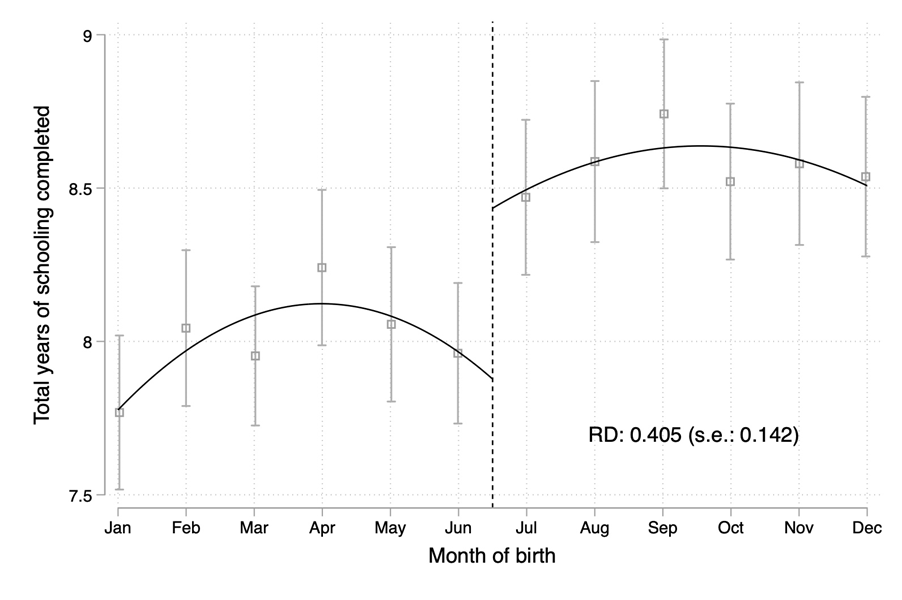
Notes: The figure shows total years of schooling completed by month of birth. We show means and confidence intervals for each month of birth, superimposed with quadratic regression discontinuity (RD) estimation. We also show regression point estimates and standard errors (s.e.) from linear RD models. The sample includes all ages 18–35 years. Source: Lesotho MICS 2018.
An early disadvantage, then a reversal
Children who start school older initially appear to fall behind. At ages 6–10, they have fewer total years of schooling because they entered school later. But this disadvantage does not last. As children move through primary and secondary school, those who started older are less likely to repeat grades and less likely to drop out. By adolescence, the pattern reverses (Figure 2). By adulthood, children who started school older complete 0.4 additional years of schooling – roughly a 5% increase over the national average. They are also more likely to be literate and to use computers. In Lesotho, the ‘quality effect’ of starting school older – greater maturity and faster skill development – outweighs the ‘quantity effect’ of entering school later.
Figure 2: Reversal of early disadvantage for cohorts born July–December
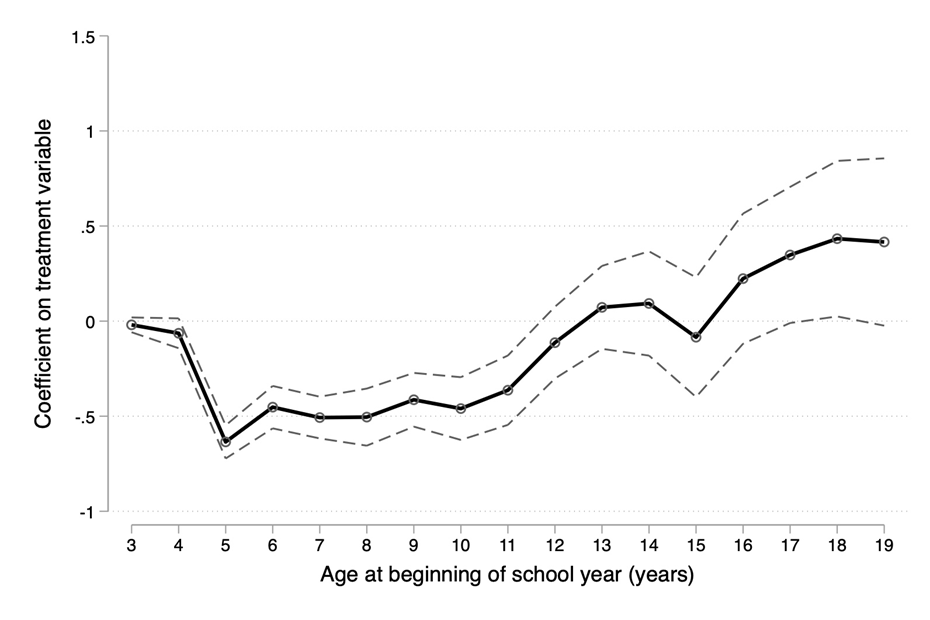
Notes: Each point in the figure shows the average difference in the highest year of school attended between children born July–December (who start school at older ages) and those born January–June (who start school at younger ages), estimated separately at each age. Children who start school at older ages initially have fewer years of schooling but catch up and surpass their peers by ages 12–15. By late adolescence, children who start school at older ages have accumulated more total schooling. The sample includes children regardless of whether they are in school or not at the time of the survey. Source: Lesotho MICS 2018.
Better jobs and higher wealth
Education also translates into economic opportunity. Adults who started school older are on average more likely to work in professional or managerial occupations and are wealthier, as measured by household asset indices. While overall employment rates appear similar, occupational quality differs. The probability of being in a higher-skilled occupation increases by around 14% relative to the baseline. These professional and managerial occupations attract higher earnings, which enable those born after the cut-off point to accumulate more wealth. In contrast to much of the evidence from high-income countries, school-entry age in this lower-income setting meaningfully shifts long-term economic trajectories.
Delayed marriage and fewer teenage births
School-entry age also shapes family formation. Individuals who started school older are less likely to marry early, less likely to have children as teenagers, and have fewer children overall (Figure 3). Teenage childbearing falls by about 11% relative to the baseline. Early marriage declines substantially, particularly among young women. These patterns are consistent with evidence that education delays marriage and fertility (Keats 2018, Chen and Guo 2022).
Figure 3: Fertility, marriage, and spousal education by month of birth
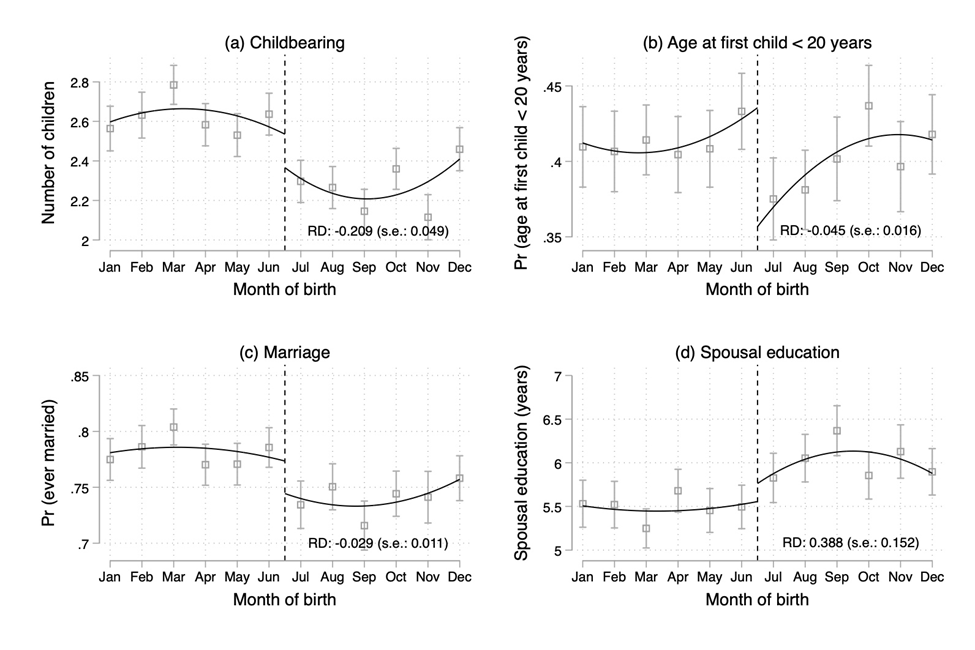
Notes: The figure shows childbearing, marriage, and spousal educational attainment by month of birth. Children born after the 30 June cut-off (July onwards) start school at an older age. We show means and confidence intervals for each month of birth, superimposed with quadratic regression discontinuity (RD) estimation. We also show point regression estimates and standard errors (s.e.) from linear RD models. Source: Lesotho DHS 2004–05, 2009–10, and 2014.
A striking result: Lower HIV risk for men
Lesotho has one of the highest HIV prevalence rates in the world. We find that men who started school at an older age are about 17% less likely to be HIV-positive in adulthood. This aligns with prior evidence showing that additional schooling reduces HIV risk (De Neve et al. 2015). For women, we do not find a statistically significant effect on HIV infection, although education still affects fertility and marriage patterns. These findings suggest that early educational trajectories can influence long-run health risks, even for health conditions decades later.
Effects that span generations
Another striking finding is intergenerational. Children born to mothers who started school at older ages are more likely to survive. Mothers born after the school-entry cut-off are significantly less likely to experience the death of a child – a reduction of roughly 20% relative to the baseline risk (Figure 4). This finding may reflect several potential mechanisms: delayed teenage motherhood, fewer births, higher maternal education, and greater household wealth. School-entry policy does not just shape one life but also influences the next generation’s survival in Lesotho.
Figure 4: Intergenerational effects on child survival by maternal month of birth
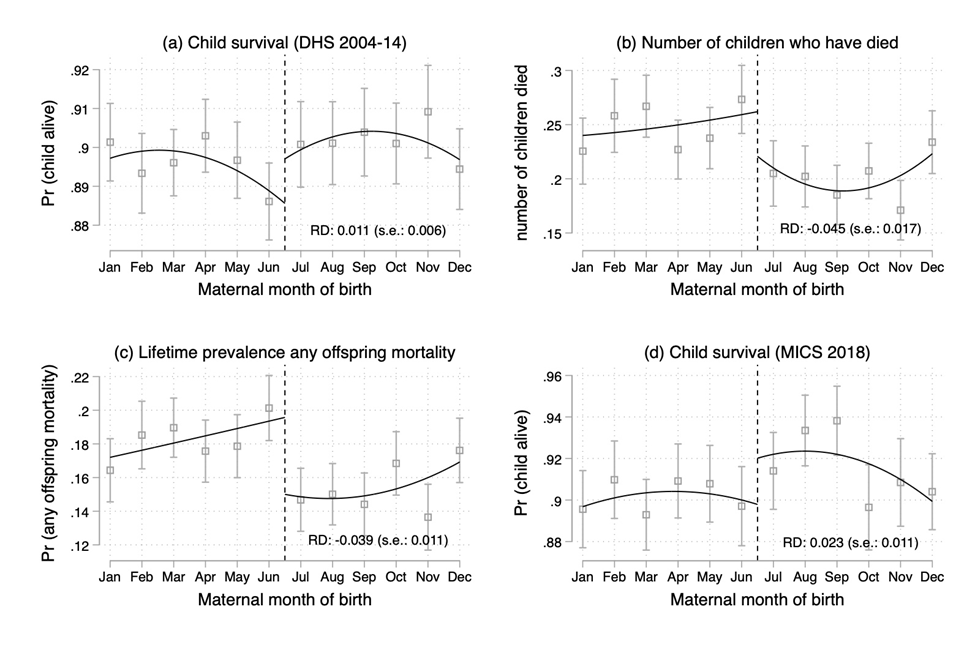
Notes: The figure shows child survival, number of children who have died, and maternal lifetime prevalence of any offspring mortality by maternal month of birth. Mothers born after the 30 June cut-off (July onwards) start school at an older age. We show means and confidence intervals for each maternal month of birth, superimposed with quadratic regression discontinuity (RD) estimation. We also show point regression estimates and standard errors (s.e.) from linear RD models. Source: Lesotho DHS 2004–05, 2009–10, 2014, and MICS 2018 data.
Why are school-entry age effects so large in Lesotho?
Why do we find such strong long-term impacts in the context of Lesotho when many high-income studies find small or zero effects? We suggest three potential mechanisms:
- More time in preschool: Children who start primary school later spend more time in preschool. This additional preparation may enhance early literacy and socio-emotional skills.
- Faster skill growth: Older entrants develop reading skills more rapidly during primary school. By early adolescence, they outperform their younger peers in foundational reading.
- Higher opportunity costs and dropout: In rural Lesotho, boys often herd livestock. We find that boys who start school at older ages are less likely to drop out and spend time herding animals. Older entrants and their communities appear to perceive higher returns to staying in school and act on them. In lower-income contexts where opportunity costs are high and educational bottlenecks are severe, small differences in maturity at entry can snowball into large differences in human capital.
Policy implications: School-entry age may matter more than we think
What does this mean for policymakers? In higher-income settings with relatively strong institutions and fewer opportunity costs among children, starting school older may matter relatively less in the long run. But in lower-income contexts, class sizes are large, skill gaps widen quickly, dropout risks are high, and opportunity costs rise quickly in adolescence. In such environments, enrolling children before they are ready may carry lasting penalties. Policymakers often focus on expanding access to schooling. Our findings suggest that the timing of school entry may be an important factor as well. This does not imply that all children should start later. Rather, it underscores the importance of school readiness, preschool access, and flexibility in enrolment policies. A seemingly small administrative rule (whether a child is born in June or July) can alter educational, economic, health, and intergenerational outcomes. In lower-income countries, school-entry age is a powerful determinant of human capital development.
References
Black, S E, P J Devereux, and K G Salvanes (2011), “Too young to leave the nest? The effects of school starting age,” Review of Economics and Statistics, 93(2): 455–467.
Chen, J, and J Guo (2022), “The effect of female education on fertility: Evidence from China’s compulsory schooling reform,” Economics of Education Review, 88: 102257.
De Neve, J-W, R Moshoeshoe, and J Bor (forthcoming), “Age at school entry and human capital development: Evidence from Lesotho,” American Economic Journal: Applied Economics.
De Neve, J-W, G Fink, S V Subramanian, S Moyo, and J Bor (2015), “Length of secondary schooling and risk of HIV infection in Botswana: Evidence from a natural experiment,” Lancet Global Health, 3(8): e470–e477.
Keats, A (2018), “Women’s schooling, fertility, and child health outcomes: Evidence from Uganda’s free primary education program,” Journal of Development Economics, 135: 142–159.
Oosterbeek, H, S ter Meulen, and B van der Klaauw (2021), “Long-term effects of school-starting-age rules,” Economics of Education Review, 84: 102144.