




Colonial railways reshaped local economies in Bosnia, but lasting gains depended on human capital, state capacity, and external competition.
Editor’s note: For a broader synthesis of themes covered in this article, check out our VoxDevLit on Land Transport Infrastructure.
Transport infrastructure is at the centre of development policy. Governments and international institutions are investing heavily in railways, ports, and roads across developing economies. Better transport links reduce trade costs, integrate markets, and stimulate growth (Redding and Turner 2015). At the same time, infrastructure projects can deepen regional inequalities by concentrating economic activity in already competitive regions (Faber 2014).
What lessons can economic history offer for development policy today? Our recent research (Neubert and Nikolić 2026) examines this question through the experience of Bosnia-Herzegovina under Habsburg colonial rule between 1878 and 1910. The Bosnian case highlights that infrastructure alone does not guarantee sustained growth. Whether railways stimulate development depends critically on local human capital, state capacity, and exposure to external competition.
A colonial economy connected by railways
When Austria-Hungary occupied Bosnia-Herzegovina in 1878, the province was poor, predominantly agrarian, and lacked a railway network. Most manufacturing took place in small workshops producing handicrafts and consumer goods. The Habsburg administration viewed railways primarily as instruments of imperial integration and resource extraction. The colonial government constructed more than 1,500 kilometres of new railways within three decades.
But not all railways served the same purpose. One part of the network directly connected Bosnia to the wider Habsburg imperial railway system. These normal-gauge railways allowed goods to move seamlessly between Bosnia and industrial centres elsewhere in the Empire. Another part of the network consisted of narrow-gauge railways that mainly connected regions within Bosnia itself. Because goods transported on narrow-gauge tracks had to be unloaded and reloaded at the provincial border, these lines offered weaker integration into Habsburg markets. This distinction turns out to be crucial for understanding the economic effects of railway access.
Figure 1: Railways and economic development in Bosnia-Herzegovina
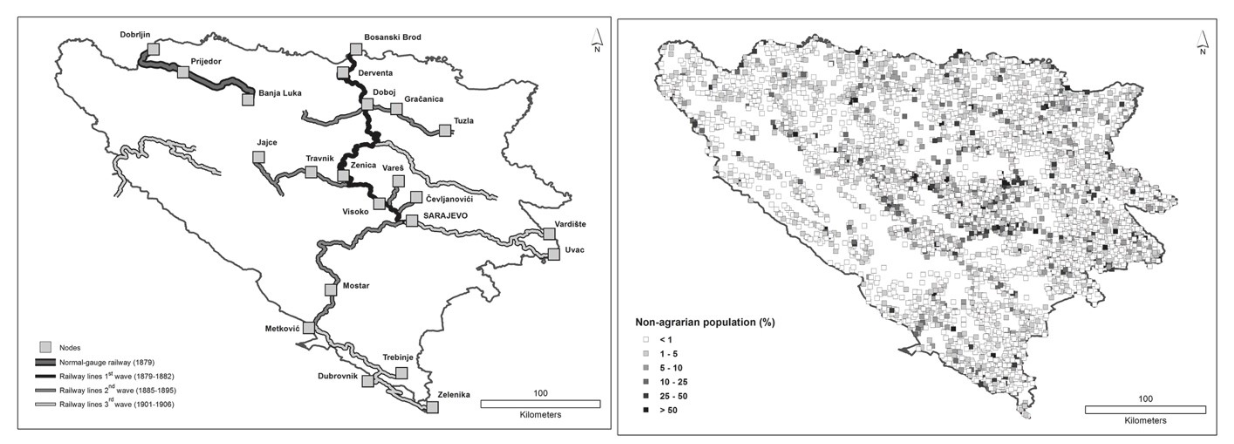
Notes: Left image maps the expansion of the railway network in Bosnia–Herzegovina, 1878–1910. Right image illustrates the share of non-agricultural population in Bosnia–Herzegovina, 1910. Source: Neubert and Nikolić (2026).
How we study the effects of railways
We assembled a new dataset covering more than 4,500 Bosnian settlements between 1885 and 1910, tracking changes in occupational structure and population and incorporating information on education, policing, and industrial activity. To identify the effects of railway access, we compare settlements that gained railway connections with otherwise similar settlements that did not. We also exploit variation in the timing of railway construction and distinguish between different parts of the railway network. To address concerns that railways were deliberately routed through more promising locations, we focus on settlements that were quasi-randomly located along least-cost railway routes connecting major nodes. This allows us to isolate the impact of railway access on local economic development.
When market integration hurts local manufacturing
Interestingly, we find that settlements directly connected to the imperial railway network experienced a decline in non-agricultural employment. Normal-gauge railway access reduced the non-agricultural population share by 2.9 percentage points between 1885 and 1895, followed by limited subsequent change. Why? Lower transport costs exposed local craftsmen to competition from more productive manufacturers elsewhere in the Habsburg Empire. Small-scale Bosnian producers often lacked the capital, skills, and scale needed to compete with industrial firms in Vienna, Budapest, or Prague. As imported manufactured goods became cheaper and more widely available, many craftsmen abandoned their trades and returned to agriculture. In other words, railway integration generated displacement alongside market access. This mechanism resembles contemporary concerns about how trade liberalisation and infrastructure integration affect less developed regions. Better connectivity can improve aggregate efficiency while simultaneously concentrating production in already industrialised locations.
Railways also created new opportunities
The story, however, is not one of uniform decline. Narrow-gauge railways had a different effect. These lines mainly integrated the domestic Bosnian market without fully exposing local producers to external industrial competition. Settlements connected by narrow-gauge railways experienced temporary increases in non-agricultural employment. Those connected between 1885 and 1895 saw non-agricultural employment rise by 2.5 percentage points during that period, with no subsequent gains. Settlements connected between 1895 and 1910 experienced an increase of 4.9 percentage points during the same period.
Much of this increase was driven by the arrival of foreign workers and factories. Building and operating railways required engineers, administrators, mechanics, and skilled labourers. Bosnia’s educational system had been neglected under Ottoman rule and could not initially supply enough trained workers. The Habsburg administration therefore imported labour and expertise from elsewhere in the Empire. Moreover, factories disproportionately clustered near railway lines built to access timber and raw materials. But these gains were temporary. In many settlements, non-agricultural employment increased during railway construction and early operation, only to stagnate later. Infrastructure alone did not generate self-sustaining industrialisation.
Why schools and state capacity mattered
A crucial lesson from the Bosnian experience concerns the conditions under which infrastructure generated lasting effects. Settlements located near schools experienced more sustained increases in non-agricultural employment after receiving railway access. The non-agricultural population share increased by about 1.7 percentage points per year between 1885 and 1895, and by 0.9 percentage points per year between 1895 and 1910. These settlements were also more likely to attract factories and capital-intensive industry.
Education mattered because local workers needed basic skills to operate machinery, maintain industrial equipment, or participate in factory production. Human capital reduced dependence on imported labour and made these locations more attractive to investment.
State capacity mattered too. Railways had more lasting effects in settlements located close to armed forces and law enforcement. The non-agricultural population share increased by 1 percentage point per year between 1895 and 1910. These areas were more likely to attract industrial activity and sustain occupational change over time. Greater security reduced the risks associated with fixed investment, trade, and factory production. By contrast, remote areas with weak state presence remained vulnerable to banditry and political unrest. In these places, railway access alone was insufficient to generate sustained development.
The broader point echoes Albert Hirschman’s (1958) classic idea of ‘absorptive capacity’: infrastructure investments have more lasting effects when local economies possess the capabilities needed to respond to new opportunities.
Lessons for development policy today
The Bosnian case cautions against viewing transport infrastructure as a silver bullet for development. Infrastructure projects can generate very different outcomes depending on local conditions and the nature of market integration. In some settings, better connectivity may stimulate industrialisation and growth. In others, it may expose less competitive producers to external competition before local firms have the capabilities needed to adapt.
This lesson remains highly relevant today. Large infrastructure initiatives – from cross-border railways in Africa to transport corridors under China’s Belt and Road Initiative – are often justified as engines of development. Yet the Bosnian experience suggests that infrastructure investments are most likely to generate durable gains when accompanied by investments in education and state capacity.
References
Faber, B (2014), "Trade integration, market size, and industrialization: Evidence from China's National Trunk Highway System", Review of Economic Studies, 81(3): 1046–1070.
Hirschman, A O (1958), The Strategy of Economic Development, Yale University Press, New Haven.
Neubert, M, and S Nikolić (2026), "Why railways fail: Colonial railways and economic development in Habsburg Bosnia-Herzegovina," Journal of Development Economics: 103747.
Redding, S J, and M A Turner (2015), "Transportation costs and the spatial organization of economic activity," in G Duranton, V Henderson, and W Strange (eds), Handbook of Regional and Urban Economics, 5: 1339–1398.