

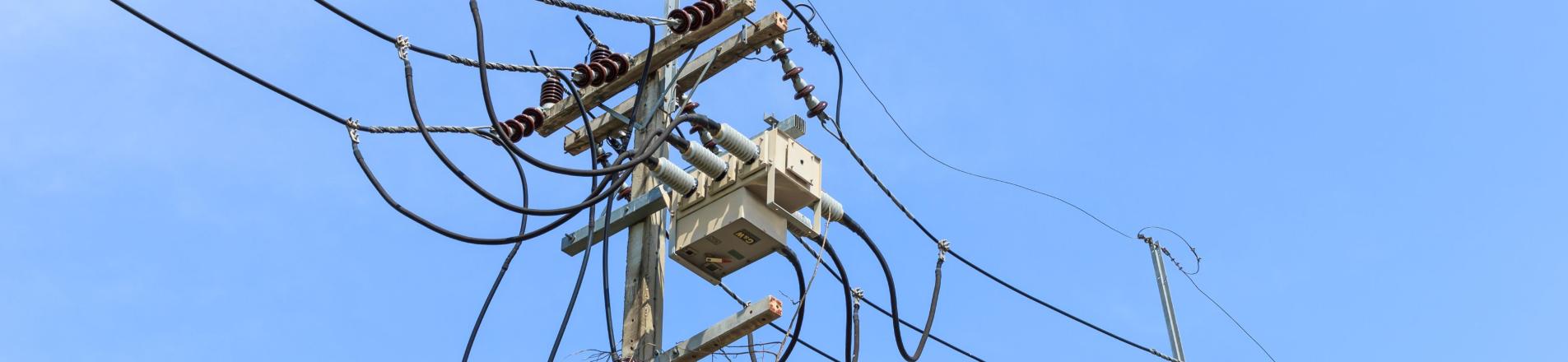





Upgrading Karachi’s electricity network from bare low-voltage wires to aerial bundled cables significantly reduced theft and feeder losses, leading to improved revenue recovery and fewer power outages. However, while the intervention strengthened the utility’s finances and service reliability, it increased billing complaints and may have disproportionately affected poorer households who were newly formalised and consumed relatively little electricity.
Editor’s note: For a broader synthesis of themes covered in this article, check out our VoxDevLit on Electricity Infrastructure.
Electricity service quality in many developing countries is substantially worse than in developed countries, with frequent outages, voltage fluctuations, and billing disputes. A central reason for this is poor cost recovery, driven by high subsidies, bill non-payment, and electricity theft (Burgess et al. 2020). While there is growing evidence on the efficacy of reforms that reduce high subsidies and improve bill payments (McRae 2015, Jack and Smith 2020), little is known about theft; specifically, whether it can be reduced and what effects such reductions would have, not only on utilities’ finances, but also on consumers.
In our research (Ahmad, Ali, Meeks, Wang, and Younas 2025), we present evidence from the study of a large-scale infrastructure intervention in Karachi, Pakistan, that aims to reduce electricity theft by making it physically more difficult.
Kundas and how to reduce theft
Unbilled consumption, a substantial component of non-technical losses, occurs when individuals access electricity while bypassing the utility’s meter. This happens through meter tampering, billing irregularities, or most often in Pakistan, by using a kunda, a wire attached directly to a low-voltage transmission line. Kundas, which are known by different terms elsewhere, are common in developing countries, as low-voltage transmission lines are typically bare overhead wires, chosen historically because they are the cheapest infrastructure option.
We study a large-scale infrastructure upgrade in Karachi, Pakistan, where the city’s electricity utility (Karachi Electric, or KE) began replacing traditional bare low-voltage wires with aerial bundled cables (ABCs). ABCs are insulated and twisted together, making it extremely difficult to attach illegal connections that bypass meters. ABCs are not a new technology, but their use as a theft deterrence is relatively recent. They have been used for decades in Europe, Japan, and other high-income countries, as they offer improved safety over bare wires while still being significantly cheaper than underground wiring. Because ABCs are insulated, they reduce accidental contact, damage from trees, and the risk of fire.
These same features that make ABCs safer also make them effective at preventing theft. With bare wires, utilities must constantly detect and remove illegal connections, a costly and often futile exercise, since connections can be taken off and reattached before inspections, ABCs require physically piercing the cable to attach a kunda, making stealing much harder.
It is for these reasons that KE accelerated the rollout of ABCs in 2018, prioritising feeder lines with particularly high losses. The staggered timing and location of these upgrades allow us to estimate their causal effects on both utility finances and consumer outcomes.
The effects of reducing theft on the utilities’ bottom line
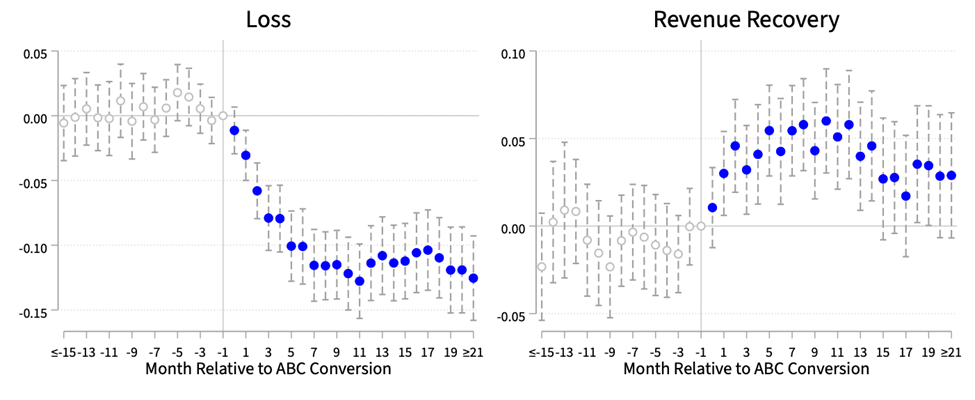
We find evidence of large and persistent changes. First, feeder-line losses fall sharply after conversion, by about 8 percentage points relative to a baseline average of about 39%. As can be seen from the left column of Figure 1, these effects persist throughout the study period.
The evidence points to the reduction in losses being driven by a reduction in theft, rather than changes in technical efficiency. We find no evidence of losses falling in areas with lower baseline losses post-conversion. Furthermore, engineering estimates from similar environments to Karachi suggest that any reduction in losses due to technical efficiency would be at most 1.5 percentage points (Abdollahi et al. 2020), reinforcing our interpretation that the dominant channel is reduced theft.
With a reduction in losses, we also find that bill payments improved, though the effect is less pronounced and fades over time. This is perhaps unsurprising. While ABCs may prevent illegal connections and may raise the opportunity cost of disconnection, they do little to directly improve households’ ability or willingness to pay bills.
Figure 1: Feeder level losses and revenue recovery pre- and post-conversion
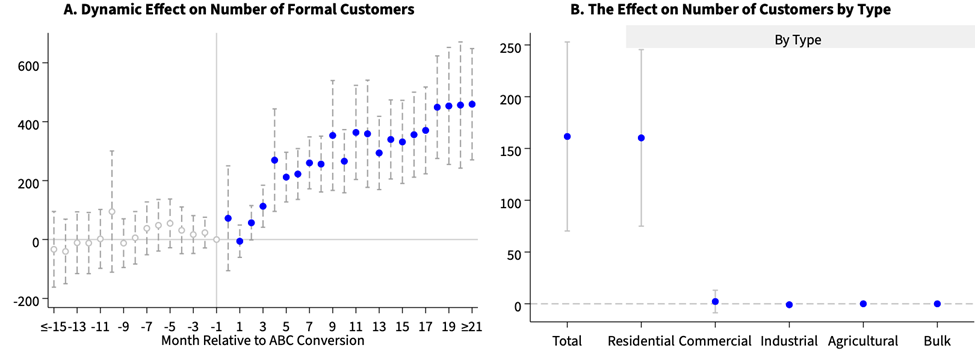
Further analysis shows that these gains are driven by areas with higher losses, that is, areas with worse conditions prior to conversion show the highest relative improvement. Two mechanisms seem to drive these improvements. First, the number of formal customers increases shortly after conversion (Figure 2A), and this increase is essentially driven by an increase in residential customers, not commercial, industrial, or agricultural customers (Figure 2B). This suggests that customers learn quickly that theft may no longer be viable and therefore seek formal connections. Second, billed consumption also rises among existing customers, both in units consumed and rupees. This may reflect improved service hours, or that even some formal customers previously met part of their electricity needs through kundas.
Figure 2: Average change in customer numbers at the feeder level, post-ABC conversion
Effects on consumers
Analysis of utility customer service data, together with primary survey data collected from a sub-sample of customers, shows that the reduced losses and improved revenue recovery are associated with improvements in service quality. As losses fall, power outages also decrease, as the utility’s policy assigns outage hours as a function of losses.
However, not all indicators are positive. Billing-related complaints increased, and households in areas with ABCs reported lower trust in both KE and the accuracy of their bills. Finally, exploratory analysis of newly formal customers shows that they tend to consume less electricity than existing customers. This raises equity concerns, as it may be the case that those previously informal customers were some of the poorest of the poor and by making theft harder, the intervention placed a disproportionate burden on those with the greatest need.
This has direct policy relevance and suggests that technological interventions aimed at theft reduction should be designed alongside complementary measures, such as tariff reform or targeted safety nets, to protect the most vulnerable.
Policy implications
Our results show that technological interventions can help utilities reduce electricity theft significantly. However, while such an intervention may reduce non-technical losses, supply-side innovations alone do not necessarily improve bill repayment, suggesting the need for utilities to pair physical infrastructure upgrades with complementary consumer-facing interventions.
Second, we find that while upgrading to ABCs was clearly a sound investment from the utilities’ perspective, policymakers should pay close attention to the needs of their most vulnerable constituents. While there is evidence that a wide range of households engaged in theft, newly formalised customers tended to be those at the lower end of the consumption distribution, highlighting the need for targeted programmes to ensure basic electrification for all. Given the rise in extreme temperature events due to climate change, ensuring the poorest households have reliable access to electricity for cooling is increasingly critical.
References
Abdollahi, R, M Moradi, H Alizadeh, and A Rafiei (2020), “Impact of replacing overhead lines with aerial bundled cable and installation of new transformers to reduce losses and improve distribution network voltage profiles: Technical and economic analysis,” Engineering Reports, 2(11): e12259.
Ahmad, H F, A Ali, R C Meeks, Z Wang, and J Younas (2025), “Down to the wire: Leveraging technology to improve electric utility cost recovery,” American Economic Journal: Applied Economics, 17(4): 60–99.
Burgess, R, M Greenstone, N Ryan, and A Sudarshan (2020), “The consequences of treating electricity as a right,” Journal of Economic Perspectives, 34(1): 145–169.
Jack, K, and G Smith (2020), “Charging ahead: Prepaid metering, electricity use, and utility revenue,” American Economic Journal: Applied Economics, 12(2): 134–168.
McRae, S (2015), “Infrastructure quality and the subsidy trap,” American Economic Review, 105(1): 35–66.