



Weather forecasts in low-income countries are about 20 years behind those in high-income countries, worsening economic losses and increasing vulnerability to climate-related risks.
Weather information is key for resilience: it helps communities anticipate hazards and prepare responses in sectors such as agriculture, energy, transportation, and health. But weather services are much less developed in many low-income countries, creating a large weather services gap between high and low-income countries (WMO 2024). There are various reasons for this gap, including limited public resources for national institutions to provide weather information to the population. In recent research (Linsenmeier and Shrader 2025), we focus on a fundamental constraint to better services in low-income countries: the accuracy of the global weather predictions those services rely on.
Low forecast accuracy hinders economic activity and – because climate change is raising the stakes of everyday weather preparedness efforts – will matter even more as adaptation needs rise in the future. New evidence suggests that forecast accuracy is not evenly distributed across the world. Instead, it is systematically lower in poorer countries, precisely where people tend to be the most vulnerable to the weather and where projected climate damages are the most severe.
Global differences in forecast accuracy
We quantify forecast accuracy using anomaly correlations – a widely used metric in operational meteorology – that measures how well weather forecasts predict deviations from a location’s usual pattern. We focus on short-term forecasts of near-surface air temperature because previous research has shown that temperature has important effects on a wide range of economic outcomes (Hsiang 2025) and because our own previous work suggests that short-term temperature forecasts can be effective in mitigating mortality from extremes (Shrader et al. 2023, Shrader et al. 2026).
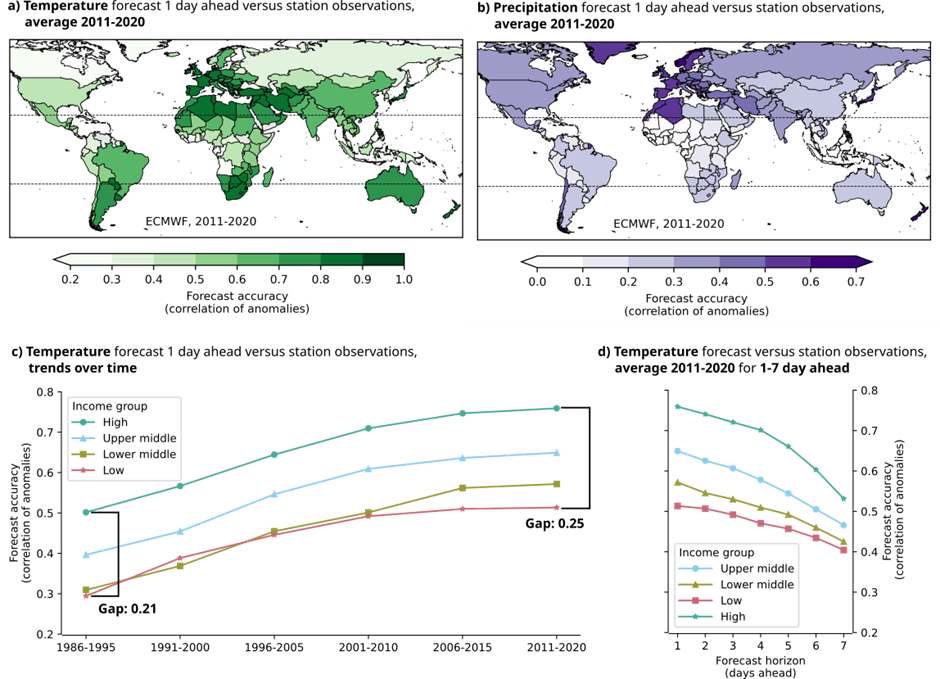
The headline result is large global inequality in forecast accuracy: forecasts one to seven days ahead are, on average, more accurate in high-income countries than in low-income countries. The difference is large enough that a seven-day-ahead forecast in a high-income country is, on average, more accurate than a one-day-ahead forecast in a low-income country. We find similar patterns for precipitation and surface pressure, although the details differ by variable and forecast horizon. And while forecast accuracy has improved throughout our sample period (starting in the 1980s), the gap between rich and poor countries has been persistent. Forecast accuracy in poor countries consistently lags that of rich countries by two decades.
Figure 1: The accuracy of weather forecasts is unequally distributed across countries and tends to be higher in countries with higher GDP per capita
What drives the inequality: Geography, infrastructure, and institutions
Why are weather forecasts less accurate in some places than in others? And what can we do about it? An important determinant of forecast accuracy is geography. The global tropics face a fundamental challenge: weather systems in the tropics are dominated by small-scale, moisture-driven atmospheric patterns which are inherently harder to predict and represent in forecast models compared to the large-scale weather systems that occur outside the tropics. Because many low-income countries are in the tropics, this ‘predictability geography’ contributes to an income gradient in forecast skill.
Continued investments in model development can help to reduce inequalities, especially via a better representation of physical processes important to weather in the tropics such as cloud formation, but it remains uncertain how much these advances – including the use of artificial intelligence and machine learning – can close the forecast accuracy gap between the tropics and extra-tropics (Keane et al. 2025). Experience with seasonal forecasts shows that the gap is surmountable. The stronger connection of tropical weather systems to slower-moving oceanic conditions, which have been increasingly well understood since the 1980s, allows for accurate forecasting of some aspects of tropical weather months in advance.
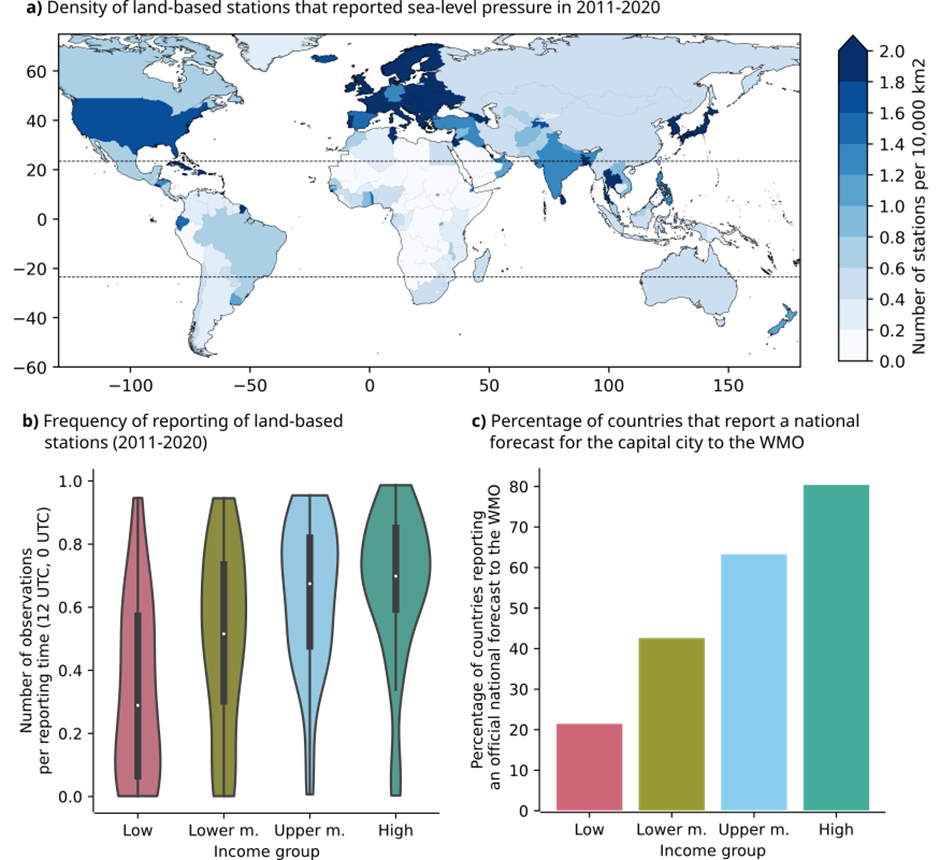
Our analysis also points to other, more tangible levers that policymakers can influence. We document large inequalities in weather observing infrastructure –especially land-based weather stations and upper-air observations from radiosondes (instruments carried by weather balloons) – and show that even if the infrastructure exists, it is utilised less frequently in poorer countries, leading to reporting gaps. In poorer, tropical countries, these infrastructure inequalities are making a geographically challenging forecasting situation even worse. Experiments by meteorologists, and our own analysis, attribute some of the differences in forecast skill to differences in the density of observations, as forecasts depend fundamentally on the accuracy of weather observations used to initialise models.
We also find evidence that institutional capacity likely amplifies the forecast accuracy gap. Most national meteorological services do not run their own prediction models. Instead, they rely on a small number of global forecast centres and then downscale, correct biases in, and tailor products locally. Using reports to the WMO as a proxy, we find that high-income countries are much more likely to provide official forecasts for their capitals than low-income countries. This suggests that the ‘operational forecast quality’ experienced by end users may diverge even more than the underlying global model skill.
Figure 2: The infrastructure for meteorological observations is unequally distributed across countries
Policy options for adaptation and development
While some inequality in forecast accuracy reflects differences in the inherent predictability of weather, some of it does not. Three practical options follow.
- Close the observation gap and leverage existing infrastructure.Recent initiatives such as the Systematic Observations Financing Facility (SOFF) are designed explicitly to close the surface-based observation gap in data-sparse countries and support sustained international exchange of essential observations under WMO standards (SOFF 2026). This is a global public good: better observations in data-sparse regions improve forecasts both locally and globally. And even if funding is not available to expand weather infrastructure, there is a ready opportunity to better use existing infrastructure. In many places, the binding constraint is maintenance and sustained operations which affect the availability and quality of resulting climate data (Dinku 2019).
- Use new AI forecasting technology where it helps. AI-based weather forecasts have shown a lot of promise globally, but their ability to improve forecasting in the tropics is still unclear. Current AI-based forecasts are typically trained on output from existing global weather models and can inherit the same regional predictability constraints and biases. Indeed, early evidence suggests that the same differences in prediction accuracy between mid-latitudes and tropics that we document above also appear in AI-based forecasts (Keane et al. 2025), suggesting that alternative training methods might be needed. Even if AI models cannot overcome geographic challenges, their reduced computing costs hold promise for helping lower-resourced meteorological agencies to produce their own, local forecasts.
- Invest in the ‘last mile’: usable, trusted, locally relevant services. Forecast accuracy is necessary but not sufficient for forecasts to have value. A large body of evidence reports barriers to utilisation of forecasts and the importance of service design and communication (Farkas et al. 2025). Capacity building for national meteorological agencies, co-production with users, and impact-based forecasting can increase the actual benefits of forecasts.
This agenda complements other adaptation priorities. For example, Nath (2025) highlights how climate change may trap workers in agriculture in low-income settings – a particularly weather-dependent sector. Better forecasting is not a substitute for development or structural transformation, but it can make other investments more effective, including investments in disaster risk management, resilient infrastructure, energy reliability, and public health preparedness.
References
Dinku, T (2019), "Challenges with availability and quality of climate data in Africa," in E Rodrigues-Navarro (eds), Extreme Hydrology and Climate Variability, 71–80.
Farkas, H, M Linsenmeier, M Talevi, P Avner, B Arga Jafino, and M Sidibe (2025), "The economic value of weather forecasts: A quantitative systematic literature review," Unpublished manuscript.
Hsiang, S (2025), "The global economic impact of climate change: An empirical perspective," Unpublished manuscript.
Keane, R J, D J Parker, E Dunn-Sigouin, E W Kolstad, and J H Marsham (2025), "Mid-latitude versus tropical scales of predictability and their implications for forecasting," Meteorological Applications, 32: e70055.
Linsenmeier, M, and J Shrader (2025), "Global inequalities in weather forecasts," Unpublished manuscript.
Nath, I (2025), "Climate change, the food problem, and the challenge of adaptation through sectoral reallocation," Journal of Political Economy, 133: 1785–1843.
Shrader, J, L Bakkensen, and D Lemoine (2023), "Fatal errors: The mortality value of accurate weather forecasts," Unpublished manuscript.
Shrader, J, S Thies, L Bakkensen, M Linsenmeier, and D Lemoine (2026), "Weather forecasts become more important for reducing mortality as the climate warms," Unpublished manuscript.
SOFF – Systematic Observations Financing Facility (2026), "Closing the weather and climate data gap," Unpublished manuscript.
World Meteorological Organization (WMO) (2024), "Hydromet Gap Report 2024."