






Amateur football clubs in Latin America show no overall discrimination against immigrants, but treatment varies sharply by origin, with players from lower-ranked football countries facing fewer positive responses, driven largely by perceived player quality rather than language or integration signals.
Editor’s note: For a broader synthesis of themes covered in this article, check out our VoxDevLit on Refugees and Other Forcibly Displaced Populations.
Football (soccer) is an activity that unites people – a ball, two teams, and a few rules to kick the ball into a goal. At the amateur level, weekend matches are a meeting point with chats, tactics, and excitement before the games, and drinks, food, and late plans after. This is the kind of friendly context Granovetter (1973) would argue gives people the chance to create ‘weak ties’ and expand their social networks. Football is a language that can easily cross borders and build bridges, even in the harshest contexts (Mousa 2020). For immigrants in particular, sport has long been viewed as a key integration strategy (Council of the European Union 2010).
Amateur leagues offer an ideal setting for research. They have very similar structures across countries, with millions of registered players, making them easily comparable. Regional federations organise the competitions, but economic incentives are minimal; most people within clubs work out of passion. In these leagues, winning is important, but participants also want to have fun. Clubs have full responsibility for member admission, and there are no limits on foreign players.
The immigrant participation gap
Despite health benefits, popularity, and efforts by governing bodies to launch specific football programmes to boost inclusion, survey research shows that immigrants participate less in sports than natives worldwide (Bottenburg et al. 2005, Johnston et al. 2007). For example, in Italy, first-generation immigrants, from nearly all origins, have lower participation rates in sports than natives (van Tubergen and Molteni 2024, Figure 1).
Figure 1: Sports participation rates by origin group in Italy
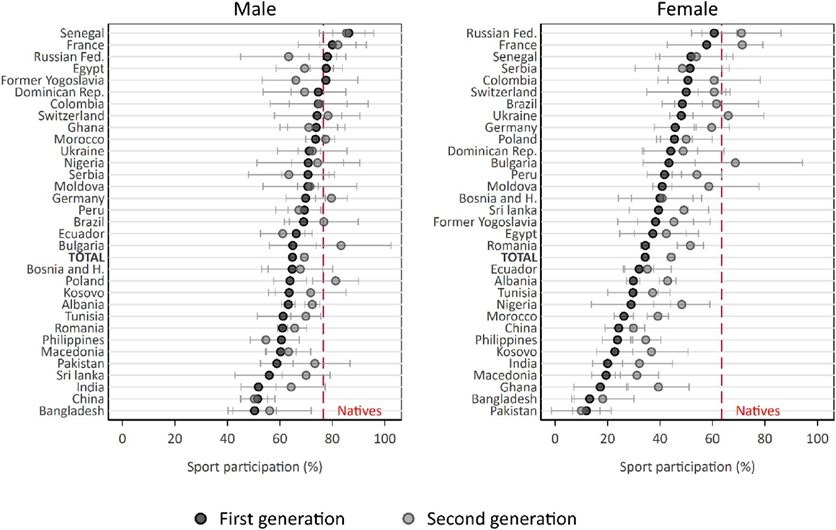
Source: van Tubergen and Molteni (2024).
Research has traditionally centred the debate around preferences and self-segregation mechanisms, and while discrimination narratives existed, it was challenging for researchers to disentangle processes of exclusion (van Haaften 2019). To assess the presence of such discrimination, we borrowed a methodology commonly used in labour markets: a correspondence study (Bertrand and Mullainathan 2004).
In such studies, researchers send fictitious applications to firms, varying only the characteristics of interest (e.g. race, gender, national origin, etc.) and compare response rates. A pioneering correspondence study in amateur football, involving more than 23,000 interactions with clubs in Europe, showed that discrimination against immigrants seeking to join clubs is substantial (Gomez-Gonzalez et al. 2021).
Beyond its magnitude, the origin of discrimination has been a source of intense debate in economics for decades. Two theories traditionally emerge: on the one hand, taste-based discrimination assumes that discrimination comes from distaste (animus) towards a particular group (Becker 1957); on the other hand, statistical discrimination assumes that discrimination emerges from imperfect information and the use of group membership as signals of productivity (Arrow 1973).
A large-scale correspondence study in Latin America
We conducted a large-scale correspondence study in amateur football in Latin America (Gomez-Gonzalez, Clochard, Dietl, and Duhalde forthcoming), a context where ethnic inequality is particularly relevant (Neidhöfer et al. 2018). We contribute to the understanding of discrimination in two ways:
- By expanding the geographical scope to Latin America, where this is the first correspondence study on discrimination in amateur football.
- By making the distinction between individual statistical discrimination (‘can this player play well?’) and compositional statistical discrimination (‘can this player fit in well with the teammates?’).
Such cues about potential mechanisms are key to driving policy decisions.
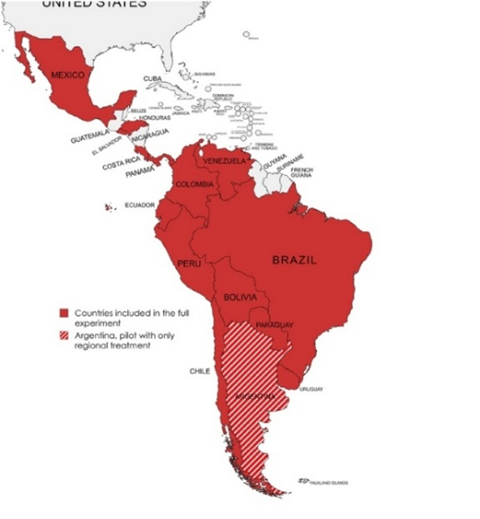
We sent approximately 10,000 applications to amateur teams in 15 Latin American countries, asking whether the fictitious applicant could join a practice session (Figure 2). Each club received one application with randomly varied characteristics: national origin (local applicant vs. immigrant from Latin America, Europe, or Asia), individual signal (mention of having played in a professional youth academy), and a compositional signal (mention of fluency in the local language). Discrimination is present if the number of positive responses differs between groups.
Figure 2: Countries included in the study
Discrimination varies by origin and perceived quality
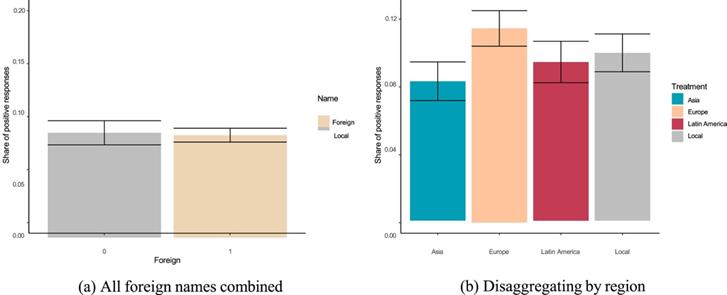
Our results show no overall discrimination against immigrants (Figure 3a). However, this masks substantial variation across regions of origin. We find that European players receive marginally more positive responses, while Asian immigrants face significant barriers (Figure 3b).
We find that this difference is partly explained by individual statistical discrimination, in the sense that applicants from countries with lower FIFA rankings (a proxy for player quality) receive fewer positive responses. We find no significant evidence that compositional statistical discrimination (coming from a country that shares the language) or our productivity signals influence response rates.
Figure 3: Share of positive responses by applicant origin
Policy implications for integrating immigrants
Amateur football is a regulated context where public policymakers may have an impact. Information campaigns, light-touch interventions, or large-scale programmes are well-suited to influence the behaviour of clubs and coaches, improving accessibility for all interested parties. However, this is not an obvious task, and even well-intended interventions in collaboration with football federations may backfire (see an example in Norway, Dur et al. 2023).
In our study, the fictitious applicant’s signals in the body of the message were designed to shed light on different sources of discrimination and highlight key areas for public policy effort, such as language programmes. However, the signals did not have a significant impact; they may have been too subtle or not credible enough. Designing better signals that link discrimination patterns to specific mechanisms, and understanding how people perceive them in this context, remains a challenge for future research and policy development.
References
Arrow, K (1973), “The theory of discrimination,” in O Ashenfelter and A Rees (eds.), Discrimination in labor markets: 3–33, Princeton University Press.
Becker, G S (1957), The economics of discrimination, University of Chicago Press.
Bertrand, M, and S Mullainathan (2004), “Are Emily and Greg more employable than Lakisha and Jamal? A field experiment on labor market discrimination,” American Economic Review, 94: 991–1013.
Bottenburg, M van, B Rijnen, and J Sterkenburg (2005), Sports participation in the European Union: Trends and differences, Arko Sports Media, Nieuwegein.
Council of the European Union (2010), “Council conclusions of 18 November 2010 on the role of sport as a source of and a driver for active social inclusion,” Unpublished manuscript.
Dur, R, C Gomez-Gonzalez, and C Nesseler (2023), “How to reduce discrimination? Evidence from a field experiment in amateur soccer,” Journal of Ethnic and Migration Studies, 49: 175–191.
Gomez-Gonzalez, C, C Nesseler, and H M Dietl (2021), “Mapping discrimination in Europe through a field experiment in amateur sport,” Humanities and Social Sciences Communications, 8: 1–8.
Gomez-Gonzalez, C, G J Clochard, H Dietl, and J C Duhalde (2026), “Migration and sources of discrimination in a social context: Experimental evidence from 15 Latin American countries,” Journal of Development Economics, 179: 103633.
Granovetter, M S (1973), “The strength of weak ties,” American Journal of Sociology, 78: 1360–1380.
Johnston, L D, J Delva, and P M O’Malley (2007), “Sports participation and physical education in American secondary schools: Current levels and racial/ethnic and socioeconomic disparities,” American Journal of Preventive Medicine, 33: S195–S208.
Mousa, S (2020), “Building social cohesion between Christians and Muslims through soccer in post-ISIS Iraq,” Science, 369: 866–870.
Neidhöfer, G, J Serrano, and L Gasparini (2018), “Educational inequality and intergenerational mobility in Latin America: A new database,” Journal of Development Economics, 134: 329–349.
van Haaften, A F (2019), “Ethnic participation in Dutch amateur football clubs,” European Journal for Sport and Society, 16: 301–322.
van Tubergen, F, and F Molteni (2024), “Does parental origin-country culture affect the gender gap in sport participation? A study of immigrant youth in Italy,” Journal of Ethnic and Migration Studies, 50: 4002–4020.