



Evidence from Latin America and the Caribbean suggests that skin tone is a powerful predictor of intergenerational mobility.
Promoting intergenerational mobility is a central policy challenge across the globe (van der Weide et al. 2023), especially in developing countries (Alesina et al. 2019, 2021, Genicot and Ray 2024, Genicot et al. 2024). When mobility gaps align with social group boundaries, and discrimination reinforces those gaps, the challenge becomes both more urgent and more politically sensitive. Understanding how these dynamics interact is essential for designing policies that foster inclusive development.
Latin America offers a striking example. In many countries, national narratives celebrate mestizaje, the idea that widespread racial mixing has softened or erased racial divisions. Concepts such as the "Cosmic Race" in Mexico or "racial democracy" in Brazil suggest that because most people identify as mixed-race, racism is largely a problem of the past.
Yet behind this myth lies a stark reality: darker-skinned individuals consistently face worse economic outcomes. These disadvantages are not just contemporaneous, but are also passed from one generation to the next.
Figure 1: Ethnoracial categories and skin tone in Latin America
Panel a: Self-identified racial categories Panel b: Distribution of skin tones by racial categories

Notes: Based on LAPOP waves 2012, 2014, and 2016/2017. Panel (a) shows the self-identified racial categories across Latin America. Panel (b) reveals the distribution of skin tone within those categories, highlighting the considerable phenotypic diversity within groups such as Mestizos.
Assessing the impact of skin tone on inequality
To examine how skin tone shapes economic inequality and mobility, I draw on survey data from over 80,000 individuals across 25 countries in Latin America and the Caribbean (Woo-Mora 2025). These nationally representative surveys include a unique feature: interviewers assigned each respondent a skin tone using a standardised 1-to-11 scale. This measure goes beyond self-identified race to capture how individuals are perceived by others, an essential social dimension of discrimination.
The findings are striking: for each step darker on the skin tone scale, individuals earn around 2.7% less income per capita and complete less schooling. Those with the darkest skin earn 20% less and complete two fewer years of education than those with the lightest skin, even after accounting for gender, maternal education, and where they live.
Figure 2: Skin tone gaps in income and education
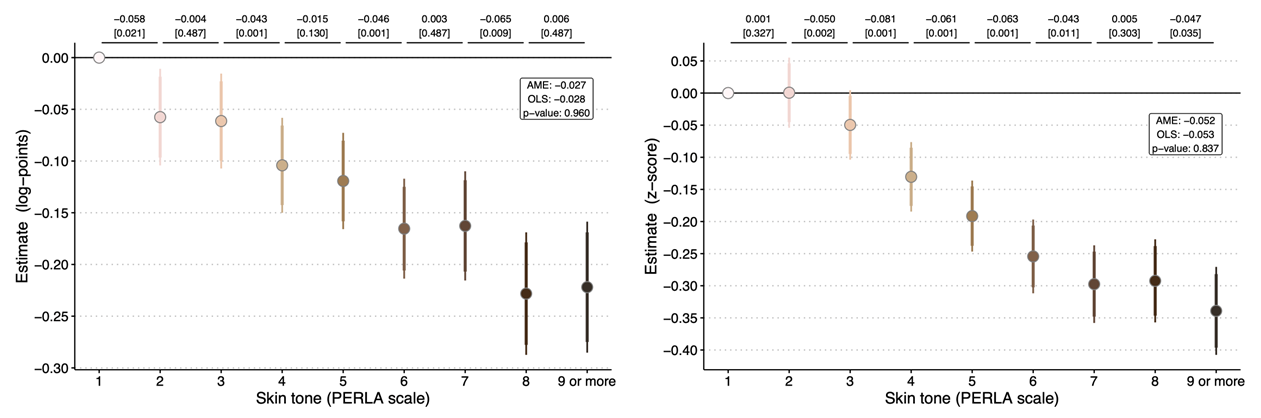
Notes: The x-axis shows interviewer-assessed skin tone on a 1–9 scale, using the PERLA palette (top-coded above 9 due to small sample sizes). The left panel plots log household income per capita; the right panel shows standardised years of schooling. Estimates control for age, sex, maternal education, and use cluster fixed effects (geography × year × enumerator). Bars indicate 95% (thin) and 90% (thick) confidence intervals. Labels above the graphs show p-values and differences between adjacent tones, adjusted for multiple testing.
These disparities persist within racial categories. Among those who identify as Mestizo, the region's dominant ethnoracial identity, darker-skinned individuals still earn and learn less. In fact, skin tone alone explains as much variation in outcomes as self-reported racial categories.
The impact of skin tone on intergenerational opportunity
My research also looks at intergenerational mobility: whether children attain more education than their parents. The answer depends, in part, on skin tone.
A person with the darkest skin tone is 11 percentage points less likely to surpass their mother's education than someone with the lightest skin. These gaps persist even after accounting for maternal education and local geography. And while upward mobility is often framed in relative terms, my results shows that absolute gaps in education by skin tone remain large and consistent.
Figure 3: Skin tone and intergenerational disparities
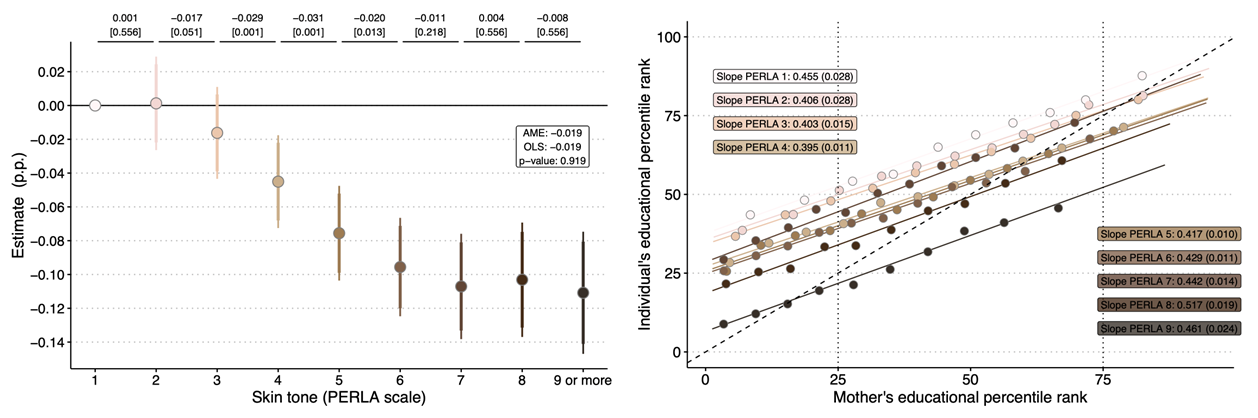
Notes: The left panel shows gaps in absolute mobility: the likelihood of completing more education than one’s mother, by skin tone (PERLA scale 1–9, top-coded). The right panel plots relative mobility: respondents’ education rank versus their mother’s, by skin tone group. Estimates control for age, sex, and maternal education, and include fixed effects for geography, year, and enumerator. Bars show 95% (thin) and 90% (thick) confidence intervals; labels show average marginal effects and p-values adjusted for multiple testing.
Machine measures validate skin tone-related disparities
A common concern is that interviewer-assessed skin tone might reflect socioeconomic traits rather than visual characteristics. To test this, I replicate the analysis using a separate dataset from Mexico with machine-rated skin tone and more detailed parental background data.
The results hold: even with machine measures and richer controls, darker skin is associated with lower education and mobility. This suggests that perceived skin tone is a durable and socially meaningful driver of inequality.
Implications for policy tackling racial inequality
My findings suggest that tackling racial inequality in Latin America requires more than targeting ethnic or cultural identity. Policies must explicitly acknowledge and address colourism, the social hierarchy based on skin tone. I recommend the following policy priorities:
- Investments in early childhood and education should prioritise communities most affected by these disparities.
- Affirmative action policies must account for phenotypic inequality—not just self-identified ethnoracial categories.
- Stronger anti-discrimination enforcement and the use of anonymous hiring trials can help mitigate bias in the labour market.
Collecting and analysing data on skin tone is a critical first step. What gets measured gets managed. While ethical considerations remain important, confronting phenotypic inequality directly is essential to breaking the intergenerational cycle of disadvantage in the region.
References
Alesina A, S Hohmann, S Michalopoulos, and E Papaioannou (2019), “Intergenerational mobility in Africa,” VoxDev.
Alesina A, S Hohmann, S Michalopoulos, and E Papaioannou (2021), “Intergenerational mobility in Africa,” Econometrica 89(1): 1–35.
Genicot G, D Ray, and C Concha-Arriagada (2024), “Upward mobility in developing countries,” Unpublished manuscript.
Genicot G and D Ray (2024), “Measuring upward mobility in developing countries,” VoxDev.
van der Weide R, C Lakner, DG Mahler, A Narayan, and R Ramasubbaiah (2023), “Intergenerational mobility around the world: A new database,” Journal of Development Economics 166: 103167.
Woo-Mora LG (2025), “Unveiling the cosmic race: Skin tone and intergenerational economic disparities in Latin America and the Caribbean,” Journal of Development Economics 103594.