





Anti-corruption campaigns – such as Brazil’s Lava Jato – can reduce corruption but may also trigger significant unintended economic costs – disrupting credit markets while reducing employment and wage bills across both targeted and non-targeted firms.
Authors’ note: The views expressed in this article are those of the authors and do not necessarily reflect those of the Central Bank of Brazil or the Getulio Vargas Foundation.
Corruption is pervasive globally (Shleifer and Vishny 1993, Mauro 1995, Bardhan 1997, Svensson 2005, Fisman and Golden 2017), making anti-corruption measures essential for promoting economic growth, development, and political legitimacy (Olken and Pande 2012, Giannetti et al. 2020, Colonnelli et al. 2022, Colonnelli and Prem 2022). However, research has largely focused on these benefits while neglecting the potential negative spillover effects of prosecuting major corrupt firms (Szerman 2023). While curbing corruption is beneficial, targeting a country's largest firms can disrupt economic activity, raise unemployment, hinder credit allocation, and erode public trust in such initiatives.
The potential for substantial economic disruption is particularly evident in cases such as Brazil's Operação Lava Jato (Operation Car Wash), which shook the country from 2014 to 2021. This investigation exposed extensive bribery among major construction companies in exchange for contracts. Given these firms’ extensive input-output linkages and banking relationships, the impact of investigation on the economy was substantial (Gabaix 2011, Acemoglu et al. 2012).
In Ferraz, Moura, Norden and Schechtman (2025), we show that Operação Lava Jato directly harmed firms under investigation and also caused substantial adverse spillover effects for the wider economy. This occurred because banks that had high credit exposure to implicated firms before the scandal reduced credit to other, non-investigated firms, particularly those with political connections. Consequently, these non-investigated firms experienced significant declines in employment and wage bills.
The unfolding of Brazil’s Lava Jato operation
Operação Lava Jato, launched in 2014, began as a money laundering and bribery investigation targeting foreign currency dealers before expanding rapidly to include the state-owned oil company, Petrobras, and major construction firms. This large-scale corruption scheme involved the overbilling of construction projects and diversion of funds into secret accounts, distributed among the involved parties. The investigation eventually implicated politicians, political parties, state governors, Congress, the federal government, and even governments in other Latin American and African countries.
The operation focused on crimes such as active and passive corruption, fraudulent foreign currency exchange, bribery, and illegal campaign financing. Lava Jato, considered the largest anti-corruption investigation in Brazil and Latin America (Fisman and Golden 2017, Campos et al. 2021), resulted in over 360 convictions, nearly 400 plea bargains, 30 corporate leniency agreements, the imprisonment of high-level politicians and top executives, and approximately US$3 billion in fines, penalties, and voluntary indemnities (Da Ros and Taylor 2022). After a period of success from 2014 to 2016, the operation experienced a slowdown following the impeachment of President Dilma Rousseff. In 2019, leaked information raised questions regarding the impartiality of the investigations. The operation gradually lost momentum and faced political pressure, culminating in the task force's dissolution in early 2021.
Lava Jato hit investigated firms hard
To determine the direct impact of the anti-corruption crackdown, we employed a difference-in-differences strategy to study the investigated construction companies in Brazil. We compared these firms' employment, wage bills, and credit with those in the control group before and after the investigations, using matched data from the Federal Public Prosecutor's Office (MPF), Ministry of Labor (RAIS), and Central Bank of Brazil (SCR). Figure 1 shows the increasing negative effects on the number of employees of investigated firms following Lava Jato.
Figure 1: Number of employees in investigated firms
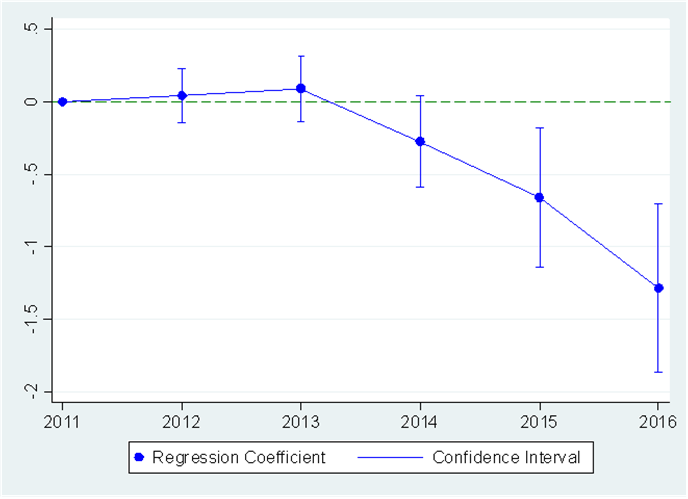
Our analysis confirms significant negative effects on the investigated firms, including a 54% and 63% reduction in employment and wage bills, respectively. While the loss of government contracts explains part of these negative outcomes, a simultaneous reduction in access to credit appears to be a significant factor. To explore this mechanism, we used loan-level data from the Central Bank of Brazil’s (SCR) credit registry to compare the credit access of investigated and non-investigated firms. The results show that investigated firms were hit hard, experiencing a 50% decline in new loans, lower bank credit ratings, and higher bank loan loss provisions. We confirmed the consistency of these results through a series of robustness tests.
Lava Jato hit other (non-investigated) firms too!
We investigate the indirect effects of Brazil's Lava Jato anti-corruption investigation on non-investigated large firms, focusing on the bank credit channel. Given Brazil's bank-based financial system, bank credit was a natural conduit for the economic shock, as the investigated firms held a non-negligible portion of banks’ credit portfolios. We conduct a difference-in-differences analysis to test whether banks more exposed to the scandal altered their lending to other firms.
Our analysis reveals that banks with greater pre-investigation exposure significantly decreased lending to non-investigated firms after the scandal broke. This is consistent with highly exposed banks being concerned about increased credit risk within their corporate loan portfolios. This effect is not caused by a reallocation of credit from firms to households.
A more granular, firm-bank-quarter level analysis distinguishes between the extensive and intensive margins of credit. At the extensive margin, new borrowers are less likely to receive loans from more exposed banks. At the intensive margin, the lending reduction is amplified for firms with perceived political connections, identified by campaign finance contributions in the elections before the investigations. The total indirect effect on non-investigated firms amounted to an 18% reduction in new credit at the firm level.
Finally, we document the real effects experienced by non-investigated firms as a result of this adverse credit supply shock. After the onset of the investigations, non-investigated firms with higher bank exposure to the scandal reduced their wage bill by and employee numbers by 12% and 10%, respectively.
Policy implications: Anti-corruption measures and spillovers
We show that while the literature highlights the positive economic effects of anti-corruption measures, these must be weighed against potential unintended negative effects. We propose that due to the immense scale of the Lava Jato investigation and significance of the firms it targeted, the operation generated adverse spillover effects throughout the broader economy.
Policymakers, independent of the judicial system, should recognise and account for these potential indirect (spillover) effects, especially when the investigations are extensive and target very large firms. Our results on bank credit reallocation capture only a partial equilibrium effect, likely underestimating the full impact, which may also include trade credit disruptions, public procurement debarments, credit risk contagion, and other economic linkages.
References
Acemoglu, D, V Carvalho, A Ozdaglar, and A Tahbaz-Salehi (2012), “The network origins of aggregate fluctuations,” Econometrica 80: 1977–2016.
Bardhan, P (1997), “Corruption and development: A review of issues,” Journal of Economic Literature 35: 1320–1346.
Campos, N, E Engel, R Fischer, and A Galetovic (2021), “The ways of corruption in infrastructure: Lessons from the Odebrecht case,” Journal of Economic Perspectives 35: 171–190.
Colonnelli, E, S Lagaras, J Ponticelli, M Prem, and M Tsoutsoura (2022), “Revealing corruption: Firm and worker level evidence from Brazil,” Journal of Financial Economics 143: 1097–1119.
Colonnelli, E, and M Prem (2022), “Corruption and firms,” Review of Economic Studies 89(2): 695–732.
Da Ros, L, and M Taylor (2022), Brazilian politics on trial: Corruption and reform under democracy, Lynne Rienner Publishers.
Ferraz, C, L Moura, L Norden, and R Schechtman (2025), “The real costs of washing away corruption: Evidence from Brazil’s Lava Jato investigation,” Unpublished manuscript.
Fisman, R, and M Golden (2017), Corruption: What everyone needs to know, Oxford University Press.
Gabaix, X (2011), “The granular origins of aggregate fluctuations,” Econometrica 79: 733–772.
Giannetti, M, G Liao, J You, and X Yu (2020), “The externalities of corruption: Evidence from entrepreneurial activity in China,” Review of Finance 25: 629–667.
Mauro, P (1995), “Corruption and growth,” Quarterly Journal of Economics 110: 681–712.
Olken, B, and B Pande (2012), “Corruption in developing countries,” Annual Review of Economics 4: 479–509.
Shleifer, A, and R Vishny (1993), “Corruption,” Quarterly Journal of Economics 108: 599–617.
Svensson, J (2005), “Eight questions about corruption,” Journal of Economic Perspectives 19: 19–42.
Szerman, C (2023), “The employee costs of corporate debarment in public procurement,” American Economic Journal: Applied Economics 15(1): 411–441.