




When it comes to labour laws, enforcement is often challenging, especially in developing countries. But what if enforcing regulations against just a few companies could influence dozens of others to comply as well? New research on Brazil's disability employment quotas reveals how strategic enforcement can create powerful ripple effects that multiply policy impact beyond directly targeted firms.
When laws exist on paper but not in practice
Brazil's experience illustrates a common challenge: the gap between laws on paper and laws in practice, where formal rules exist but the ability to ensure compliance remains weak. This phenomenon is widespread, appearing in areas such as tax compliance (Slemrod 2019, Okunogbe 2025) and environmental regulation (Shimshack 2014, Liu et al. 2025), but tends to be especially problematic in developing countries, where enforcement mechanisms are often weakened by limited state capacity (Acemoglu et al. 2015).
Since 1991, Brazilian companies with more than 100 workers have been required to allocate at least 2% of their positions to persons with disabilities. Yet for over two decades, this legal requirement was largely ignored due to weak enforcement procedures.
The employment statistics paint a stark picture. In Brazil, individuals with disabilities have employment rates ranging from just 8.6-11.9% compared to those without disabilities–mirroring those of other Latin American countries (Berlinski et al. 2021) but far below the OECD average of 60%. By 2009, less than 30% of firms required to comply were actually employing the minimum mandated number of persons with disabilities.
In 2012, however, Brazil introduced stricter enforcement procedures. The new administrative act established clearer inspection guidelines, enabled inspectors to examine companies across multiple facilities, and required medical documentation for workers with disabilities. Following this reform, disability Quota Law (QL) fines increased sharply, especially in comparison to other labour regulation fines. Our research documents the direct and indirect effects of this heightened enforcement (Berlinski and Gagete-Miranda 2025).
Direct enforcement effects: Meaningful but limited reach
We start our analysis by documenting how the Administrative Act of 2012, which introduced more stringent inspection procedures, impacted firms’ hiring in the formal sector using data from a Brazilian matched employer-employee data set. Figure 1 demonstrates that, among firms surpassing the policy threshold, there was no significant discontinuity in the hiring of persons with disability prior to 2012; however, we do observe a clear discontinuity afterwards. We estimate that companies just above the 100-worker threshold increased their hiring of persons with disabilities by approximately 6% after 2012.[1] The increase was most pronounced among individuals with mobility impairments, followed by those with visual and cognitive impairments.
Figure 1: Regression discontinuity on quota-law threshold
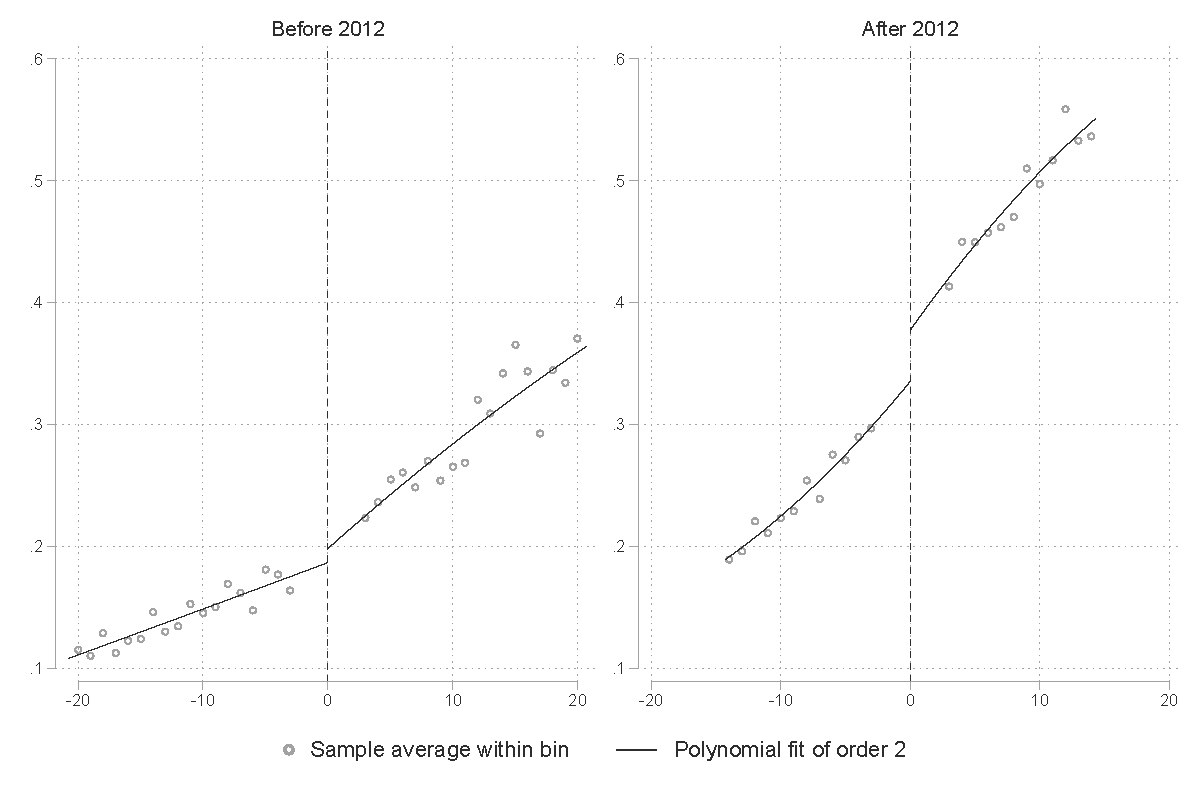
Note: Figure 1 shows results from local polynomial regressions where we estimate firms’ hiring behaviour regarding workers with disabilities once they pass the 100 workers threshold established by the Quota Law. The dependent variable is the hyperbolic sine transformation of the number of workers carrying a disability.
Importantly, most new hires came from outside the formal labour market rather than from poaching workers with disabilities from other companies. The policy also improved job tenure for persons with disabilities in large firms, suggesting it created genuine new opportunities.
However, direct enforcement has natural limits. This reflects the fundamental challenge facing regulators worldwide: limited resources make it impossible to directly monitor and punish every violation.
The hidden multiplier: Network spillover effects
This is where enforcement spillovers become crucial. Our analysis reveals that when a firm receives a disability QL fine, other companies in its networks also increase their hiring of persons with disabilities–despite not being directly targeted by enforcement.
To measure these spillover effects, we used the timing of fines as a natural experiment. We compared firms whose business networks experienced a QL fine with similar firms whose networks would receive such fines in the future–but had not yet. This approach isolates the effect of information about enforcement from other factors that might influence hiring decisions.
While receiving a fine may be predictable (non-compliant firms are more likely to be targeted), the exact timing of when a fine occurs within a network can be considered random. By tracking what happens to firms before and after another company in their network gets fined, we can measure how information about enforcement spreads and changes behaviour across connected businesses.
We examined three types of business networks through which information about fines might spread:
- Neighbour networks: Firms located in the same zip code.
- Ownership networks: Companies sharing common owners or business associates.
- Human resources professional networks: Firms connected through human resources workers who had previously worked at other companies.
Firms respond to a QL fine within their network by increasing the number of workers with disabilities, regardless of which network the fine occurs in. This pattern is evident in Figure 2, which displays the results from estimations considering all firms with more than 100 workers, for QL fines in the firm’s neighbour (Figure 2a), owner (2b), and HR workers network (2c).
Figure 2: Law enforcement at firm networks and the number of workers with a disability
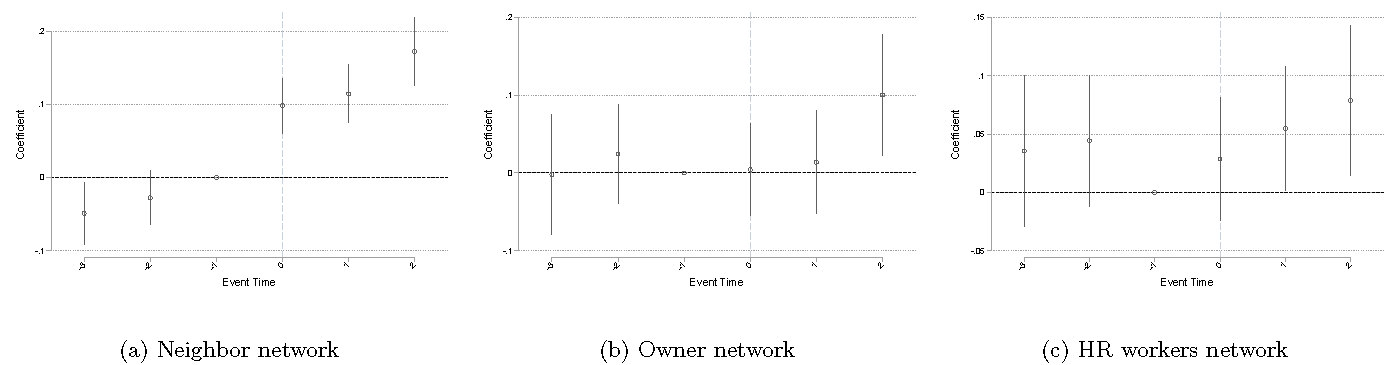
Note: Figure 2 presents estimates from a stacked differences-in-differences specification, where the dependent variable is the hyperbolic sine transformation of the number of workers with a disability in the firm. The sample includes firms with more than 100 employees that did not receive a QL fine in period t=0. ‘Event Time’ refers to the number of periods since the occurrence of a QL fine in the firm’s network.
Firms located in the same zip code showed the strongest spillover effects. When a company in their area was fined, neighbouring firms increased their hiring of workers with disabilities by 12.3% in subsequent years. In ownership networks, disability hiring increased by 4.5%, while in HR networks it increased by 4%.
Information—as opposed to increased monitoring—drove spillovers
Crucially, we show these spillover effects are not caused by increased government monitoring of network firms. Companies in networks where another firm was fined did not become more likely to be inspected themselves. Instead, we speculate, the spillovers appear to result from information sharing about enforcement risks and compliance expectations.
The effects were strongest among firms that were previously non-compliant with the disability quota. Non-compliant firms increased their hiring by 20.5-26.7% depending on which network was affected, while firms already meeting at least 50% of their quota requirements showed no significant response.
Spillovers multiply the policy impact
The spillover effects dramatically amplify the impact of each enforcement action. In the neighbour network, spillovers led to 3.4 times as many disability hires as the direct effect of fining a company. HR networks showed spillovers 2.4 times larger than direct effects. Even the smaller ownership networks generated spillovers equivalent to 20% of the direct impact. These spillover effects are notably larger than those found in developed economies, where similar studies find spillovers only 50% larger than direct effects (Johnson 2020).
Policy implications: Strategic enforcement in resource-constrained environments
The spillover effects we document are particularly important for developing countries where enforcement capacity is limited. Rather than needing to fine every non-compliant firm, strategic enforcement can leverage network effects to improve compliance across many more companies with the same resources. Of course, our findings also have broader implications beyond disability quotas: similar network effects could apply to environmental regulations, tax compliance, or workplace safety enforcement.
Policymakers designing enforcement strategies may want to take into consideration the following:
- Target strategically: Enforcement agencies could maximise impact by targeting firms in densely connected business areas or those with extensive ownership networks, rather than focusing on isolated companies.
- Leverage human resources networks: Communicating enforcement actions through channels likely to reach human resources professionals across multiple firms could amplify the impact of individual inspections.
- Focus on non-compliant firms: Since spillover effects are strongest among previously non-compliant companies, enforcement strategies should prioritise bringing the worst violators into compliance rather than targeting firms already making good-faith efforts.
References
Acemoglu, D, C García-Jimeno, and J A Robinson (2015), “State capacity and economic development: A network approach,” American Economic Review, 105(8): 2364–2409.
Berlinski, S, S Duryea, and S M Perez-Vincent (2021), “Prevalence and correlates of disability in Latin America and the Caribbean: Evidence from 8 national censuses,” PloS One, 16(10): e0258825.
Berlinski, S and J Gagete-Miranda (2025), “Enforcement spillovers under different networks: The case of quotas for persons with disabilities in Brazil,” Journal of Development Economics, 176: 103516.
De Souza, G (2023), “Employment and welfare effects of the quota for disabled workers in Brazil,” Unpublished manuscript.
Johnson, M S (2020), “Regulation by shaming: Deterrence effects of publicizing violations of workplace safety and health laws,” American Economic Review, 110(6): 1866–1904.
Liu, M, M T Buntaine, S E Anderson, and B Zhang (2025), “Transparency by Chinese cities reduces pollution violations and improves air quality,” Proceedings of the National Academy of Sciences, 122(14): e2406761122.
Okunogbe, O (2025), “Becoming legible to the state: The essential but incomplete role of identification capacity in taxation,” CEPR Press.
Shimshack, J P (2014), “The economics of environmental monitoring and enforcement,” Annual Review of Resource Economics, 6(1): 339–360.
Slemrod, J (2019), “Tax compliance and enforcement,” Journal of Economic Literature, 57(4): 904–954.
Szerman, C (2022), “The labor market effects of disability hiring quotas,” Unpublished manuscript.