






New measures reveal that advanced economies are leading a global surge in industrial policy—developing countries must navigate the consequences.
Long the preserve of developing economies, industrial policy is staging a comeback in the rich world. From Washington to Brussels, governments are increasingly intervening in markets with the goal of making certain domestic activities more attractive. As economists reconsider industrial policy (Juhász et al. 2023), one thing is missing: data. For all the attention industrial policy now receives, we know surprisingly little about what governments are actually doing. Is it true advanced economies dominate industrial policy today—or are we simply paying more attention when they do it?
Using a text-based approach to measure industrial policy
In recent work (Juhász, Lane, Oehlsen and Pérez 2025), we aim to measure industrial policy more systematically to identify patterns in its implementation and support evidence-based evaluation. Our approach analyses the text of policy announcements using a large language model (LLM) to determine whether a policy qualifies as industrial policy. This differs from traditional approaches that classify policies based on the tools they use. This allows us to include, for example, a Brazilian import tariff on IT and telecommunications equipment aimed at supporting the domestic industry, while excluding a similar tariff in Pakistan that is primarily intended to raise government revenue (Table 1 contains further examples).
Table 1: Illustrative examples show that the same policy instrument can be used for industrial policy objectives and other objectives
| Instrument | Industrial policy | Not industrial policy |
| tariff | Brazil increased import tariffs for various IT and telecommunication goods to stimulate innovation and strengthen the national IT sector. | Pakistan’s Economic Coordination Committee approved several measures to increase the revenue of the government. An additional 1% duty has been imposed on all imported products except certain exempted items. |
| state loan | China’s Ministry of Industry and Information Technology released a policy to boost growth in the battery industry, particularly for automobiles. | The European Investment Bank and Banco Comercial Portugues SA approved a loan for financing small and medium size projects impacted by forest fires in Portugal. |
| production subsidy | The government of Egypt increased its subsidies for international charter flights by US$1,000. The core scope of this programme was to boost Egyptian tourism overall. | Vietnam’s Ministry of Industry and Trade reduced electricity price by 10% to ease business difficulties amid the COVID-19 pandemic. |
Source: Global Trade Alert.
We apply this approach to the Global Trade Alert, the world’s largest database of commercial policy measures (Evenett and Fritz 2020). To support future research, we have made our dataset of industrial policy interventions at the country-sector-year level publicly available here. We have also released the LLM model weights here, so that researchers can apply our method in other policy contexts.
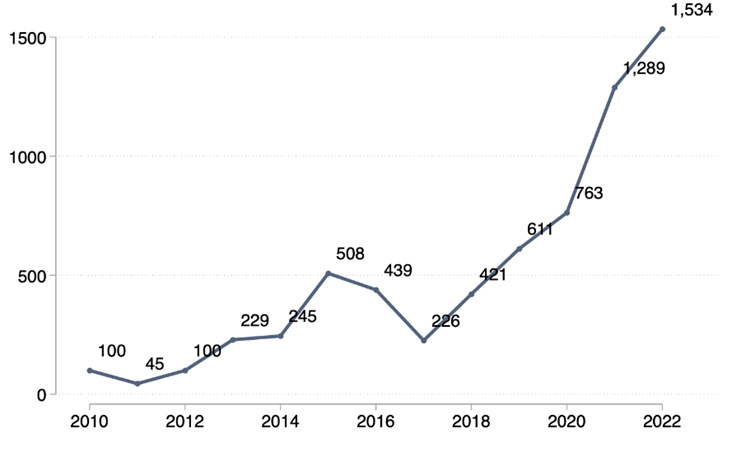
Figure 1: New announcements of industrial policy activity (2010=100%)
The global prevalence of industrial policy
Our analysis reveals new insights about current industrial policy practice, showing why a systematic approach to measurement matters. First, our results suggest that industrial policy is common, accounting for about half of the policies we are able to classify. When countries enact policies that affect domestic and foreign interests differently (the criteria for inclusion in the Global Trade Alert), they often do this because they want to change the composition of what is produced domestically–that is, for industrial policy objectives. Not only is industrial policy common, but it has risen markedly since the 2010s. Figure 1 suggests that announcements of national industrial policy activity (measured as policy counts) have increased more than tenfold since 2010. Like it or not, industrial policy is a regular feature of the global economic landscape, and increasingly so. After decades on the margins of academic research, this finding alone underscores the need for more systematic, evidence-based study of industrial policy.
Another insight from our analysis is that industrial policy practice today differs substantially from conventional wisdom. Unlike its traditional emphasis in development economics, we find that advanced economies account for the vast majority of industrial policy activity in recent years. Figure 2 suggests that countries in the top quintile of the income distribution deploy substantially more industrial policies on average than those in the bottom quintile.
Figure 2: Industrial policy activity by income quintile 2010-2022
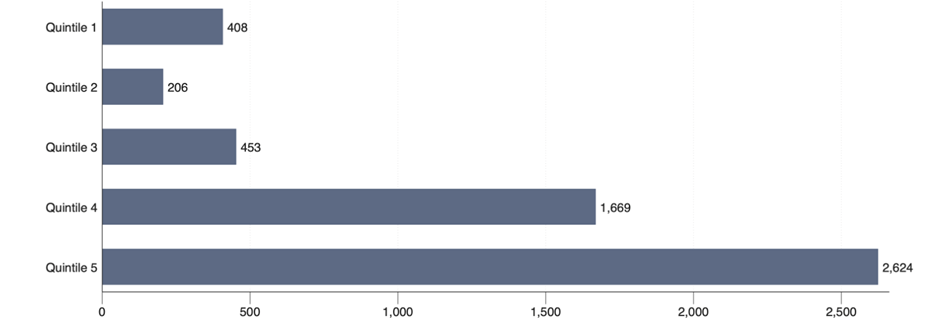
Notes: Quintile 1 contains countries in the lowest income quintile; quintile 5 contains countries in the highest income quintile.
Global trends in industrial policy
The dominance of industrial policy activity in rich countries may partly be explained by another finding: most policy today—in rich and poor countries alike—is deployed using fiscally and administratively intensive instruments like subsidies and export-related measures such as trade financing. If doing modern industrial policy requires high levels of state capacity, it makes sense that rich countries are those best placed to make use of it. Moreover, relative to a large evidence base that examines the use of tariff policy for industrial policy (e.g. Harrison and Rodríguez-Clare 2010), we find that most tariffs are not used for industrial policy purposes, and tariffs are not the instrument of choice for most modern industrial policy even in poor countries. Further, the relative importance of export-related instruments over import tariffs shows that modern industrial policy is more outward looking and less protectionist. While recent episodes (tariff escalation and President Trump's tariffs) harken back to earlier eras, in general, contemporary industrial policy practice looks far different than import-substituting industrialisation (ISI) and protectionist approaches of the past.
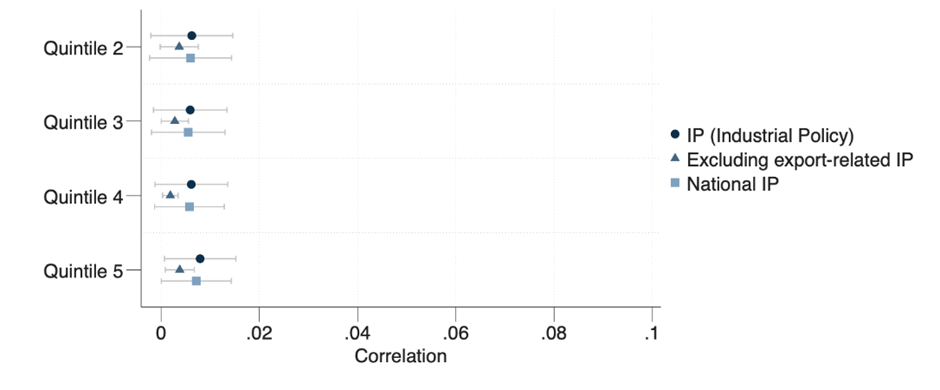
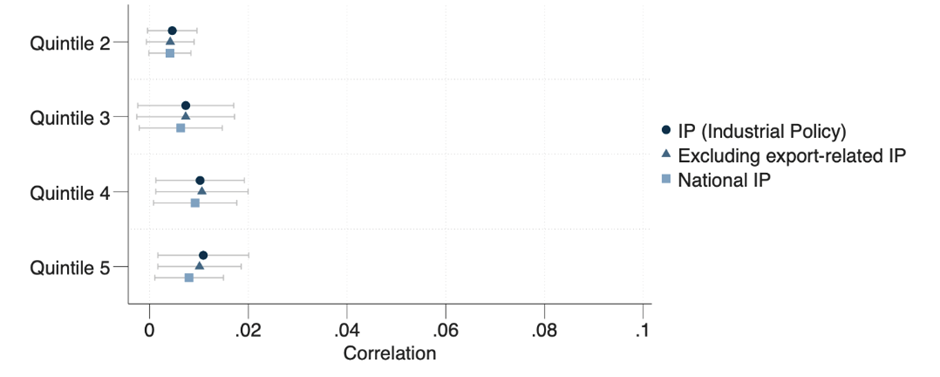
The typical sector targeted by industrial policy also challenges conventional wisdom. Theories of infant industry promotion suggest that industrial policy should defy comparative advantage—that is, governments should target nascent sectors in which a country does not (yet) have a dominant presence. In contrast, we find that new industrial policies typically target sectors in which a country already has a comparative advantage. This pattern, however, is completely driven by advanced economies. In Figure 3, we split countries into different quintiles of the income distribution (Panels a-c) to examine the pattern of targeting by income level. We order countries’ sectors based on their measured (revealed) comparative advantage and test for systematic differences in targeting. In rich countries, we see that sectors with a stronger existing international presence (i.e. sectors in higher quintiles of the revealed comparative advantage distribution) are much more likely to receive new industrial policy support than sectors with a weaker international presence. This pattern of targeting does not appear in lower income countries.
Figure 3. Industrial policy targeting of sectors, by income group
Panel A: Low-income countries
Panel B: Middle-income countries
Panel C: High-income countries
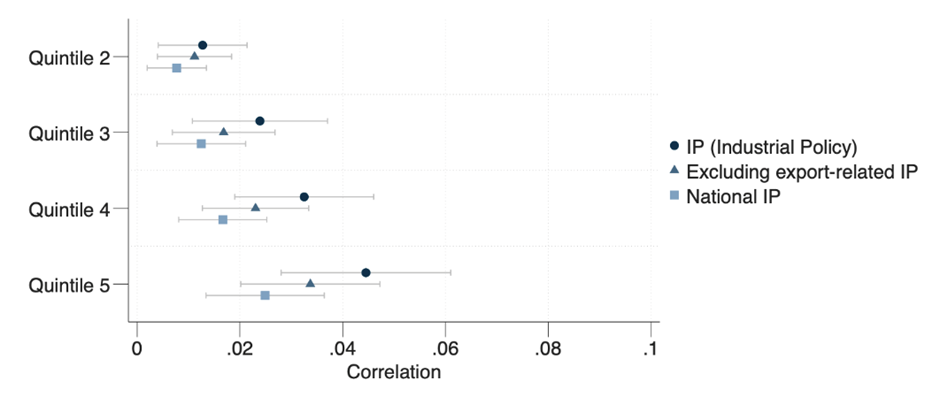
Notes: Quintile 1 contains a country’s worst performing sectors (lowest revealed comparative advantage); quintile 5 contains a country’s best performing sectors. ‘Excluding export-related IP’ drops industrial policies that are export-related; ‘National IP’ excludes industrial policies that target only specific (typically individual) firms.
Lessons for developing countries on industrial policy
These findings raise several important questions for the developing world. While it seems clear that the age of laissez-faire economic policy is over (though whether rich countries ever really practiced what they preached remains an open question), this new world poses distinct challenges for developing countries. If modern industrial policy is expensive and administratively complex, developing countries have much more limited space to manoeuvre. Any effort to reform the current trading system needs to account for this reality. Moreover, poor countries should be wary of emulating policy practice from advanced economies. Encouragingly, less fiscally intensive forms of industrial policy have successfully been pioneered in middle-income countries (Ghezzi 2017).
Second, the fact that much industrial policy is outward looking suggests that globalisation and industrial policy are not mutually exclusive. The use of trade-related investment measures and foreign direct investment (FDI) for industrial policy suggests that countries—including developing ones—have engineered policies that are complementary to global economic integration. Leveraging FDI in combination with industrial policy as an engine of development is one example that developing countries have pioneered (Bai et al. 2024), and one strategy that advanced economies may be looking to emulate (Politico 2024).
Finally, understanding the pattern of targeting merits further work. Why do rich countries target their best-performing sectors, and why does targeting not follow this pattern in poor countries? One possible explanation is that industrial policy should not defy comparative advantage, but, to the contrary, should target sectors in which a country already has an established international presence (Lin and Chang 2009). Moreover, in R&D intensive sectors such as semiconductor manufacturing, maintaining a competitive edge may require continued industrial policy support. As R&D intensive sectors are more prevalent in advanced economies, this may explain differences in targeting. Of course, policy practice may not be driven by economics. An equally plausible explanation for targeting may be that superstar exporters can effectively lobby for industrial policy support. Yet, like many aspects of industrial policy practice, these are open questions. More data and more careful work are needed to answer them.
References
Bai, J, P J Barwick, S Cao, and S Li (2020), “Quid pro quo, knowledge spillover, and industrial quality upgrading: Evidence from the Chinese auto industry”, Unpublished manuscript.
Evenett, S J, and J Fritz (2022), "The Global Trade Alert Database Handbook", Global Trade Alert.
Ghezzi, P (2017), “Mesas ejecutivas in Peru: Lessons for productive development policies”, Global Policy, 8(3): 369–380.
Harrison, A, and A Rodríguez-Clare (2010), “Trade, foreign investment, and industrial policy for developing countries”, in Handbook of Development Economics, 5: 4039–4214.
Juhász, R, N Lane, and D Rodrik (2023), “The new economics of industrial policy”, VoxEU.
Juhász, R, N Lane, E Oehlsen, and V C Pérez (2025), “Measuring industrial policy: A text-based approach”, Unpublished manuscript.
Lin, J, and H-J Chang (2009), “Should industrial policy in developing countries conform to comparative advantage or defy it? A debate between Justin Lin and Ha-Joon Chang”, Development Policy Review, 27(5): 483–502.
Politico (2024), “Europe gives China a taste of its own trade medicine”.