



What do we know about the methods, funders and focus of development economics research?
Shaping the direction of development research first requires understanding the current contours of the discipline. Recently, there have been vociferous debates about the questions development economists should be working on. Or, as an economist would say, is our current collective allocation of effort within the discipline optimal?
As economists, we should base this debate on empirical evidence documenting what development economists are actually publishing. To track this systematically, I built an AI-assisted coding pipeline to identify development papers published in top general-interest journals between 2021 and 2025, supplementing this with the full set of papers published in the Journal of Development Economics (JDE).
For general-interest journals, a script classified each paper as development using journal codes and/or whether any names of low- or middle-income countries were identified in the title or abstract. I then used additional coding pipelines to identify papers that report randomised trials, and to categorise papers based on a primary and secondary topic of interest (as well as a country site). The full coding pipeline is public, and it yielded a sample of 1,600 development papers over five years.
Headline findings on development economics research
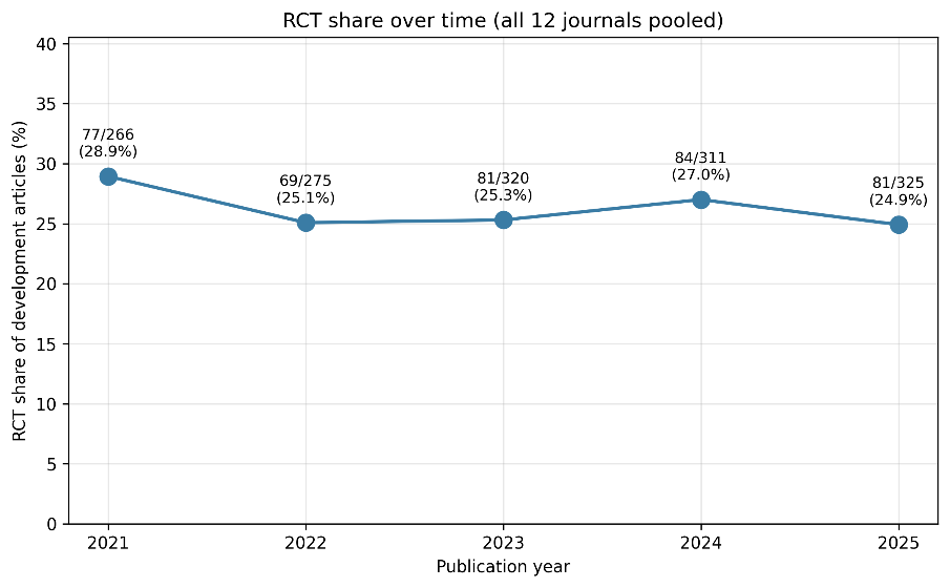
In terms of methodology and topic, we find that RCTs comprise 25% of the sample, a share that holds fairly steady in this five-year period. It is somewhat higher than earlier estimates; for example, in 2015, David McKenzie found that the percentage of RCTs was under 20%, suggesting there has been some growth over time. However, this growth seems to have stalled at its current level. The highest representation of RCTs is observed in AEA family journals (though it never exceeds 45%), the percentage of RCTs in the JDE is 25%.
Figure 1: RCT share by journal, 2021–2025
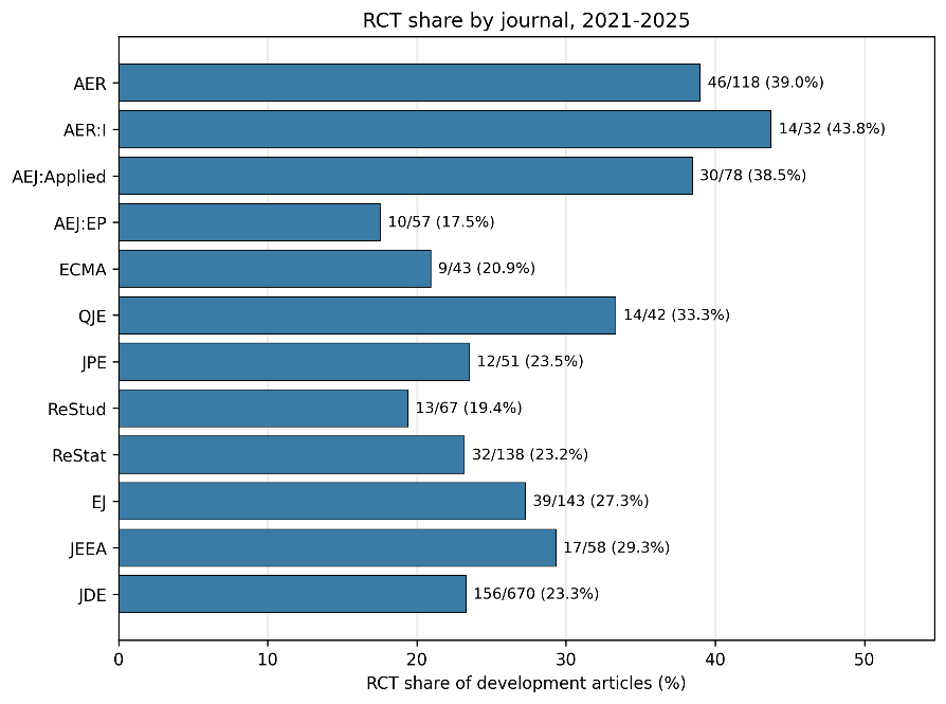
Figure 2: RCT share over time (all 12 journals pooled)
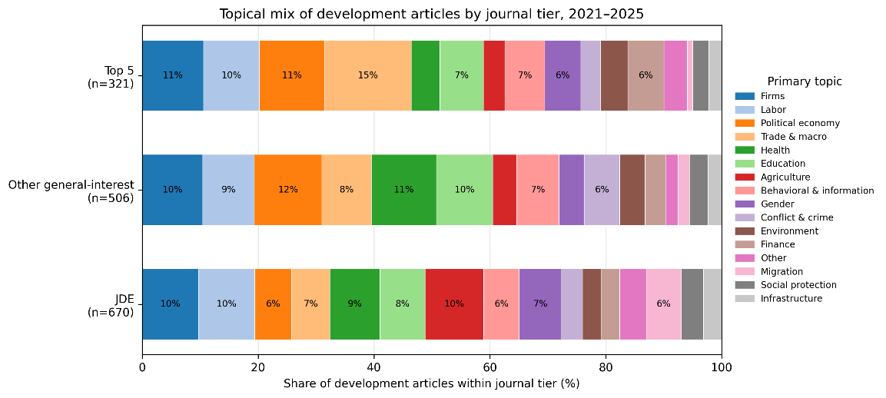
The single most common topic is firms, followed by labour, political economy, behavioural economics, and trade/macro, with health, education, and agriculture outside the top five. The topic mix is broadly consistent across journal tiers, with two exceptions: macro and trade are notably more prevalent in top-five journals (15%) than in other journals, especially the JDE (7%), while agriculture is more common in the JDE (10%) than in general-interest journals (under 5%).
It is also important to note, however, that this analysis does not include other field journals that would plausibly be preferred publication outlets for papers primarily focused on development macroeconomics or trade, and thus there is some mechanical underestimation. For example, in the same 2021–2025 period, AEJ: Macro and the Journal of Macroeconomics published an estimated 69 development macro papers (identified as development using the same logic described above, including JEL codes or the reference to any developing country in the title or abstract); this would imply a total development macro sample (summed with the 135 papers below) over 200, rendering this by far the largest topic represented. Obviously, the precise sample of journals is inevitably somewhat arbitrary: even the above analysis does not include the Journal of International Economics (frequent home of trade papers), and there are also other field journals that might publish more micro-oriented papers about low- and middle-income countries (e.g. Journal of Labor Economics, Journal of Public Economics). But it seems plausible to conclude overall that while development macro papers might be underrepresented in certain development field journals and the top five, the overall absolute number is not notably low; they’re just published elsewhere.
Figure 3: Development articles by topic (weighted), 2021–2025 (n=1,497)
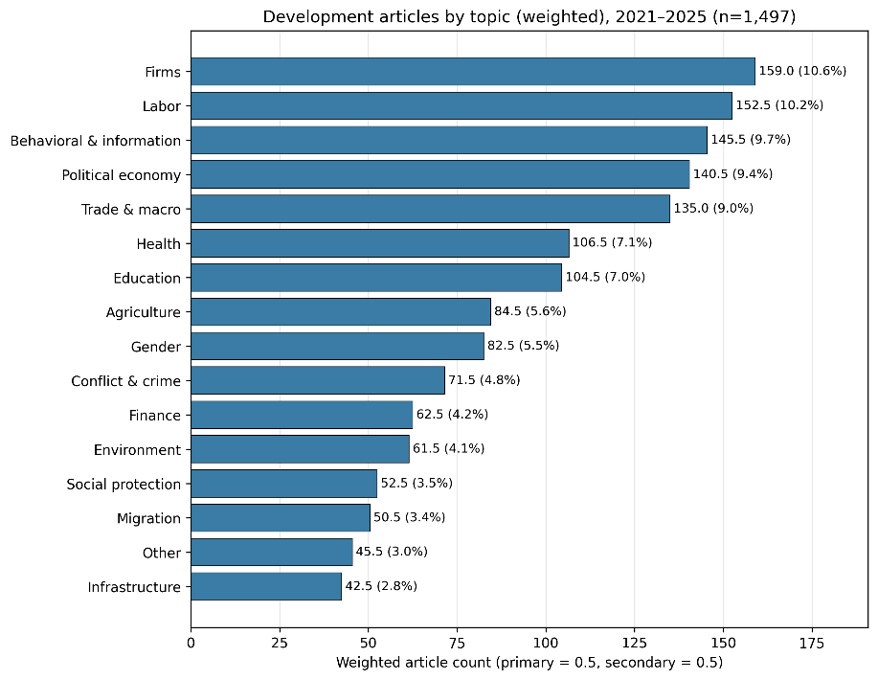
Figure 4: Topical mix of development articles by journal tier, 2021–2025
Who funds RCTs in development?
Using my sample, another AI-assisted script pulled information from funding acknowledgments (generally extracted from the full text, though in some cases, some funding information is recorded in metadata). Many RCTs cite multiple funding sources and, if so, they are weighted equally (it’s generally impossible to assess if there is, for example, a primary funder and a top-up funder, or the relative contribution of each). The funder names were then harmonised to enable aggregation.
Two important caveats: first, for research funders that themselves are aggregating and re-distributing funding (such as 3ie, J-PAL, etc.), this method is not effective in identifying the ‘ultimate’ source of the funds – a source that may or may not be identifiable given public information. Only the acknowledged funder can be reported. Second, this information is not extracted for non-experimental papers (despite the fact that some may report research funding).
Within the 392 RCTs, virtually all (360) report a funder, and there is high dispersion (612 distinct funders). This may partly reflect different names employed, even given attempts at harmonisation – funding acknowledgments are messy! The first graph shows the top 22, with J-PAL topping the list at 56 (aggregating across all J-PAL initiatives cited), followed by the World Bank and then FCDO and USAID who are nearly tied. USAID, of course, is no longer funding RCTs.
Figure 5: Most common funders of development RCTs, 2021–2025
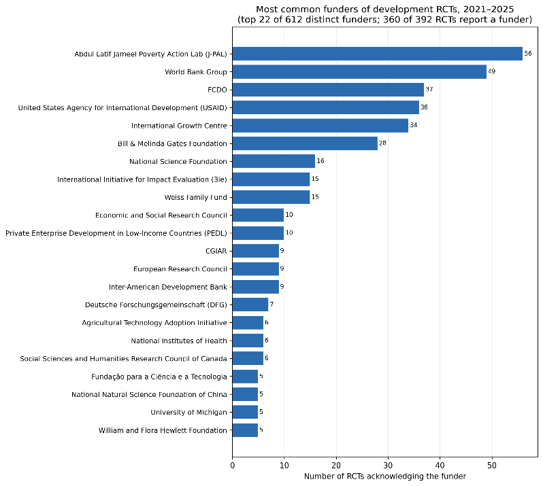
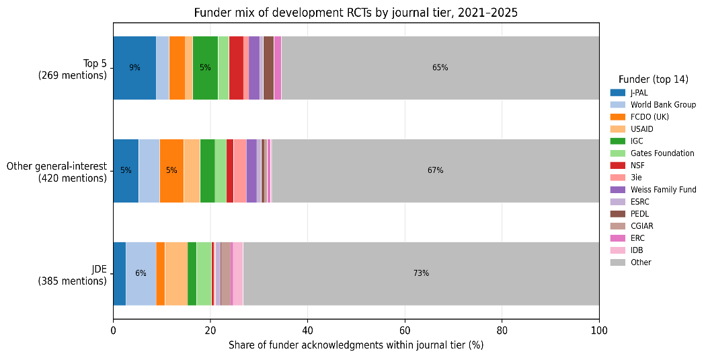
If FCDO is aggregated with IGC and PEDL – substantially funded by FCDO – that would be 82 RCTs, substantially outstripping all other funders. Importantly, there is only one funder here that is based in a low- or middle-income country (the National Natural Science Foundation of China). If we examine funders across journal tiers, J-PAL is even more dominant in papers published in top five journals, with IGC also overperforming. The World Bank, USAID, and the Gates Foundation are overrepresented in the Journal of Development Economics. But given the high level of dispersion, smaller funders dominate in all three categories (see the final graph). Going forward, harmonising the process of funder acknowledgments would be an extremely useful step to enable more systematic tracking of funder engagement in knowledge production.
Figure 6: Funder mix of development RCTs by journal tier, 2021–2025 (restricted to the 22 most common funders)
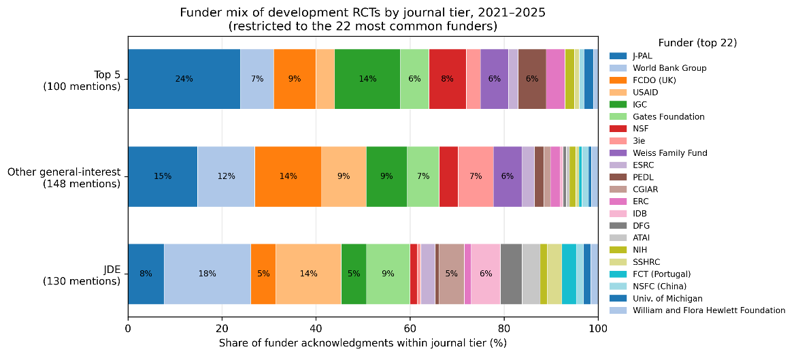
Figure 7: Funder mix of development RCTs by journal tier, 2021–2025
What can we conclude from this?
Development economics is an incredibly diverse discipline, and there is little evidence it is heavily tilted toward randomised trials, or the traditional micro-development topics (health, education, and gender). Certain funders are clearly influential in shaping the landscape of published RCTs, with J-PAL, the World Bank, and FCDO and its funded research networks playing a leading role; but there is also high dispersion in funding sources, suggesting limited scope for dominance by a single funder.