






Industrial clusters can fuel economic booms today, but can also trap cities into tomorrow's decline. Evidence from two centuries of British cities reveals the lasting costs of specialisation.
Economic activity naturally clusters in space. Densely populated regions tend to be more productive, offering higher wages and more innovation (Melo et al. 2009). Due to local comparative advantages, this spatial concentration often comes with industrial specialisation, with local economies further benefiting from returns to scale (Ciccone 2002). This success tempts policymakers to accelerate the process in order to ‘build the next Silicon Valley’. Yet, as Duranton (2011) cautions, top-down cluster schemes and 'beauty contests' to attract flagship firms and industries rarely succeed when such investments are not anchored by universities, transport, housing supply, or natural advantages.
There is another risk to the spatial and industrial clustering of activity: the long-run cost of overspecialisation. Two effects may operate. First, industries have life cycles. Cities that tie their fate to a single sector through specialised infrastructure or skills thrive while that industry grows, but falter when it fades. By putting all eggs in one basket, specialisation increases future exposure to sectoral decline. Second, cross-industry spillovers foster long-run dynamism. Examples include skilled workers moving between related industries and bringing expertise with them, innovations in one sector finding unexpected applications in another, or suppliers serving multiple industries and spreading best practices across them. Urban diversity as a source of productivity gains was first articulated by Jacobs (1961, 1969) in her landmark and influential book, The Death and Life of Great American Cities. Lucas (1988) brought this insight into modern economic analysis via knowledge spillovers, and Glaeser et al. (1992) popularised the term ‘Jacobs’ externalities’ to capture cross-industry spillovers (Cai and Li 2019) and productivity gains from diversity.
A long view of British cities
Britain offers a textbook case of these forces at work. In the early 1800s, the country’s economic geography was still dominated by small settlements and cottage industries. Over the course of the nineteenth century, these evolved into an interconnected network of industrial cities. These cities specialised in their industries of comparative advantage, following the rapid rise in domestic and international trade – fostered by policy (Heblich et al. 2024) and transportation improvements. A century later, Britain faces stark regional inequalities and many stagnant cities (Swinney 2021). Are Jacobs’ externalities behind the death and life of great British cities?
To quantify the consequences of past specialisation, one needs detailed, long-run geographic data on the early growth and specialisation of agglomerations. We address these questions by delineating early urban footprints from circa 1800 maps and tracking future towns and cities of England and Wales from the early 1800s through the Industrial Revolution to the present (Heblich, Nagy, Trew, and Zylberberg 2025). Our empirical strategy relies on two separate exogenous sources of variation:
- An exogenous driver of city growth over the 19th century: natural fragmentation in land parcels around early settlements.
- Historical sources of specialisation: the nature of initial cottage industries interacted with changes in external demand.
We also control for an extensive set of confounders: first- and second-nature geography, transport access, market access, agricultural conditions, and the role of specific industries.
The long shadow of specialisation
Industrial concentration causes long-run decline. Cities that had higher industrial concentration in 1881 perform worse today, even when we take account of industry trends: a one standard deviation increase in 19th-century industrial concentration costs around 4.5 percentage points more unskilled employment, 34% lower returns to labour, and 30% lower firm productivity.
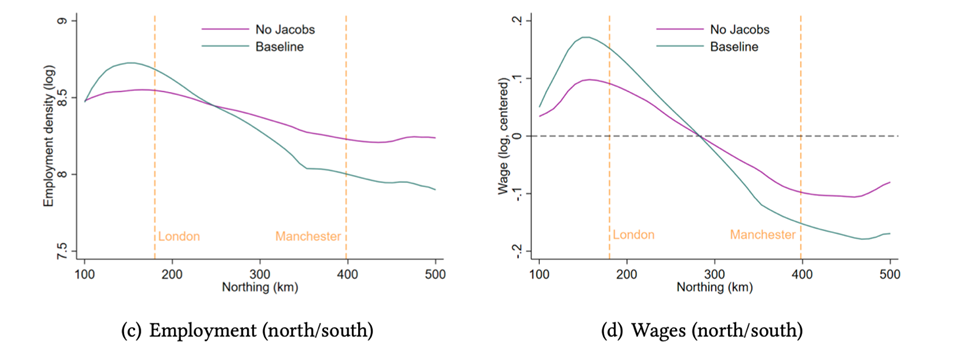
We quantify the implications of such Jacobs’ externalities with the help of a model that tracks how cities and industries evolve over time. The best way to visualise the effects of past concentration is to project England and Wales on a North-South line and study the North-South profiles of employment density and wages (Figure 1). Moving from London towards Manchester, the current economy of England and Wales shows a pronounced gradient. We use the model to simulate England and Wales in the absence of long-run Jacobs’ externalities, i.e. in the absence of cross-industry spillovers that favour more diverse cities, and trace how employment and wages reallocate across 435 British cities.
In this scenario, historically diverse places lose ground: a city in the 20th percentile of 1881 concentration would have around 25% and 20% lower employment and wages, respectively, than at baseline. Historically specialised places gain: a city in the 80th percentile expands, with wages rising by roughly 12%. Spatially, this reallocation compresses the North-South gradient: the wage gap between London and Manchester falls from 35% to around 20% – a 40% decrease. In short, eliminating Jacobs’ externalities shifts activity towards nineteenth-century specialisers and materially narrows regional disparities, indicating that a significant share of today’s inequality reflects the long-run imprint of past industrial concentration.
Figure 1: The impact of long-run Jacobs’ externalities
The trade-offs of industrial concentration: Growth today or resilience tomorrow?
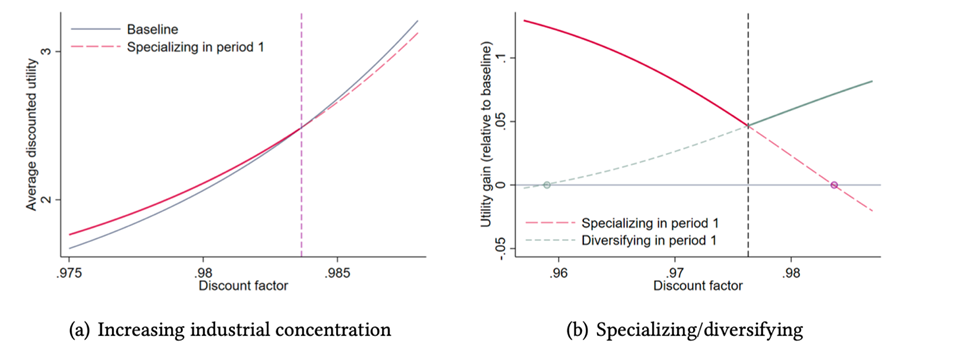
These large externalities imply a clear trade-off between the short- and long-run effects of industrial concentration. We formalise this trade-off by introducing a stylised policy perturbation of city-industry productivity: for each city, initial productivities are reweighted around the city mean. Policymakers have the choice between an emphasis (i) on comparative advantages and specialisation or (ii) on diversification. Taking present-day England and Wales as the initial state, we resolve equilibrium allocations and compute welfare over two generations under the assumption of 2.1% annual growth – the historical average over the past 60 years. We cast this intertemporal policy trade-off in Figure 2, showing the effect of specialisation- or diversification-inducing policies as a function of the discount factor. We see that the welfare curves cross at intermediate discount factors, making explicit that the preference between specialisation and diversification pivots with time horizon preferences. The crossing arises because specialisation raises current welfare in period 1 but increases the present discounted value of the costs from concentration in period 2, whereas diversification does the converse.
What does it mean for optimal policy? When decision-makers place a large weight on present outcomes, a specialise-now strategy yields higher welfare. As the planner becomes more patient, the ranking flips and diversify-now dominates. The best policy thus depends on the discount rate used in public investment appraisals. With discount rates above roughly 4% annually (below a discount factor of 0.96), only specialisation delivers higher net benefits. With rates below 1.6% (a discount factor above 0.984), only diversification dominates. At discount rates between 1.6% and 4%, both policies can improve welfare.
Figure 2: Policies affecting local industrial concentration
Lessons for developing economies
Do these lessons travel beyond Britain? The same mechanics – industry life cycles, exposure to sectoral shocks, and cross-industry spillovers – operate in today’s emerging economies, even if their institutions and industrial structures differ from Britain’s historical experience. Applying our evidence to these developing contexts suggests several regularities:
- Early specialisation can yield large payoffs when complementary fundamentals are in place: skilled workers, reliable transport, access to markets, and flexible land supply (Duranton 2011). In such settings, the benefits of specialisation can diffuse through input-output linkages (Jones 2011, Lane 2025), making concentration a practical entry point for structural transformation (Heblich et al. 2022).
- The longer-term risk of lock-in increases where university-industry links are narrow, skill formation is sector-specific, and supplier networks are thin (Glaeser 2005, Heblich et al. 2022).
- What might matter is not only how much cities specialise, but in what. Is concentration in digital services or finance as risky in the long run as specialisation in ceramics or textiles once was? This question is particularly relevant today, as many fast-growing cities in developing countries expand through services and construction rather than manufacturing (Henderson and Turner 2020). Our findings suggest that service-based clusters face only slightly weaker long-run losses than manufacturing ones. Moreover, technological shocks, such as automation, can affect service industries as much as factory jobs.
Taken together, the British experience offers a cautionary tale: industrial concentration can power rapid early growth, but sustaining prosperity depends on the strength of Jacobs externalities – and on how easily local economies can recombine their capabilities when the world changes.
References
Cai, J, and N Li (2019), “Growth through inter-sectoral knowledge linkages,” Review of Economic Studies 86(5): 1827–1866.
Ciccone, A (2002), “Input chains and industrialization,” Review of Economic Studies 69(3): 565–587.
Duranton, G (2011), “California dreamin’: The feeble case for cluster policies,” Review of Economic Analysis 3(1): 3–45.
Duranton, G, and D Puga (2023), “Urban growth and its aggregate implications,” Econometrica 91(6): 2219–2259.
Glaeser, E L, H D Kallal, J A Scheinkman, and A Shleifer (1992), “Growth in cities,” Journal of Political Economy 100(6): 1126–1152.
Glaeser, E (2005), “Reinventing Boston: 1630–2003,” Journal of Economic Geography 5: 119–153.
Glaeser, E, and M Resseger (2010), “The complementarity between cities and skills,” Journal of Regional Science 50(1): 221–244.
Heblich, S, S J Redding, and Y Zylberberg (2024), “The distributional consequences of trade: Evidence from the Grain Invasion,” Unpublished manuscript.
Heblich, S, D K Nagy, A Trew, and Y Zylberberg (2025), “The death and life of great British cities,” Unpublished manuscript.
Heblich, S, et al. (2022), “Industrial clusters in the long run: Evidence from Million-Rouble plants in China,” Unpublished manuscript.
Henderson, J V, and M A Turner (2020), “Urbanization in the developing world: Too early or too slow?,” Journal of Economic Perspectives 34(3): 150–173.
Jacobs, J (1961), The Death and Life of Great American Cities, Random House.
Jacobs, J (1969), The Economy of Cities, Vintage.
Jones, C I (2011), “Intermediate goods and weak links in the theory of economic development,” American Economic Journal: Macroeconomics 3(2): 1–28.
Lane, N (2025), “Manufacturing revolutions: Industrial policy and industrialization in South Korea,” Quarterly Journal of Economics, qjaf025.
Lucas, R E Jr (1988), “On the mechanics of economic development,” Journal of Monetary Economics 22(1): 3–42.
Melo, P C, D J Graham, and R B Noland (2009), “A meta-analysis of estimates of urban agglomeration economies,” Regional Science and Urban Economics 39(3): 332–342.
Swinney, P (2021), Is London Too Successful? Centre for Cities.