

Maha Rehman
PhD student in Applied Economics
Maha Rehman is a fourth-year Ph.D. student in Applied Economics at Cornell University, where she studies how firms respond to economic disruptions and shocks. Her research investigates how frictions such as infrastructure failures, financial constraints, and weak state capacity shape firm adaptation, resource reallocation, and long-run productivity in developing economies.
She works across two related streams: one on shock-induced misallocation and another on behavioral responses during crises, both anchored in policy-relevant design. Her recent work shows that when firms anticipate limited government support, they rationally over-adapt by substituting public goods through costly self-provisioning. This behavior undermines long-term productivity and resilience. She formalises this mechanism in a model of adaptive misallocation, where policy uncertainty drives over-investment in short-term defensive strategies, distorting capital allocation and entrenching inefficiency.
Methodologically, Maha combines experimental and quasi-experimental designs with tools from empirical industrial organization to identify institutional inefficiencies and misaligned incentives. These empirical insights inform economic theory and help design scalable reforms that improve industrial resilience and policy delivery—especially in South Asia.
Recent work by Maha Rehman
-
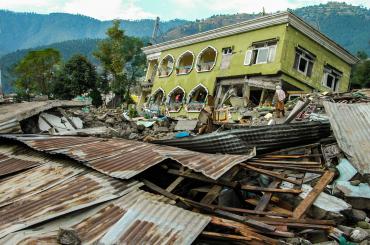
Adapting under uncertainty: How firms misallocate resources after disasters
When firms expect little help from the state, they over-adapt to shocks at the cost of long-term growth.

Published 29.08.25