



Can discretion in corrupt bureaucracies reward talent? Evidence from Pakistan’s civil service suggests merit can prevail—when incentives align.
Editor’s note: For a broader synthesis of themes covered in this article, check out our VoxDevLit on Bureaucracy.
In many developing countries, bureaucracy is synonymous with patronage and corruption. Promotions are assumed to go to those with the right connections, not necessarily those with the right abilities. Conventional wisdom holds that the solution is to reduce discretion in bureaucracies and rely on rule-based promotions. But can discretion ever be harnessed for better outcomes? In low-corruption settings, discretion has been shown to improve leader selection (Voth and Xu 2022). However, this is rarely the case in developing countries, where entrenched corruption norms (Fisman and Miguel 2007) and pervasive patronage undermine bureaucratic effectiveness.
In new research (Aman-Rana 2025), I examine the Pakistan Administrative Services (PAS) in Punjab, a highly selective civil service operating in a context of high corruption and limited transparency, to assess whether discretion in promotions allows senior officials to reward ability or favour social ties.
The impact of senior influence on fast-track promotions for bureaucrats
The PAS is a small but powerful cadre of civil servants who occupy top federal and provincial roles, managing districts and large government departments. Their performance significantly shapes how over 230 million citizens experience public services.
While rule-based promotions exist, fast-track promotions provide a discretionary path often secured through referrals or direct requests by senior bureaucrats to top officials. Within the bureaucracy, the belief that “seniors who worked with you early in your career will look after you” is widespread (Ali 2022, p. 740). This dynamic makes early-career connections, especially with influential seniors, critical for advancement. Indeed, I find empirically that as officers advance, juniors connected to powerful seniors from their first assignments tend to progress faster than peers without such connections (Figure 1).
Figure 1: Fast-track promotions and power of potential seniors
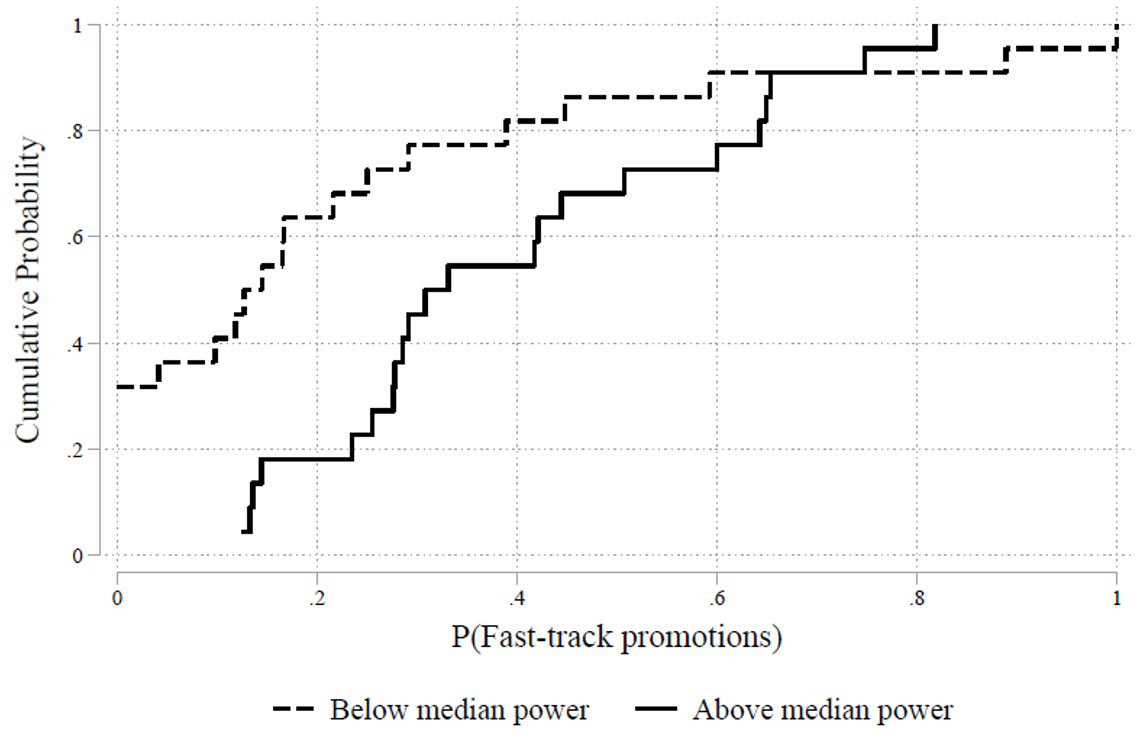
Notes: The figure illustrates the cumulative distribution function of fast-track promotions of junior bureaucrats whose potential seniors (explained below) have above vs. below median power.
Studying discretionary promotions in Pakistani bureaucracy
Identifying the causal effects of discretionary promotions is challenging. Senior officers are not randomly assigned to juniors, and the rise of seniors and their discretion may itself be endogenously shaped by unobserved factors such as political networks affecting both senior and junior promotions. Moreover, measures of the ability of junior bureaucrats and their social ties with senior officials may correlate with omitted variables affecting career outcomes.
To address this, I use an instrumental variables approach combined with difference-in-differences. I use the power of potential seniors, defined as the average theoretical rank of potential seniors that a given cohort of juniors could have worked with in their first post, as an instrument for seniors’ power. Under government rules, new recruits receive their first post when a vacancy arises or after an incumbent serves one year. Exploiting this rule, I define potential seniors as bureaucrats stationed in districts with open positions when a junior cohort begins its first posting. I observe potential seniors from hand-collected and digitised incumbency board data on vacancies and tenures, as well as career records of bureaucrats. I then combine this cross-sectional variation in potential seniors with a theoretical time variation in their power or discretion based on rules. While the instrument helps to overcome the endogeneity of power of seniors, the differences-in-differences strategy that compares the career trajectories of high- and low-ability (social ties) juniors in cohorts with more and less powerful potential seniors, helps to net out the effects of any omitted variables that may be correlated with ability (social ties) and affect promotions.
To measure junior bureaucrats’ ability, I digitised their tax collection performance in their first job. Unlike social ties, measured through shared hometowns, tax-based ability is significantly correlated with other service delivery indicators, suggesting that in this setting performance-based promotions would be more meritocratic.
Importantly, while juniors manage key revenue tasks, their individual performance–a strong early signal of team-management ability–is visible to senior officials but is not centrally tracked, formally recorded in career files, or used in promotion decisions. This creates a unique setting to study discretion: senior bureaucrats hold private information about junior performance that the formal system does not observe, allowing us to examine whether discretion is used to reward ability or social ties.
Discretionary promotions are based on merit, not social ties
Results show that despite the high corruption and low transparency context, discretionary promotions are meritocratic. As a senior’s power increases, juniors with above-median tax collection performance are fast-tracked at a higher rate than those who are below median. These effects are statistically significant and economically meaningful (30% of the mean of fast-track promotions). In contrast, social ties are statistically and economically insignificant predictors of promotions (see Figures 2a and 2b). Given that tax-based ability better predicts service delivery than social ties, these results suggest that discretion can improve talent allocation within the bureaucracy.
Figure 2a: Tax-based ability and careers of juniors by power of potential seniors
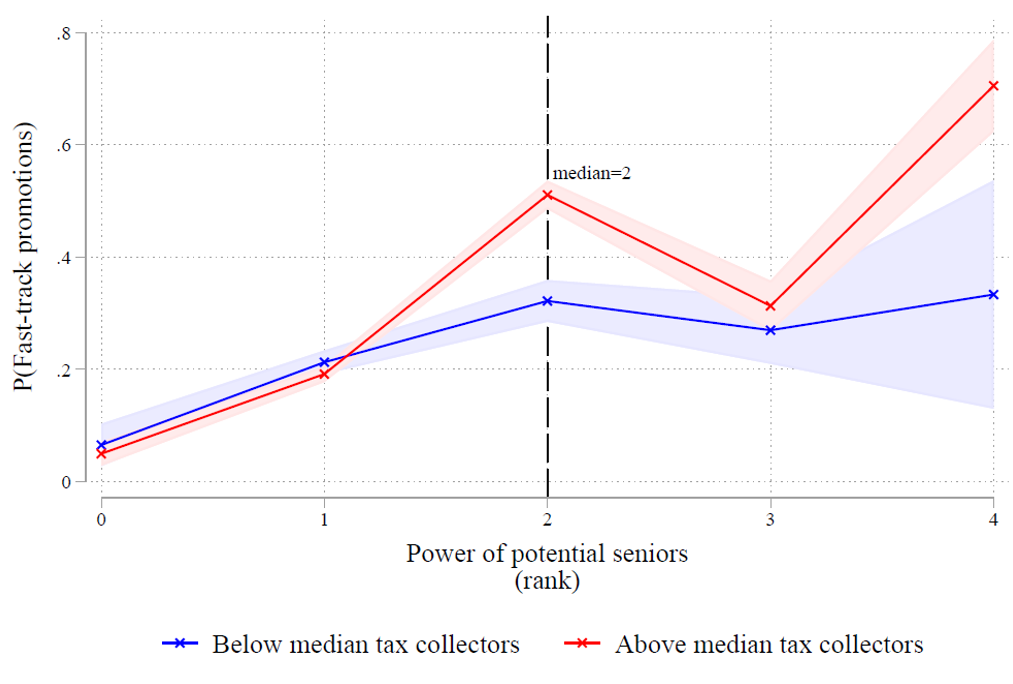
Notes: The figure plots the average probability, along with confidence intervals, of fast-track promotions for below-median tax-collecting juniors (blue) and above-median tax collectors (red), based on the power of potential seniors.
Figure 2b: Social ties and careers of juniors by power of potential seniors
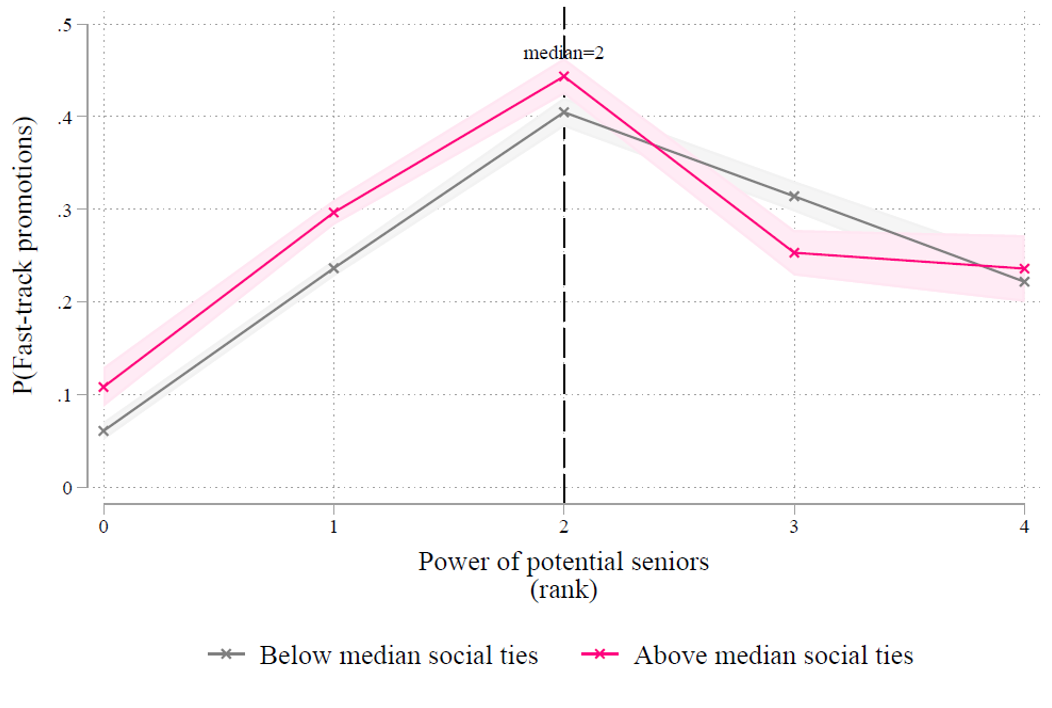
Notes: The figure plots the average probability, along with confidence intervals, of fast-track promotions for below-median social ties juniors (grey) and above-median social ties (pink), based on the power of potential seniors.
Unpacking the nuances: Reputational concerns may driver meritocratic behaviour
Given the broader evidence on bureaucracies in developing countries, which emphasises the role of patronage and personal connections in human resource allocation, it is striking that senior officials appear to favour high-ability individuals over those with whom they enjoy social ties. This is particularly striking in the context of Pakistan, which ranks well below average on the 2019 Corruption Perception Index, scoring just 32 out of 100, indicating high perceived levels of public sector corruption.
Two potential mechanisms may explain these results. One possibility is that senior bureaucrats are driven by career incentives and seek to improve departmental performance by retaining and promoting only high-ability juniors. Alternatively, they may be concerned about their reputation when referring juniors to other senior officials, which would also motivate them to favour more capable individuals. I present evidence that reputation concerns, rather than career incentives, are the primary driver of meritocratic promotions.
To test this, I examine the long-run likelihood that a junior bureaucrat will work or be fast-tracked within two types of departments: (1) those where their initial senior colleagues are present, and (2) those where none of these original seniors are present. My results suggest meaningful differences in promotion patterns. Within departments where the original seniors remain, juniors with social ties to those seniors are more likely to be retained and fast-tracked. By contrast, as the original seniors gain more power, juniors with higher tax-based ability are more likely to be fast-tracked in departments where none of those seniors are present.
This variation suggests that meritocracy is not the norm; rather, promotion decisions reflect the incentives of those in charge. In particular, reputational concerns, when seniors are referring juniors to other bureaucrats, appear to play a key role in encouraging meritocratic behaviour.
Publicly observed ability of juniors does not affect discretionary promotions
I also examine whether publicly available signals of ability, like recruitment exam ranks, affect discretionary promotions. I find exam ranks do not predict bureaucratic performance (i.e. there is no correlation with key service delivery measures), indicating public signals of ability are not a substitute for private information. Moreover, as the power of seniors increases, exam rank has no significant impact on promotions, suggesting discretion favours privately observed performance over formal credentials. Understanding these trends is the first step to designing effective anti-corruption policy.
Implications for anti-corruption policy
While corruption and patronage remain persistent challenges, simply imposing rigid rules to limit bureaucratic discretion may be counterproductive. Such restrictions can reduce the flexibility needed to reward genuine talent, utilise decision-makers’ private information, and adapt to complex administrative realities. Instead, policymakers should aim to align bureaucrats’ incentives with organisational goals, fostering an environment where rewarding merit directly benefits decision-makers. For example, designing a system in which merit-based promotions enhance officials’ reputation and career prospects can help leverage discretion to improve governance and service delivery. Additionally, increasing job rotation or encouraging more frequent interaction between seniors and juniors can broaden the candidate pool for discretionary promotions, thereby rendering the discretion-based meritocracy more effective.
References
Ali, S A M (2022), “Networks of effectiveness? The impact of politicization on bureaucratic performance in Pakistan,” The European Journal of Development Research, 34(2): 733–753.
Aman-Rana, S (2025), “Meritocracy in a bureaucracy,” Journal of Development Economics, 175: 103428.
Fisman, R and E Miguel (2007), “Corruption, norms, and legal enforcement: Evidence from diplomatic parking tickets,” Journal of Political Economy, 115(6): 1020–1048.
Voth, J and G Xu (2022), “Discretion and destruction: Promotions, performance, and patronage in the Royal Navy,” Unpublished manuscript.