




A new long-term follow-up on a cash grant programme in Uganda shows that impacts partly reappear during crisis times, shedding light on the challenges of long-term RCTs.
Cash transfers have become a cornerstone of social protection efforts in low- and middle-income countries (Gentilini 2024). A recent meta-analysis of 115 randomised evaluations confirms the positive welfare effects of unconditional transfers, which consistently boost income and consumption (Crosta et al. 2025). But not all cash transfer programmes are created equal. Their long-term effectiveness can depend on how they are designed—whether transfers are conditional or unconditional, disbursed repeatedly or as a lump-sum, and who they target.
One of the most influential examples of a lump-sum transfer is Uganda’s Youth Opportunities Program (YOP), evaluated by Blattman et al. (2014, 2020) four and nine years after disbursement. Launched in Northern Uganda in 2008, the YOP programme offered young adults a one-time entrepreneurial grant of around US$380, labelled for vocational training and tools, but with no enforcement on its use.
The four-year evaluation documented significant short-run gains: recipients of the grant invested more in tools and training, shifted into skilled trades (e.g. carpenter, blacksmith, hairdresser), and earned higher incomes. However, a nine-year follow-up painted a more sobering picture (Blattman et al. 2020). While some structural changes remained—grant recipients had more assets and were more often engaged in skilled trades—the income and earning gains have ‘dissipated’, as the control group had eventually caught up by finding more profitable work over time.
Twelve years later: Cash grants helped men weather COVID-19
Our new research (Fiala, Rose, Aryemo, and Ankel-Peters 2025) builds on this, tracing YOP participants 12 years after the original intervention in July and September 2020, i.e. during the early months of the COVID-19 crisis. Before surveying over 1,600 original participants, using both phone and in-person interviews, we pre-specified three main outcomes: employment, income, and food security.
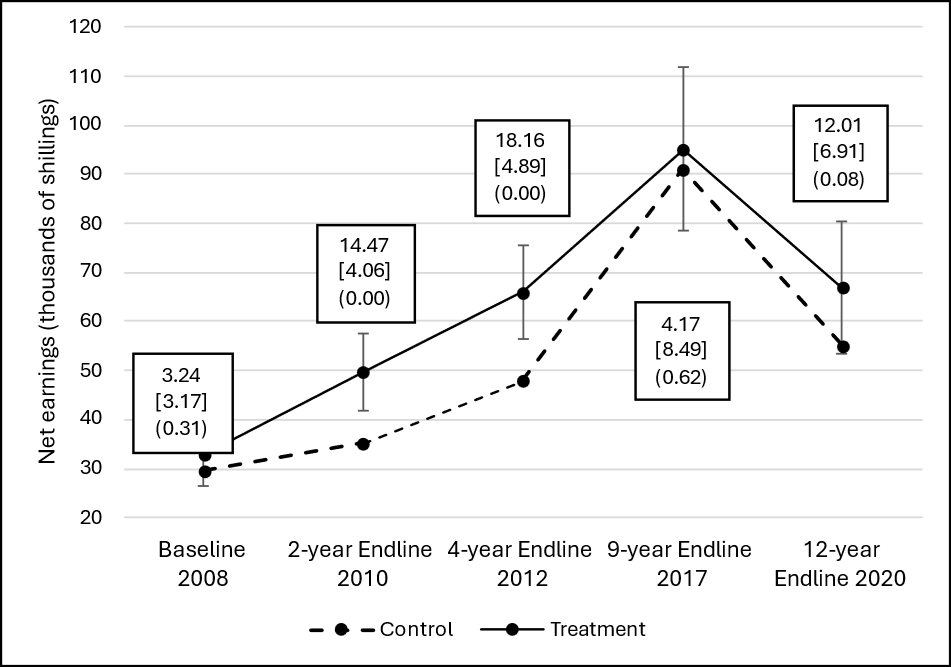
Figure 1 presents our main finding relative to previous evaluations. In the 12-year follow-up, grant recipients had 22% higher income than those in the control group; however, we found no employment effects. The income effect was entirely driven by men, who also reported higher employment levels. For women, we find no measurable long-term impacts. Nor do we observe lasting effects on food security for either men or women. While the income effect is economically large, it is borderline statistically significant at the 10% level. To assess robustness, in the paper we also conduct specification curve analysis (following Simonsohn et al. 2020), illustrating the sensitivity of the result to different analytical choices.
Figure 1: Progression of earnings across time
Timing matters for long-run evaluations
The resurfacing of these income effects after 12 years, following their nine-year disappearance, provide a trivial but important insight: long-run impacts can depend heavily on when the follow-up takes place. During stable economic times, treatment and control groups may converge; however, during shocks, underlying structural differences can resurface.
This finding echoes insights from Bouguen et al. (2019), which cautioned that long-run studies can miss such dynamics. Our finding also underscores the importance of interpreting null result findings cautiously. If researchers stop following up after null results, they risk overlooking potentially re-emerging effects. In the YOP case, the interpretation of the nine-year follow-up in Blattman et al. (2020) as a null result was mainly motivated by the lack of significant effects in income related variables, despite the indication for structural improvements in the treatment group in terms of skill and asset acquisitions as well as occupational shifts. Our findings should thus be interpreted with care, especially given the borderline significance of the main effects, which may well be contingent on the pandemic.
Implications for research focusing on the long-term
Our main findings go beyond the programme under evaluation, offering a warning to the emerging research on long-term impacts. First, our paper extends on the call for more (short-term) T in experiments (McKenzie 2012): without repeated observations over time, researchers risk drawing misleading conclusions, particularly for outcomes such as income and employment, which are highly sensitive to macroeconomic conditions beyond singular events like a pandemic. Second, there is risk of a specific type of publication bias if researchers only follow up on interventions with positive early results. Consider, for instance, Banerjee et al. (2015), a set of six RCTs, of which the most successful ones were examined for long-term effects (Rose et al. 2024). Such selection of RCTs that have proven successful in the shorter term, while neglecting those less promising, can skew our understanding of what works–leading to suboptimal policy decisions.
References
Banerjee, A, E Duflo, N Goldberg, D Karlan, R Osei, W Parienté, J Shapiro, B Thuysbaert and C Udry (2015), “A multifaceted program causes lasting progress for the very poor: Evidence from six countries,” Science, 348(6236): 1260799.
Blattman, C, N Fiala and S Martinez (2014), “Generating skilled self-employment in developing countries: Experimental evidence from Uganda,” The Quarterly Journal of Economics, 129(2): 697–752.
Blattman, C, N Fiala and S Martinez (2020), “The long-term impacts of grants on poverty: Nine-year evidence from Uganda’s youth opportunities program,” American Economic Review: Insights, 2(3): 287–304.
Bouguen, A, Y Huang, M Kremer and E Miguel (2019), “Using randomized controlled trials to estimate long-run impacts in development economics,” Annual Review of Economics, 11(1): 523–561.
Crosta, T, D Karlan, F Ong, J Rüschenpöhler and C R Udry (2024), “Unconditional cash transfers: A Bayesian meta-analysis of randomized evaluations in low and middle income countries,” Unpublished manuscript.
Fiala, N, J Rose, F Aryemo and J Ankel-Peters (2025), “Timing matters: The (very) long-run impacts of cash grants during a crisis,” Journal of Development Economics, 103447.
Gentilini, U (2024), “The history of cash transfers,” VoxDev.
McKenzie, D (2012), “Beyond baseline and follow-up: The case for more T in experiments,” Journal of Development Economics, 99(2): 210–221.
Rose, J, F Neubauer and J Ankel-Peters (2025), “Long-term effects of the Targeting the Ultra Poor program—A reproducibility and replicability assessment of Banerjee et al. (2021),” Q Open, 5(3): qoae031.
Simonsohn, U, J P Simmons and L D Nelson (2020), “Specification curve analysis,” Nature Human Behaviour, 4(11): 1208–1214.