






A government-led programme in North Macedonia combined wage subsidies with matching services to decrease long-term unemployment among vulnerable jobseekers. Experimental evidence indicates that the programme significantly improved formal employment in this population.
Subsidised employment programmes are a widely used active labour market policy aimed at tackling long-term unemployment. Yet evidence on their effectiveness, particularly in low and middle-income countries (LMICs), is limited and often discouraging. Prior studies have found little to no sustained employment impact beyond the subsidy period (Galasso et al. 2004, Groh et al. 2016, Levinsohn et al. 2014, McKenzie 2017). On the other hand, a growing body of evidence on active labour market policies in LMICs highlights the importance of reducing job search frictions (Abebe et al. 2021, Bassi and Nansamba 2022) and supporting skill development (Brown et al. 2024, Alfonsi et al. 2020, Crépon and Premand 2024). This raises critical questions about how wage subsidies should be designed to improve long-term employment.
Experimental evidence from North Macedonia provides an encouraging counterpoint. In a setting characterised by high structural unemployment, a programme that combined temporary wage subsidies with matching and screening services led to persistent improvements in formal employment.
North Macedonia’s subsidised employment programme
In 2015, North Macedonia’s unemployment rate stood at 28%, with youth unemployment surpassing 50% and over 80% of the unemployed remaining out of work for more than a year (World Bank 2023).
Against this backdrop, the Ministry of Labor and Social Policy introduced the ‘Subsidized Employment Program’ (SEP) to promote durable labour market participation. The programme offered employers a subsidy covering six months of wages and training costs, conditional on hiring eligible long-term unemployed individuals. Unlike voucher-based schemes that often create temporary employment spikes (De Mel et al. 2010, Levinsohn et al. 2014), SEP required employers to commit to at least 12 months of employment and prohibited substituting subsidised for existing workers.
Importantly, the programme matched jobseekers to specific vacancies based on skills and qualifications, addressing common frictions in LMIC labour markets where firms face high costs of screening and uncertainty about worker productivity (Lange 2007, Kahn and Lange 2014, Caria et al. 2024).
Using experimental design to study the subsidised employment programme
Our evaluation (Armand, Carneiro, Tagliati, and Xia 2025) focused on 153 jobseekers matched to 22 vacancies. These candidates were randomly assigned either to receive a job interview invitation for the vacancy they were matched to (treatment group) or not (control group). Employers were allowed to freely choose among all interviewed candidates, but only received programme benefits if they hired one of the invited candidates. This design allows the estimation of both the intention-to-treat effect (i.e. the effect of the interview invitation) and local average treatment effect of receiving a subsidised job offer (instrumenting the endogenous job offer with the random assignment to the interview treatment).
Our findings demonstrate the significant and enduring impacts of the programme. Figure 1 shows the employment share by treatment group in Panel A and estimated intention-to-treat effect in Panel B. Jobseekers invited to an interview experienced a 14 percentage point increase in formal employment 3.5 years after the launch of the programme, corresponding to an 82% gain relative to those that were not invited to the interview. They also accumulated 85% more formal employment days during this period. Gains were concentrated in open-ended contracts, with little effect on fixed-term employment. Those who received subsidised job offers saw even larger effects: a 56-percentage-point increase in formal employment and substantial earnings gains.
The effects persisted well beyond the subsidy period. While employment in the control group also increased gradually, reflecting jobseekers’ ability to secure work outside the programme, the treatment group maintained a clear advantage throughout the follow-up period. The programme was also highly cost-effective: the additional earnings generated by participants who received subsidised jobs offset the programme costs in less than two years.
The programme impacts were strongest among jobseekers with weaker attachment to the labour market, such as women and individuals without prior formal employment. This suggests that the intervention helped reduce information frictions by giving employers a chance to assess the productivity of workers who might otherwise struggle to signal their capabilities. Beyond securing initial employment, beneficiaries also appeared to gain valuable experience and skills that likely helped sustain their employment after the subsidy ended. Importantly, while the programme’s eligibility criteria may have attracted firms with relatively stable labour demand, participating firms were otherwise similar to the broader population in size and on the incidence of fixed-term employment. This result indicates that firm selection is unlikely to fully explain the lasting employment gains observed.
Figure 1: Subsidised employment and employment dynamics
A. Share of employed B. Effect of interview invitation
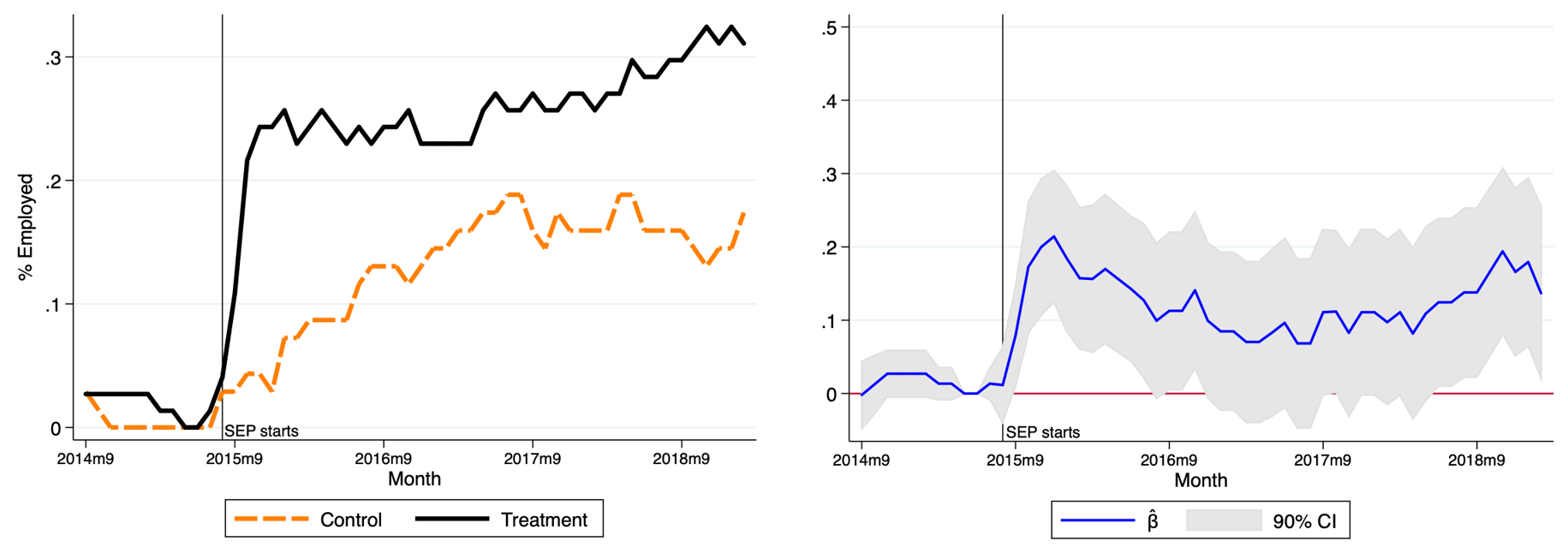
Notes: Panel A shows the share of participants in the treatment group (solid line) and control group (dashed line) that are employed in formal jobs. Panel B shows the effect of being invited to the job interview on employment using administrative data, estimated using OLS. The dependent variable is a dummy equal to 1 if the individual is employed in the corresponding month, and 0 otherwise. The solid line represents the point estimates, while the band around the point estimates is the 90% confidence interval. The vertical lines indicate the month in which the programme started.
Implications for programmes targeting long-term unemployment
The North Macedonian experience highlights how wage subsidies have the potential to promote durable formal employment and the importance of programme design. Rather than offering subsidies in isolation, combining them with matching services and employer commitments may be key to overcoming the information frictions that often prevent vulnerable workers from securing stable jobs. Programmes that help firms identify suitable candidates and give them time to assess workers’ productivity at low risk could be especially valuable in contexts with high long-term unemployment.
At the same time, this experience raises important questions about scale. While customised matching and screening appear to have amplified the programme’s impact, these features may limit how many jobseekers can benefit, particularly in settings where skills mismatches are widespread. Policymakers might therefore consider how wage subsidies could be combined with broader efforts to build skills or improve job search infrastructure.
Authors’ note: The views expressed are those of the authors and do not necessarily reflect those of the Banco de España or the Eurosystem.
References
Abebe, G, A S Caria, M Fafchamps, P Falco, S Franklin, and S Quinn (2021), “Anonymity or distance? Job search and labour market exclusion in a growing African city,” The Review of Economic Studies, 88(3): 1279–1310.
Alfonsi, L, O Bandiera, V Bassi, R Burgess, I Rasul, M Sulaiman, and A Vitali (2020), “Tackling youth unemployment: Evidence from a labor market experiment in Uganda,” Econometrica, 88(6): 2369–2414.
Armand, A, P Carneiro, F Tagliati, and Y Xia (2025), “Can subsidized employment tackle long-term unemployment? Experimental evidence from North Macedonia,” Unpublished manuscript.
Bassi, V and A Nansamba (2022), “Screening and signalling non-cognitive skills: Experimental evidence from Uganda,” The Economic Journal, 132(642): 471–511.
Brown, G, M Hardy, I Mbiti, J McCasland, and I Salcher (2024), “Can financial incentives to firms improve apprenticeship training? Experimental evidence from Ghana,” American Economic Review: Insights, 6(1): 120–136.
Caria, S, K Orkin, A Andrew, R Garlick, R Heath, and N Singh (2024), “Barriers to search and hiring in urban labour markets,” VoxDevLit, 10(1).
Crépon, B and P Premand (2024), “Direct and indirect effects of subsidized dual apprenticeships,” The Review of Economic Studies, rdae094.
De Mel, S, D McKenzie, and C Woodruff (2010), “Wage subsidies for microenterprises,” American Economic Review: Papers & Proceedings, 100(2): 614–618.
Galasso, E, M Ravallion, and A Salvia (2004), “Assisting the transition from workfare to work: A randomized experiment,” ILR Review, 58(1): 128–142.
Groh, M, N Krishnan, D McKenzie, and T Vishwanath (2016), “Do wage subsidies provide a stepping-stone to employment for recent college graduates? Evidence from a randomized experiment in Jordan,” Review of Economics and Statistics, 98(3): 488–502.
Kahn, L B and F Lange (2014), “Employer learning, productivity, and the earnings distribution: Evidence from performance measures,” The Review of Economic Studies, 81(4): 1575–1613.
Lange, F (2007), “The speed of employer learning,” Journal of Labor Economics, 25(1): 1–35.
Levinsohn, J and T Pugatch (2014), “Prospective analysis of a wage subsidy for Cape Town youth,” Journal of Development Economics, 108: 169–183.
McKenzie, D (2017), “Assessing the effectiveness of active labour market programmes in developing countries,” VoxDev.
World Bank (2023), “Unemployment, youth total (% of total labor force ages 15–24) – North Macedonia.”