

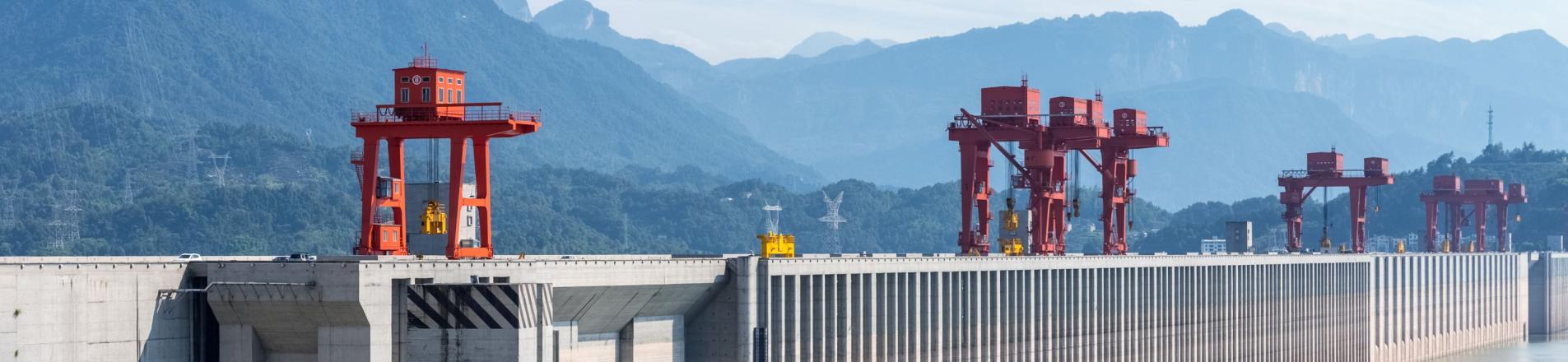





China’s South-North Water Diversion Project delivered substantial agricultural and economic gains to water-receiving regions, with limited costs to source areas—highlighting the promise of large-scale, long-distance transfers in tackling water scarcity.
Water scarcity and the promise of long-distance transfers
Water underpins nearly all economic activity yet remains scarce for billions of people worldwide (Dupas et al. 2024). Climate change and population growth are expected to intensify this challenge, posing serious risks to development (Damania et al. 2017).
Governments have long relied on dams, reservoirs, and irrigation systems to manage water supply. While often effective at a local level, these solutions are limited in scale and may benefit some areas at the expense of others (Duflo and Pande 2007). In contrast, large-scale inter-basin water transfers aim to move water from resource-rich regions to those facing acute scarcity, offering a potentially more balanced and far-reaching solution. When source regions have ample supply, such projects can improve water access elsewhere without imposing large local costs.
Despite their potential, large-scale transfers are controversial due to high financial costs and long construction timelines. A key question is whether the benefits justify these investments. This uncertainty has slowed progress, leaving many proposed projects stalled in early planning stages. To inform this debate, we study China’s South-North Water Diversion Project (SNWDP) and evaluate its agricultural and economic impacts (Huang et al. 2025).
China’s megaproject: Studying the world’s largest water diversion programme
The South-North Water Diversion Project (SNWDP) is an ambitious water infrastructure initiative, designed to channel water from the Yangtze River—rich in water resources—to China’s arid northern regions. First proposed by Mao Zedong in 1952, the project entered national planning in 1995 as part of the Eighth Five-Year Plan. Following a comprehensive feasibility study, construction began in 2002. With a total investment of RMB 266 billion (approximately US$42.7 billion in 2015), the SNWDP stands as the largest water transfer project in the world.
Figure 1: Annual investment of the SNWDP from 2001 to 2020
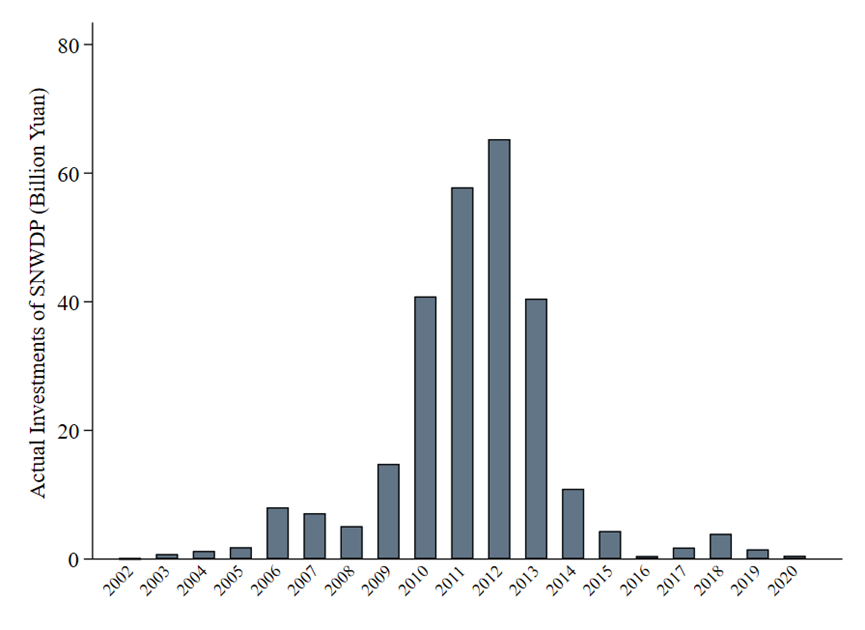
Source: China South-to-North Water Diversion Project Construction Yearbook.
The project consists of three routes: Eastern, Central, and Western. The Eastern Route, launched in 2002 and operational by 2013, channels water from the lower Yangtze River to Jiangsu and Shandong provinces via the historic Grand Canal, spanning around 1,150 km. The Central Route began construction in 2003 and became operational in late 2014. It draws water from the Han River (a major Yangtze tributary) and carries it northward through over 1,400 km of canals to Henan, Hebei, Tianjin, and Beijing, using elevation differences to enable gravity-fed flow.
By 2020, the Eastern and Central Routes had delivered more than 40 billion cubic meters of water, benefiting over 140 million people across 280 counties in six provinces. The Western Route, designed to divert water from the upper Yangtze to the Yellow River Basin, remains in the planning phase due to seismic risks and the challenges of high-altitude construction.
Figure 2: Geographic layout of China’s South-North Water Diversion Project

Notes: The Central and Eastern Routes are shown as solid brown lines, with black stars marking their starting points. The Western Route, depicted as a dashed line, remains unbuilt. Source: Department of South-to-North Water Diversion Project Management, Ministry of Water Resources, People’s Republic of China.
To assess the project’s impact, we use a difference-in-differences approach to compare changes in outcomes between counties that received diverted water and nearby non-recipient counties, before and after implementation. This method allows us to isolate the causal effect of improved water access on agricultural productivity and local economic performance.
Grain and productivity: How water diversion raised agricultural output
Given water’s essential role in agriculture (Asher et al. 2023, Blakeslee et al. 2023, Hornbeck and Keskin 2014), we begin by examining how the SNWDP affected agricultural outcomes.
Our findings show that the project significantly boosted grain output and agricultural total factor productivity (TFP) in water-receiving counties—by about 8.2% and 4.7%, respectively. These gains grew over time (Figure 3), consistent with the gradual ramp-up in water delivery. We also observe a significant increase in key agricultural inputs: sown area and machinery power expanded by 6.2% and 8.6%, respectively, while labour and fertiliser use remained largely unchanged.
Figure 3: Dynamic effects of the SNWDP on grain output and TFP
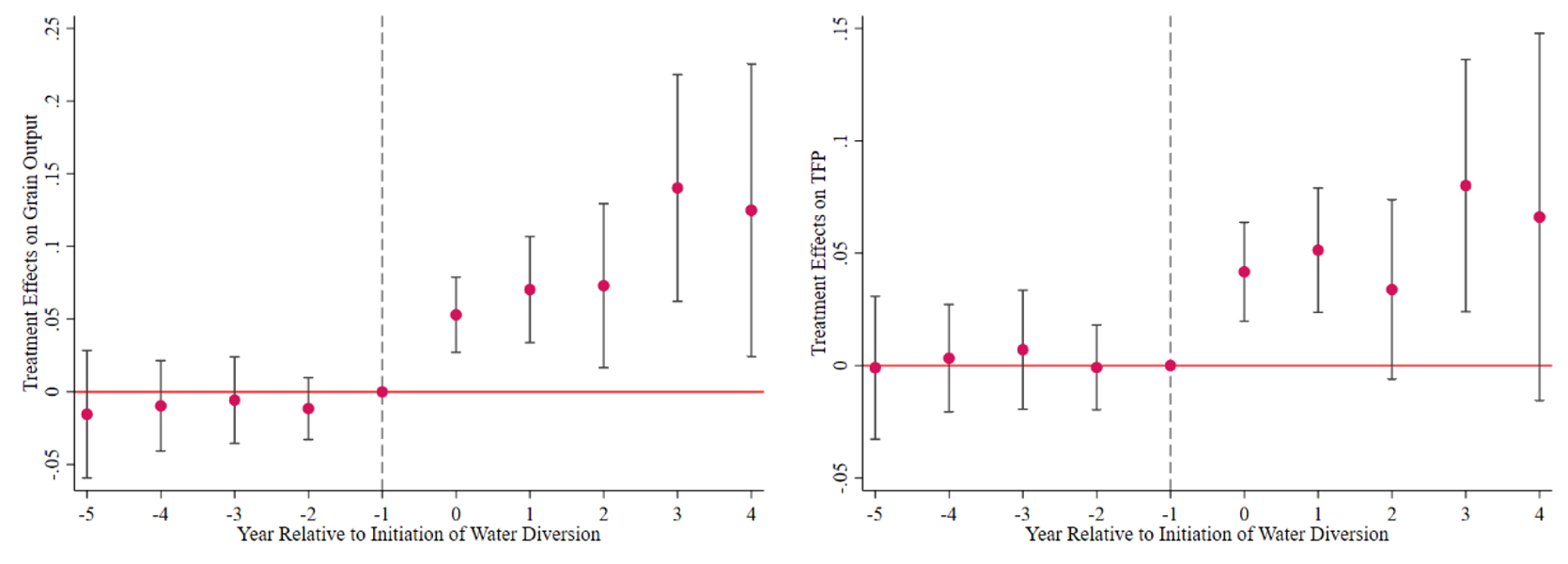
Note: The markers at the left and right ends of the timeline represent average effects five years before and four years after water diversion began, respectively. All effects are benchmarked against the year immediately preceding the start of water diversion.
Furthermore, these effects are especially pronounced in drought-prone areas, suggesting that the project’s primary impact stems from easing water scarcity. This also highlights the SNWDP’s role in helping regions buffer against extreme weather shocks.
Adapting to abundance: Farmers’ response to rising groundwater
Data from over 1,000 national monitoring stations show that the SNWDP raised groundwater levels in water-receiving counties by an average of 4.4 metres, a 3.5% increase relative to the sample mean.
Farmers responded to improved water access by shifting towards more water-intensive and higher-yielding crops. Moreover, the area planted with single-season rice declined, while multi-season rice increased, indicating a move towards more intensive cropping. We also find evidence of scale expansion, suggesting that improved water access enabled farmers to cultivate larger areas.
Beyond agriculture: Can better water access boost local economies?
While the SNWDP significantly improved agricultural productivity, such gains do not always translate directly into income growth. Input costs may rise, and prices can adjust in general equilibrium. To assess broader economic impacts, we examine changes in local income and sectoral outcomes.
We find that the SNWDP led to a moderate rise in rural incomes: annual per capita income increased by about 2% in water-receiving counties. The industrial and service sectors also expanded, likely driven by spillovers from agriculture or improved water access for non-farm activities. Urban incomes rose as well, by roughly 1.5% per capita, suggesting that the economic benefits extended beyond agriculture and across sectors.
Do source regions suffer? How large are the net gains?
Large-scale water transfers often raise concerns about negative consequences for source regions. Since the SNWDP diverts water from the Yangtze River in southern China, it is natural to ask whether donor areas experience reduced water availability, potentially undermining local productivity and income.
To explore this, we compare counties that supply water to nearby non-supplying counties. We find no evidence of significant adverse effects in source regions, suggesting that the benefits in recipient areas do not come at the expense of meaningful losses where the water originates. This aligns with the fact that the diverted volume represents only about 1% of the Yangtze River’s total annual runoff.
The absence of major distributional costs highlights a key strength of long-distance transfers from water-abundant basins: they can generate substantial benefits without imposing large upstream burdens. When we factor in the estimated income gains and project investment costs, our cost-benefit analysis yields an internal rate of return of 6.4%, underscoring the project’s overall economic viability.
Policy implications of large-scale water diversion
China’s South-North Water Diversion Project offers valuable lessons for countries facing water stress, particularly those with uneven regional water distribution. In such settings, large-scale inter-basin transfers—if carefully designed—can significantly improve water allocation efficiency. These projects can ease scarcity, boost productivity, and support economic development in arid regions, often at limited cost to water-rich areas, yielding substantial net benefits. As climate change intensifies water variability, such transfers may become an increasingly important component of national water management strategies—especially for countries with the fiscal capacity to support infrastructure on this scale.
References
Asher, S, A Campion, D Gollin, and P Novosad (2023), “The long-run development impacts of agricultural productivity gains: Evidence from irrigation canals in India,” CEPR.
Blakeslee, D, A Dar, R Fishman, S Malik, H Pelegrina, and K Singh (2023), “Irrigation and the spatial pattern of local economic development in India,” Journal of Development Economics, 161: 102997.
Damania, R, S Desbureaux, M Hyland, A Islam, A-S Rodella, J Russ, and E Zaveri (2017), "Uncharted waters: The new economics of water scarcity and variability," World Bank.
Duflo, E and R Pande (2007), “Dams,” Quarterly Journal of Economics, 122(2): 601–646.
Hornbeck, R and P Keskin (2014), “The historically evolving impact of the Ogallala aquifer: Agricultural adaptation to groundwater and drought,” American Economic Journal: Applied Economics, 6(1): 190–219.
Huang, G, C Liu, T Xi, H Xu, and W You (2025), “The agricultural and economic impacts of massive water diversion,” Journal of Development Economics, 176: 103517.