



View Chapter:
Downloads:
Chapter 3
Background
We highlight two important tropical ecosystems: the Brazilian Amazon and the Indonesian rainforest. Both are under threat from agricultural expansion. As Figure 1 shows, these two countries have consistently ranked as the top two countries for annual forest loss between 2001 and 2024, with deforestation rates that substantially exceed those of other tropical forest countries, including the Democratic Republic of Congo and other Amazon basin countries.
While tropical forests in Africa, particularly in the Democratic Republic of Congo, represent a substantial portion of global forest cover, this review focuses primarily on Brazil and Indonesia for two reasons. First, as Figure 1 demonstrates, deforestation rates in Africa have been substantially lower than in these two countries over most of the past decades. Second, there is remarkably little rigorous economic research on deforestation in the African context.
Figure 1: Forest Change in the Amazon, DR Congo and Indonesia, 2001-2020
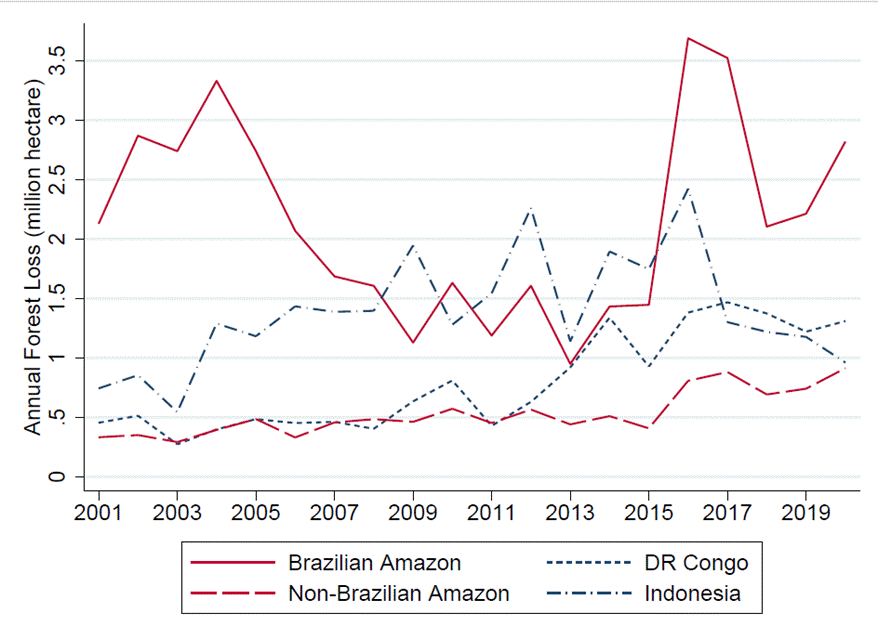
This figure (from Burgess et al. 2023) compares annual forest loss in the Brazilian and non-Brazilian Amazon, the Democratic Republic of the Congo, and Indonesia, based on data from Hansen et al. (2013).
The Brazilian Amazon
Brazilian law defines and protects the Legal Amazon (Amazônia Legal), a region that covers the majority of the Amazon rainforest, which also extends into neighbouring countries like Colombia and Peru. In particular, the Brazilian Forest Code imposes several restrictions on forest conversion, including protecting land near rivers and requiring that landowners maintain 80% of their property in the Amazon as forested land. However, enforcement of such rules has been weak, leading deforestation rates to rise to alarming levels by the early 2000s.
The Brazilian government responded to these rising levels of deforestation by strengthening regulation. In 2004, the Action Plan for the Prevention and Control of Deforestation in the Legal Amazon (PPCDAm) aimed to reduce deforestation rates. Technological innovations like DETER, a satellite-based monitoring system, allowed for real-time detection of forest loss (Assunção et al. 2023b). Deforestation on untitled land was reclassified as a felony punishable by prison, and protected areas were expanded (Soares-Filho et al. 2010, Harding et al. 2021). The deforestation rate fell by roughly half over the period from 2005 to 2012 (Burgess et al. 2023).
However, the enforcement of these regulations was weakened in the decade that followed. In 2012, the New Forest Code granted amnesty to lands that were illegally deforested before 2008 (Soares-Filho et al. 2014, Freitas et al. 2018). From 2013 to 2016, there were large cuts to the budget of Brazil’s environmental agency (IBAMA) (CGU2016), and Brazil experienced broad political realignment toward candidates that supported agricultural expansion. The result was a resurgence in deforestation and the reversal of prior gains (Rochedo et al. 2018, Burgess et al. 2023).
The Indonesian rainforest
The Indonesian forest estate (kawasan hutan), which covers roughly 70% of Indonesia’s land area, is officially owned by the central government. The forest estate includes protected areas, which are conserved, and production forests, which can be leased for commercial activity that includes agriculture, logging, and mining. Agricultural use typically involves clear-cutting, often by palm oil producers and often with fire (Balboni et al. 2024). Palm oil plantations now occupy 15% of the total land area in Indonesia and Malaysia (Hsiao 2025). The palm oil industry accounts for a large share of agricultural production in Indonesia, which supplies over half of the world’s palm oil. Palm oil is then used as a key ingredient in a wide range of goods that include food products, consumer goods, and biofuels.
A distinct feature of Indonesian deforestation is the destruction of peatland forests. Peatland forests are wetlands that are major carbon stores, housing swampy layers of decomposing organic matter – peat – that is often several metres deep. The draining and clearing of this peat layer has severe carbon consequences that greatly exceed those from the clearing of non-peatland forest. The establishment of the Peatland Restoration Agency (Badan Restorasi Gambut) recognises the importance of peatlands, but domestic efforts to regulate have faced broad challenges in curbing deforestation, including in protected areas (Busch et al. 2015).
For full reference list see the end of the conclusion chapter.
Contact VoxDev
If you have questions, feedback, or would like more information about this article, please feel free to reach out to the VoxDev team. We’re here to help with any inquiries and to provide further insights on our research and content.