



View Chapter:
Downloads:
Chapter 2
Introduction
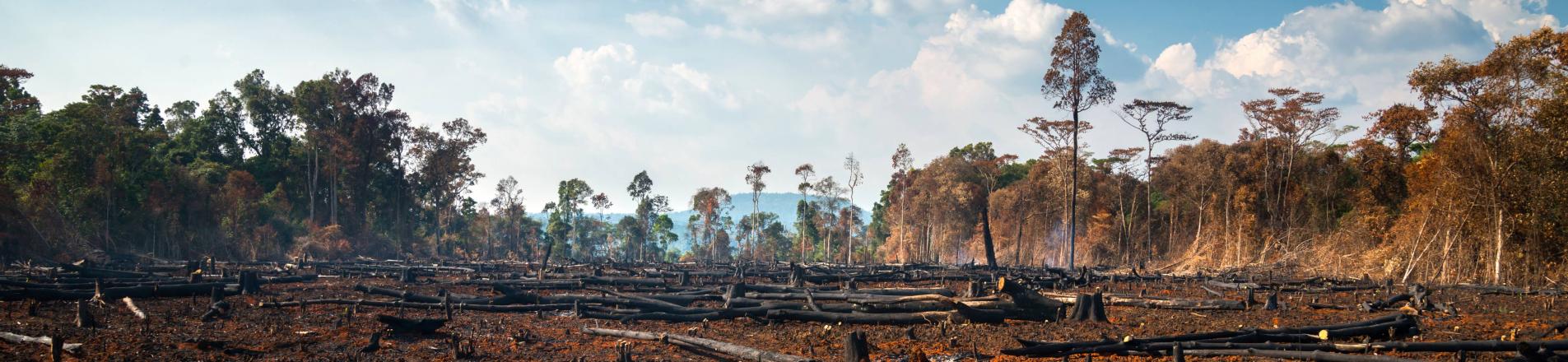
Tropical deforestation represents one of the most pressing environmental challenges of our time. From 2001 to 2024, over 2.5 million km2 of tropical forest were lost – an area about the size of France, Spain, Germany, and Italy combined. This forest loss contributes an estimated 14% of total global greenhouse gas emissions (Friedlingstein et al. 2019) and threatens biodiversity hotspots. The environmental consequences extend beyond carbon emissions to include local health impacts from air pollution, disrupted precipitation patterns, and the loss of critical ecosystem services that millions of people depend on for their livelihoods.
The vast majority of this deforestation occurs in low- and middle-income countries, where tropical forests face intense pressure from agricultural expansion, infrastructure development, and resource extraction. Unlike historical deforestation in temperate regions, driven primarily by timber harvesting, contemporary tropical deforestation is overwhelmingly motivated by converting forest land to agricultural use. This creates a fundamental tension between local economic development needs and global environmental protection, as the benefits of forest conversion accrue locally while the costs are borne globally. Understanding the economics of tropical deforestation is therefore crucial for designing policies that can balance development goals with environmental conservation.
Given the critical role of forests in climate change and the implications for economic development, deforestation and land use have been the focus of extensive research across disciplines, including climate science, land economics, and economics more broadly. The proliferation of satellite data, along with keen policy interest, has fuelled the rapid growth of work in this space.
This VoxDevLit synthesises recent economic research on deforestation, mainly in lower-income countries. We highlight recent developments within the economics literature, with an emphasis on the integration of satellite-based data – which provides spatially detailed information – with causal inference methods and quantitative economic modelling.
In Section 2, we present background information on the two main hotspots of tropical deforestation: the Brazilian Amazon and Indonesia. Combined, they were responsible for about half of the global tropical deforestation over the last two decades (Hansen et al. 2013).
In Section 3, we examine development as the primary driver of deforestation, focusing on agricultural expansion and the complex relationship between productivity improvements and forest loss. We review the contentious debate over whether agricultural productivity gains lead to reduced or increased deforestation. The section also evaluates policy interventions designed to reduce agricultural expansion, including satellite monitoring systems, credit restrictions, and protected areas, while examining how poverty alleviation and conservation goals can be aligned through careful programme design.
In Section 4, we review the application of structural economic models to understand deforestation patterns and to evaluate policy. These sophisticated quantitative models enable policymakers to assess the cost-effectiveness of various policy instruments. The evidence discussed here suggests that market-based approaches, such as payments for conservation, have great potential to preserve forests and can be cost-effective.
In Section 5, we analyse how international trade and spatial economic linkages shape deforestation outcomes. The literature reveals that trade policies generate both direct effects in targeted regions and indirect impacts that propagate across space through trade networks, making comprehensive spatial modelling essential for accurate policy evaluation. We examine evidence on how transportation infrastructure, supply chain governance, and regional trade agreements influence forest outcomes, while highlighting the importance of international coordination for effective environmental policies.
In Section 6, we explore the critical role of political economy factors in determining the feasibility and effectiveness of forest conservation policies. The research demonstrates that political concerns, which arise from the incidence of regulation, often constrain policy implementation. We review evidence on how electoral cycles, local political capture, and lobbying systematically undermine conservation efforts, suggesting that durable forest protection requires policies designed to navigate political resistance and align local economic interests with conservation goals.
For full reference list see the end of the conclusion chapter.
Contact VoxDev
If you have questions, feedback, or would like more information about this article, please feel free to reach out to the VoxDev team. We’re here to help with any inquiries and to provide further insights on our research and content.