

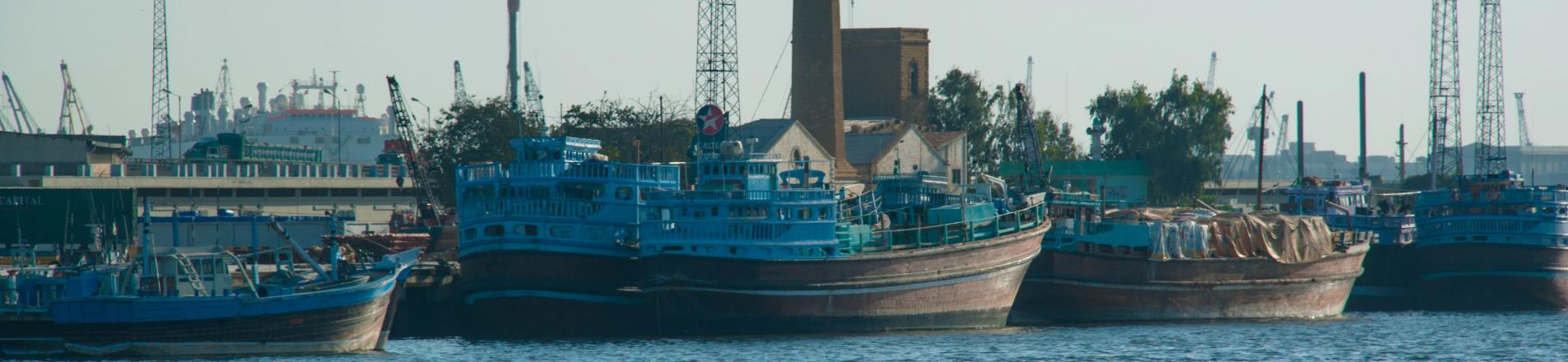


Aggregate data can mask micro-level adjustments in the wake of terrorist activities. Administrative data from Pakistan reveals how a major terrorist attack distorted export patterns across firms, products, and regions.
Editor's note: or a broader synthesis of themes covered in this article, check out Issue 2 of our VoxDevLit on International Trade. The authors have made slides available to accompany this research here.
The economic cost of conflict has been widely documented. Beyond the immediate destruction of physical capital and infrastructure, wars and terrorist incidents generate substantial economic distortions by heightening risk and uncertainty, and diverting resources towards security and response measures. A terrorist attack also damages social goodwill and erodes intergroup trust that takes a very long time to build (Korovkin and Makarin 2023). Consequently, due to elevated out-group hostility as well as a higher transaction cost associated with ‘trading with the enemy’, the flow of goods across borders diminishes.
Although big-picture studies on conflict covering a range of countries help to understand the general patterns, this comes at the cost of missing important nuances, contextual differences, and micro-level variations across countries (Rohner et al. 2025). Due to the varying nature and scale of war or physical violence, the results obtained are often not generalisable to different settings. To shed light on key mechanisms, it is therefore crucial to examine the effects of terrorist activities within a controlled institutional setting with less unobserved variation. In Liaqat and Hussain (2025), we examine how a large-scale terrorist attack affected the trade patterns of firms exporting from Pakistan, a country impacted by terrorism.
The 2016 Uri attack
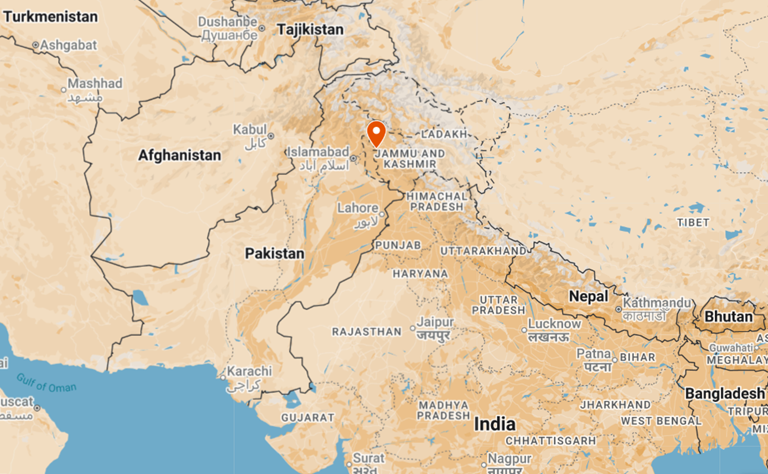
Our research focuses on the attack of a military base in Uri, a town in the Indian-administered Kashmir (see Figure 1), on September 18, 2016, allegedly planned and executed by a Pakistan-based militant organisation. India blamed Pakistan for the attack, but Pakistani officials denied any involvement. The historical context and nature of the incident offer a unique setting to study terrorism for several reasons:
- The attack is widely perceived to be unanticipated, and took place against the backdrop of stable macroeconomic conditions. A large-scale attack on security forces came as a surprise and deeply shocked the public.
- Immediately after the incident, mainstream media in both countries engaged in angry rhetoric towards each other. There was an obvious expression of hostility rooted in public sentiment. This allows us to disentangle the effects of a rise in intergroup tensions from the physical effects of violence, since the attack was confined to a single location.
- The attack had immediate economic repercussions. India revoked its participation in the 19th South Asian Association for Regional Cooperation (SAARC) summit after the attack, which was scheduled to take place in Pakistan in November 2016. After the attack, extensive security checks and inspection of shipments caused significant congestion at India-Pakistan border crossings.
- Trade between the two countries did not cease after the attack, which allows us to study the differential effects of a terrorist attack on Pakistan's exports to India versus the rest of the world.
Figure 1: Uri, in Baramulla district of Indian-administered Kashmir
Understanding the economic repercussions of terrorism
Our research capitalises on detailed administrative data on Pakistani firms to understand the impact of the Uri attack across firms, product lines, and/or geographic regions. Our econometric approach builds on a widely applied technique in international trade and development economics, using a high-dimensional fixed effects model and difference-in-differences estimates. To rationalise the identification strategy, we show that the effect of the terrorist attack on our variables of interest is not mitigated by confounders, i.e. there were no major economic changes in India in the aftermath of the attack that could potentially be responsible for the documented effects. We find that, in contrast to the aftermath of a war or conflict that lasts for several years, the aggregate economic impact of a terrorist incident may not be significant. However, the overall impact hides a substantial degree of variation in the exporting dynamics of firms.
Aggregate trade data and the ‘average’ effect
We show that Pakistani firms witnessed a significant drop in exports volume and prices in the Indian market after the attack. This result offers external validity to earlier research investigating the impact of terrorist activities on firm behaviour. However, in contrast to the existing research, our estimates obtained from aggregated trade data at the product or country levels yield less significant results. This observation aligns with the temporary nature of disruption reflected in the total volume of exports to India after the attack (Figure 2).
Figure 2: Exports to India
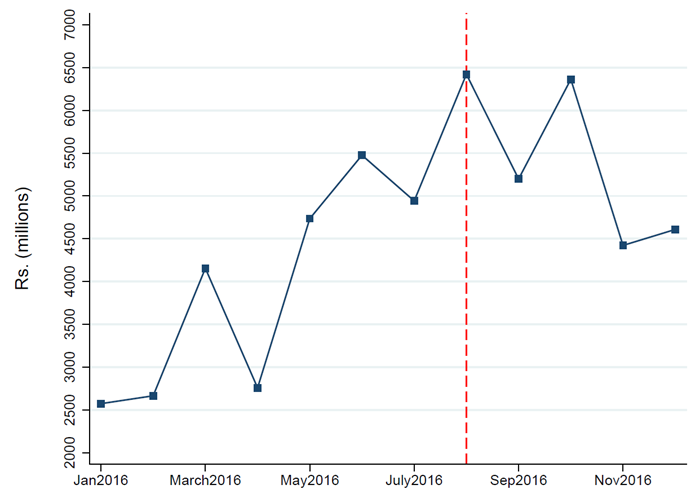
Notes: Based on authors’ calculations using FBRP data. The vertical axis measures Pakistan’s total exports to India. The red vertical line shows the time of Uri attack.
As we explore additional layers of granularity in the data, these estimates become economically and statistically significant. The rise in political and economic uncertainty in the aftermath of the attack lowered the demand for Pakistani products. At the same time, more stringent security measures caused delays at the border, increasing the transaction cost of sending shipments to India.
The shock had an uneven impact across firms and products
Not all firms experienced a decrease in demand; the effect of the attack was more pronounced among smaller businesses. On the other hand, the average effects did not hold for larger firms that relied heavily on imported inputs, particularly those manufactured in India. This result offers useful insights relevant to recent advances in research regarding the role of globally connected firms (Bernard and Moxnes 2018), and is indicative of the expectation that larger firms, which are also shown to be more productive, are more capable of absorbing the effect of the shock. In fact, these firms emerged as winners after the attack.
It is likely that at least part of the demand was diverted towards well-established Pakistani businesses, perhaps owing to a lower perceived risk of trading with them. There is also evidence of diversion through third-country hubs such as the UAE, underscoring firms’ differing capacities to adapt to terrorist incidents via indirect channels. Interestingly, we find no significant impact on firms’ imports sourced from India, relative to other countries. One possible explanation for the apparent absence of disruption on the import side may be supply-chain resilience of larger importers.
Figure 3 shows the percentage change in Pakistan’s exports to India by industry, in the month immediately following the attack. Some sectors witnessed a bigger drop compared to, say, beverages and chemical products. More formally, the effect varies across product categories based on the elasticity of import demand for Pakistani goods in the Indian market, frequency of price adjustments, and the degree of product differentiation. In general, firms may have a greater pricing power for goods with lower import demand elasticity. We observe that Pakistani exporters selling more differentiated goods or products customised to their buyers’ needs, witnessed a smaller reduction in demand.
Figure 3: Change in exports to India, by industry
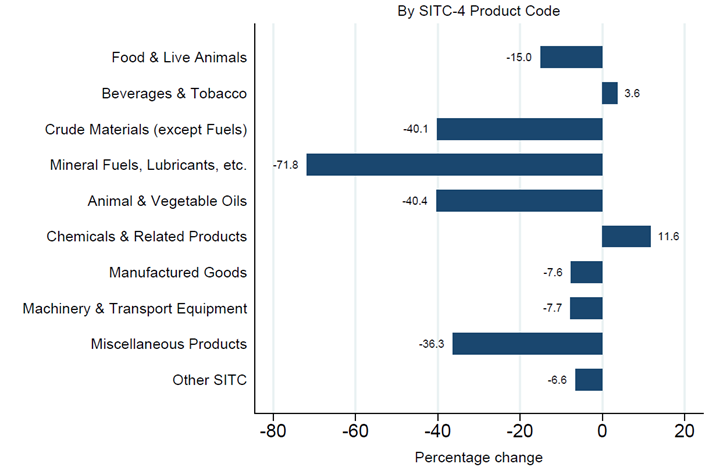
Notes: Based on authors’ calculations using FBRP data. Each bar shows the percentage change in Pakistan’s exports to India for the stated product category over August 2016, to September 2016.
Diversion of shipments through alternative routes
The impact of the attack also varied by geography. Due to its proximity to Uri, trade through Lahore was more drastically impacted. There were significant delays at Lahore ports due to stricter security measures. Consequently, many shipments were redirected to the second most feasible route: Karachi ports located in southern Pakistan (Figure 1). Despite an increase in the cost of transportation due to re-routing shipments to relatively distanced ports, many firms chose this option instead of having to face greater uncertainty and risk at the eastern border. These localised effects reveal how even geographically contained acts of violence can ripple through nearby trade corridors and cause trade distortions.
Implications for counterterrorism efforts
While micro-level evidence on specific countries is ultimately necessary (Rohner et al. 2025), the challenge of generalisability remains. The economic repercussions of terrorism depend heavily on the context, as well as firm characteristics and supply-chain structures. What we learn from our research is that terrorist incidents may not lead to a sustained collapse in bilateral trade, but they do reshape the composition of exporters and the routes through which goods move. Owing to the uncertainty and massive opportunity cost of security measures introduced in the wake of an attack, the ‘deadweight loss’ of terrorism is particularly sizeable for developing countries.
Our results suggest an important role of governments and policymakers in conflict-inflicted countries in helping mitigate the unfavourable effects of terrorism. By using effective communication instruments and containing angry rhetoric, it is central to project more confidence in resuming economic activity to counter the hostile economic blow of conflict.
References
Bernard, A B, and A Moxnes (2018), “Networks and trade,” Annual Review of Economics, 10: 65–85.
Korovkin, V, and A Makarin (2023), “Conflict and intergroup trade: Evidence from the 2014 Russia–Ukraine crisis,” American Economic Review, 113: 34–70.
Liaqat, Z, and K Hussain (2025), “Keeping the enemies closer? Exporting behaviour of firms under conflict,” The Journal of Development Studies, 1–22.
Rohner, D, O Vanden Eynde, and E Verhille (2025), “Variants of violence: Classifying conflict types and policies for peace,” Economic Policy, eiaf009.