



View Chapter:
Downloads:
Chapter 3
Structural Transformation: Key Facts and Canonical Theories
The Origins of Modern Economic Growth
Figure 1 tells a story familiar to every student of economic development. From the invention of agriculture during the Neolithic Revolution until the 18th century, human societies lived under a regime that bore out the predictions of the gloomy pair of Thomas Malthus and David Ricardo: material living standards stagnated everywhere, with each generation replicating the conditions of the last. Grandparents and grandchildren tilled the same plots and shared the same hope for their offspring. Life, in Hobbes's famous phrase, was "nasty, brutish, and short”. Then, in one place, everything changed.
The Industrial Revolution, which originated in the UK, took root between the 17th and 18th centuries, with per capita income growing at roughly 0.4% annually (Clark 2005).
The British economy became progressively more efficient, eliminating what we would now call ‘distortions’ – the structural obstacles and constraints that prevent resources from being allocated to their most productive uses (Wrigley 1990). By 1800, subsistence farming had largely disappeared: agriculture was organised into capitalist enterprises that hired labour and sold their product on competitive markets (Wrigley 1985). Trade expanded rapidly, first through re-exports of New World goods, then through woollen draperies, and finally through cotton textiles (Davis 1954, 1962). Cotton, which was marginal in the early 18th century, became the leading growth engine by mid-century (Crafts 1986), although productivity improvements extended across manufacturing (Temin 1997). As the frontier of industrialisation, Britain could not imitate; it had to innovate, supported by a supply of skilled mechanics and the cumulative advances of local invention (Mokyr 1992).
Figure 1: Gross domestic product (GDP) per capita across the world, 1820-2022.
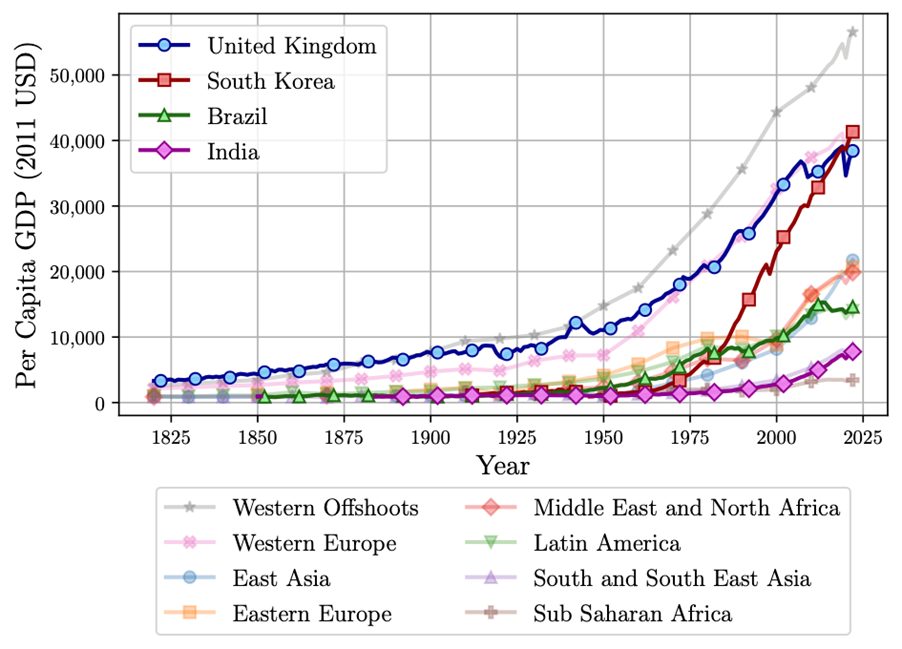
Source: Maddison Project Database 2023.
While the facts of the Industrial Revolution are widely agreed upon, its causes remain debated. Several mechanisms have been proposed: relative prices favoured labour-saving technologies (Allen 2009); imperial trade, including slave trade, networks enhanced profitability (Williams 1944, Inikori 2002, Derenoncourt 2025); secure property rights encouraged investment (North and Weingast 1989); and cultural shifts promoted behaviours conducive to capital accumulation (McCloskey 2010). Each of these accounts has plausibility, but none appears sufficient on its own. Perhaps the transition required a confluence of conditions, and it also owed something to chance.
Crucially, the growth process initiated in Britain did not remain confined to its borders. As Figure 1 shows, it spread rapidly to the Western Offshoots – English-speaking economies
in North America and Australasia – and later to parts of continental Europe. By the end of the 19th century, per capita GDP in these pioneers of industrialisation had surpassed $5,000 (2011 USD), while much of Asia, Africa, and Latin America remained near subsistence, with annual incomes of only a few hundred dollars.
Structural Transformation
The transformations that occurred in Britain and the Western offshoots were not limited to growth. The structure of these economies also changed as they grew. In landmark early empirical studies of economic development, Simon Kuznets emphasised the centrality of sectoral reallocation – particularly the decline of agricultural employment – as a key correlate of rising per capita income (Kuznets 1966).
This transformation can be observed not only in Great Britain, but also in countries that started growth later. Figure 2 shows the share of employment in agriculture for a selected group of countries: Great Britain, South Korea, Brazil, and India. The left panel plots agricultural employment against calendar time; the right panel plots it against income per capita.
The left panel highlights sharp differences in timing. Britain, as an early starter, had already reduced its agricultural employment share to below 30% by the mid-nineteenth century. By the 1960s, agricultural employment in Britain had fallen below 6%. The other countries began their transition later, so that in 1960, agricultural employment was still around 60% in South Korea and Brazil, and around 70% in India. The distinction between early and late starters is central in the literature, as we will discuss later on.
When the same data is viewed against income (right panel), the trajectories align: agricultural employment falls systematically as per capita GDP rises. Most of the cross-country differences in agricultural employment we see today thus reflect differences across different stages of development. In this sense, today's poorest economies, where 70–80% of workers remain in agriculture, resemble the now-rich economies in their own pre-industrial stages.
Figure 2: Employment shares in agriculture in four countries across time and income.
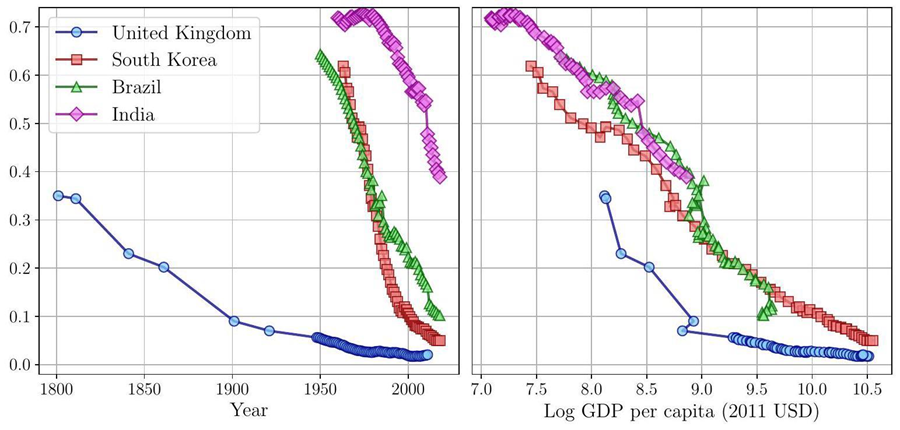
Sources: Income per capita from Maddison Project Database (2023); agricultural shares from Groningen Growth and Development Centre 10-Sector Database (2014), Kuznets (1966, 1971) and Economic Transformation Database (2021).
The movement out of agriculture has a counterpart that is central to economic transformation: industrialisation. In the early stages of development, activity shifts towards manufacturing, construction, mining, and utilities, jointly referred to as industry. At higher levels of income, services become the dominant sector.
These patterns, often referred to as the ‘Kuznets facts’ (Kuznets 1953, 1966, Chenery 1960) and documented extensively in Herrendorf et al. (2014), are clearly visible in Figure 3. Following the lessons from Figure 2, this plots employment and value-added shares in agriculture, industry, and services not against time, but against log GDP per capita, with cubic OLS fits. This clearly reveals the main features of the structural transformation: a steady decline in agriculture, a hump-shaped path for industry, and a long rise in services. These are thus clearly visible not only in the time series of successful transformers, but also in the cross-section of countries.
Figure 3: Employment and value-added shares over development in a panel of early and late starters.
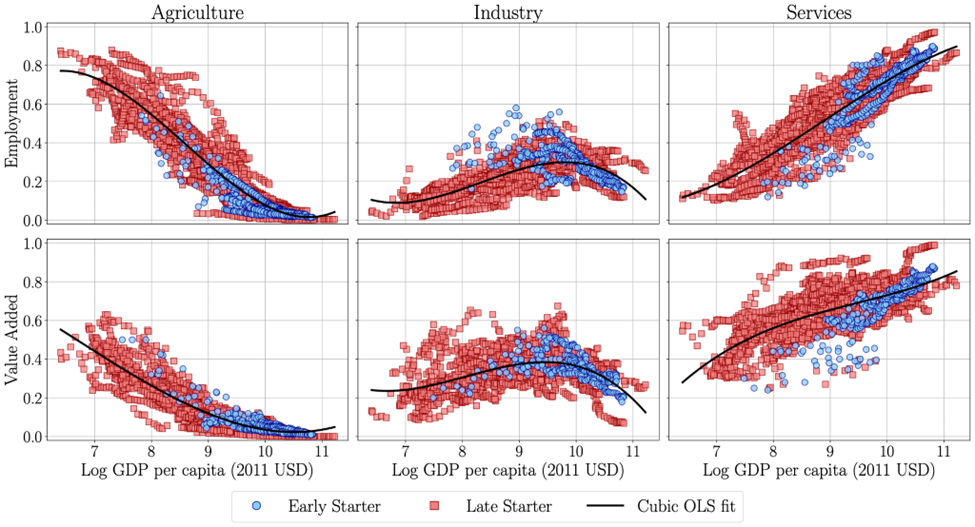
Sources: Income per capita from Maddison Project Database (2023); sectoral shares from Groningen Growth and Development Centre 10-Sector Database (2014), Kuznets (1966, 1971) and Economic Transformation Database (2021).
Early Theories of Structural Transformation
The theoretical literature considering closed economy settings has proposed two main hypotheses to explain the reallocation of economic activity across sectors. Both mechanisms have productivity growth – which also drives the growth in income per capita – as their ultimate underlying force, implying that structural change arises from and together with economic growth.
The first set of mechanisms, initially formalised by Kongsamut et al. (2001), focuses on income effects or the “food problem” (Schultz 1953). This captures the fact that, as incomes rise, expenditure patterns change. Households increase their spending on food less than proportionally and devote more resources to manufactures and services. With further growth, consumption shifts further into services. Earlier work effectively assumed that this channel was mostly present in early stages of the structural transformation, limiting its overall quantitative importance. More recent research by Boppart (2014), Comin et al. (2021) and Alder et al. (2022) suggests that the role of income effects in structural transformation can endure into later stages of structural transformation.
A second set of mechanisms builds on Baumol’s (1967) observation that productivity growth is uneven across sectors. As productivity grows more quickly in agriculture and manufacturing compared to services – the classic examples for slow productivity growth in services being haircuts or the live performance of symphonies – the relative cost of services rises, in a phenomenon known as “Baumol's cost disease”.
In the words of Alvarez-Cuadrado and Poschke (2011), the transition away from agriculture is simultaneously governed by forces “pushing” workers out of agriculture (income effects) and forces “pulling” workers into industry and services (relative productivity changes). Historically, both types of forces have operated, with different forces dominating at different times and locations.
Faster productivity growth in manufacturing compared to services has long led to a focus of policymakers on this sector (even if, as explained above, exactly this growth difference can lead the sector to shrink!). This was reinforced recently, after Rodrik (2013) showed that manufacturing appears to feature unconditional convergence in productivity across countries at a rate of 2–3% annually, even when aggregate GDP per worker does not. This suggests that industrialisation might provide an ‘escalator’ for growth: lower-income countries could catch up simply by moving resources into manufacturing.
However, the evidence that manufacturing as a whole exhibits unconditional convergence is contested. Herrendorf et al. (2025) derive comparable measures of sectoral productivity for a broad sample of developed and developing countries for the period 1990–2018. They find no evidence for unconditional convergence in manufacturing productivity when self-employment and informal enterprises in poor countries are accounted for. Convergence patterns in manufacturing thus appear to differ between the larger and formal firms captured in the UNIDO data used by Rodrik and the sector as a whole. Country studies point in the same direction (Diao et al. 2025, Kruse et al. 2022).
Finally, recent work shows a more nuanced role of the service sector. Duarte and Restuccia (2010) find that productivity gaps across countries are largest and most persistent in tradable services. Using new measures of sectoral prices, Inklaar et al. (2024) find productivity gaps only in tradable sectors, including not only goods-producing sectors, but also service sectors, namely retail and wholesale trade, transportation, finance and business services.
Early vs Late Starters
Figure 2 above illustrates that when discussing economic development, the distinction between early and late starters turns out to be particularly useful. Much of the global inequality observed in the post-World War II world reflects comparisons made at the same point in calendar time, despite countries being at very different stages of development.
To highlight the diversity of development paths, consider the four countries in Figure 2, each representative of broader groups of countries. Britain, the pioneer, expanded the stock of knowledge through innovation. South Korea, a late starter, borrowed technologies and compressed industrialisation into a few decades. Brazil industrialised but failed to sustain convergence. India, more recently, may be leapfrogging manufacturing, moving directly from agriculture into services.
South Korea is a striking example of growth outside the West. From a largely agrarian economy at the outbreak of the Korean War in 1953, it underwent a rapid process of industrialisation. By 2022, its GDP per capita had converged to that of the UK. The Korean development path mirrors the pattern observed in early industrialisers – a shift from stagnation to sustained growth – but the speed of transition was compressed into just four decades. As a late starter, South Korea benefited from what Gerschenkron (1962) termed the "advantages of backwardness", or, as emphasised by Amsden (1989), the capacity to industrialise by borrowing existing technologies. This mechanism was later formalised by Parente and Prescott (2002): late developers can adopt frontier technologies and grow faster by inheriting a larger stock of usable knowledge.
These patterns suggest that late entry into industrialisation carries the potential for rapid catch-up. But timing alone is not sufficient. Brazil offers a contrasting case. Its industrialisation began early in the twentieth century, and by mid-century, scholars such as Evans (1995) and Gereffi (1990) viewed Brazil and South Korea as parallel examples of late development – one oriented inward with protective industrial policy, the other outward with export-led strategies. Yet Brazil, and Latin America more broadly, failed to sustain growth rates consistent with convergence. The advantages of backwardness, while real, are conditional. As we will discuss in detail below, they depend not only on access to technology but on the institutional and structural capacity to absorb and deploy it effectively.
India also presents a more recent and still unfolding case that brings forth a nascent challenge. Over the past three decades, the Indian economy has undergone a remarkable transformation, in line with other South Asian economies. Whether India will follow a path closer to Korea’s, or instead face the kind of growth slowdown that has constrained Brazil and much of Latin America, remains an open question. As Fan et al. (2023) document, India's trajectory may reflect a new path for late starters in which transitions out of agriculture bypass manufacturing altogether. In this context, even the term industrialisation may be outdated.
Let’s return to Figure 3 for a more systematic view. This reveals that for most sectors, the trajectories of early starts (in blue) and late starters (in red) overlap, with one exception: industrial employment.
Figure 4: Industrial employment peaks and corresponding income per capita, with peak dates in parentheses.
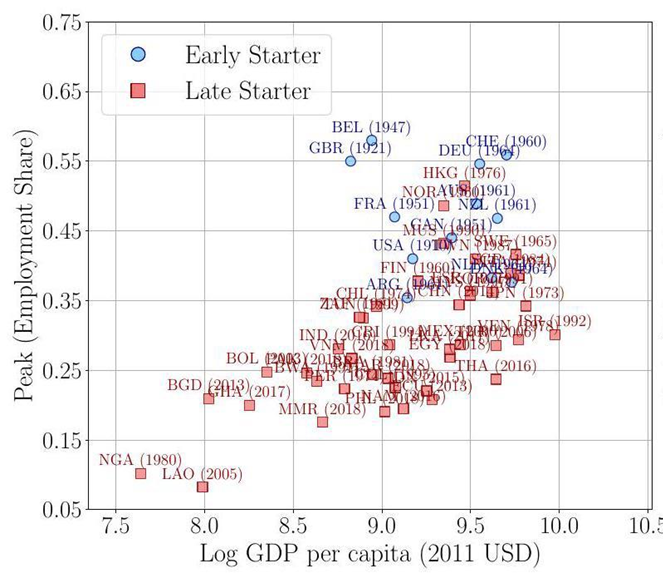
Sources: Income per capita from Maddison Project Database (2023); employment share in industry at its peak calculated from data from Groningen Growth and Development Centre 10-Sector Database (2014), Kuznets (1966, 1971) and Economic Transformation Database (2021).
What explains the pattern of premature and jobless industrialisation observed among late starters? Several explanations have been put forward. First, modern firms in these economies tend to adopt more capital-intensive technologies than in the past, as they catch up with the global technology frontier. While this may raise output and value added, it limits the creation of large-scale employment and erodes the traditional cost advantage of abundant low-wage labour (Rodrik 2022, Diao et al. 2025). Second, the fate of industrialising in a world of declining manufacturing prices due to the more advanced state of the global structural transformation, combined with trade and globalisation, undermined the comparative advantage of late starters, leading to falling employment and output shares (Rodrik 2016). Third, regulatory and size-dependent distortions – such as minimum wages and payroll taxes – constrain the expansion of high-productivity firms and limit job creation (Alfaro et al. 2025). Fourth, unlike in earlier episodes of industrialisation, rising incomes in today’s developing economies – even at relatively low income levels – may be sufficient to sustain demand for informal self-employment, both in manufacturing and in services. This can lead growth to manifest through the expansion of informal activities rather than through the creation of a broad base of secure wage employment. Finally, weak labour market competition, often manifested in employer concentration, low wages, and poor working conditions, further curtails the ability of industrial growth to generate widespread job opportunities. We will explore these mechanisms in greater detail in the remainder of this review.
Taking Stock
The evidence assembled here suggests a central regularity in the process of modern economic growth: while the calendar timing of industrialisation varies, countries experience patterns of structural transformation across agriculture, industry, and services that are similar when conditioned on income. Early starters followed gradual transitions, with labour moving steadily from agriculture into industry and productivity rising in tandem with employment.
Late starters, by contrast, experience compressed transitions. They often display faster income growth and accelerated sectoral shifts, benefiting from the stock of knowledge accumulated abroad. Yet these gains come with potential penalties. Industrialisation may arrive too late to generate large-scale employment, with services expanding before manufacturing matures and industry contributing more to value added than to jobs. Thus, lateness confers both the possibility of rapid convergence and the risk of missing the window for employment-intensive industrial growth.
A second key insight is that the distinctive role of industry in development stems not only from structural reallocation but also from its potential convergence properties. Some studies suggest that manufacturing productivity converges across countries, but more recent work cautions that unconditional convergence may hold only among large, formal manufacturing firms.
Finally, as service activities become more tradable and technology diffuses globally, parts of the service sector may increasingly share these convergence dynamics. Whether this represents a new ‘escalator’ for late developers, or whether services replicate the same conditionality seen in manufacturing, remains an open question.
Taken together, these stylised facts highlight how (sectoral) productivity growth patterns, timing, institutions, technology, and the integration into the global economy shape each country’s structural transformation. In the following sections, we review some of these aspects in more detail.
For full reference list see the end of the final chapter.
Contact VoxDev
If you have questions, feedback, or would like more information about this article, please feel free to reach out to the VoxDev team. We’re here to help with any inquiries and to provide further insights on our research and content.
Supporter Logos