



View Chapter:
Downloads:
Chapter 4
Trade and Industrial Policy
Export-Led Growth
International trade has been central to some of the most salient and recent experiences of structural transformation. This section reviews the theoretical and empirical literature linking trade and industrialisation, drawing on both macroeconomic and microeconomic perspectives.
Macro Perspectives
The argument that trade spurs manufacturing growth often draws on evidence from East Asia. Consider the cases of Japan, Korea, China, and Vietnam. In each of these cases, the evolution of a country’s share of world exports over time closely tracks its manufacturing share of GDP. Japan’s share in world exports rose sharply after WWII, peaking in the 1980s in tandem with the peak of its manufacturing share. South Korea, one of the Asian Tiger economies, followed a similar pattern beginning in the 1960s and 1970s: both its export share and its manufacturing share rose in lockstep until reaching a plateau in the 1990s. China’s export share then surged in the 1990s and 2000s, while Vietnam’s take-off began in the 2010s, with manufacturing’s share of GDP rising in parallel.
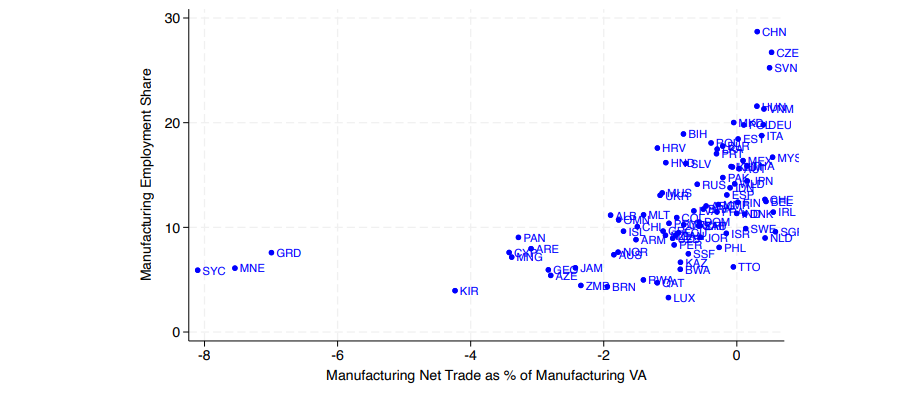
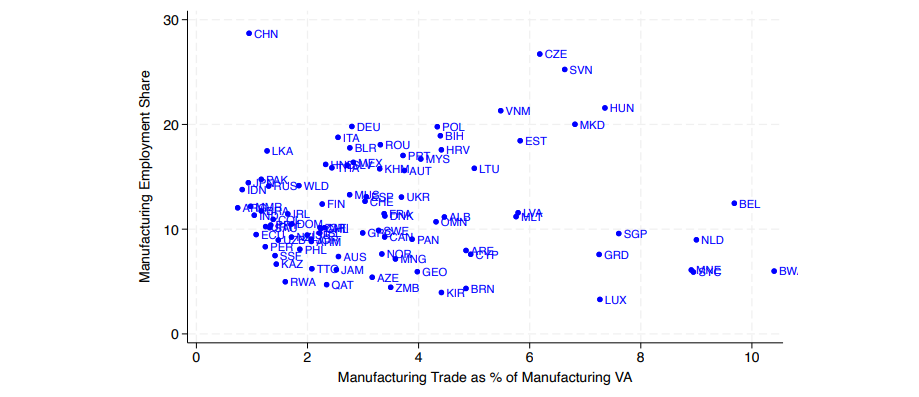
More generally, Figure 5 depicts the cross-country relationship between manufacturing employment shares and two measures of manufacturing trade in 2020. The left panel displays a positive correlation between manufacturing employment shares and net manufacturing trade, measured as a country’s manufacturing exports minus imports relative to manufacturing value added. This suggests a relationship between a country’s comparative advantage and its sectoral structure. In contrast, the right panel shows that there is no clear relationship between manufacturing employment shares and openness to manufacturing trade, measured as gross manufacturing trade over GDP (defined as the sum of a country’s manufacturing exports and imports relative to its manufacturing value added).
Figure 5: Manufacturing Employment Share vs. Trade.
Panel A
Panel B
Source: World Bank Open Data; ILOSTAT.
In what follows, we will review the main theories of structural change in an open economy, and discuss whether or not these empirical patterns are consistent with their core predictions.
We already saw in Section 2 the role that income effects and asymmetric productivity growth across sectors play in theoretical models of structural change in a closed economy. The pioneering work of Matsuyama (2009) formalises a third key mechanism operating in open economies: asymmetric productivity growth across sectors and across countries induces changes in comparative advantage, thereby shaping patterns of sectoral specialisation. Specifically, a country that experiences faster productivity growth in manufacturing gains comparative advantage in that sector, resulting in greater manufacturing net exports and a larger manufacturing employment share. The left panel of Figure 5 is in line with this prediction. Note that this mechanism runs counter to the predictions of the Baumol effect in a closed economy, where complementarities in demand across sectors can imply that faster productivity growth in manufacturing reduces its relative price so much that manufacturing’s employment share decreases.
Evolving comparative advantage is not the only way trade affects economic structure in an open economy. First, even holding productivity constant, as barriers to trade decline, the incentives for specialisation increase as underlying comparative advantage becomes increasingly revealed (Sposi 2015).
Uy et al. (2013) quantitatively assess the role of increased openness and asymmetric sectoral productivity growth in South Korea’s structural transformation between 1971 and 2005. Using a three-sector, two-country model that incorporates income and relative price effects as well as Ricardian comparative advantage, they show that greater openness and faster productivity growth – especially in manufacturing – were crucial to explaining the rise in Korea’s manufacturing share during the 1970s and 1980s, as well as the concurrent decline in agriculture and expansion of services. Their counterfactual analysis suggests that, in the absence of trade, the same productivity trends would not have produced the observed increase in manufacturing employment.
In addition to the role of international trade itself, another strand of the literature has examined how aggregate trade imbalances affect structural change.
Analysing these forces for a larger set of countries, Smitkova (2024) decomposes cross-country changes in manufacturing shares over time into the contributions of sectoral expenditure patterns, trade specialisation, and aggregate trade imbalances. Her results suggest that trade specialisation and imbalances together explain about one-third of the average change in manufacturing’s share.
Finally, some studies explore the reverse channel – from structural change to trade dynamics. Lewis et al. (2022) show that the global shift in expenditure from highly tradable goods towards less tradable services has dampened growth in the ratio of world trade to GDP. Their estimates suggest that since 1970, the global shift towards services has substantially dampened the growth of world trade: structural change has offset about half of the increase in the trade-to-GDP ratio that would have resulted from declining trade costs alone.
Micro Perspectives
A large recent literature analyses the effects of trade openness on individual manufacturing firms. Atkin and Khandelwal (2020), Atkin et al. (2025), and Verhoogen (2023) provide excellent overviews that closely relate to the themes addressed here. Their central lesson is that, at the micro level, the impact of trade openness on firms depends crucially on firm heterogeneity and domestic frictions. A central lesson from the literature is that only a small subset of firms participate in export markets, and these tend to be larger, more productive, and better connected. Melitz (2003) formalised this selection mechanism, and subsequent empirical evidence has documented it in many settings. For example, Bernard et al. (2007) show for the US that exporters are larger and more productive than non-exporters. Clerides et al. (1998) document similar patterns in Colombia, Mexico, and Morocco. In developing countries, where information frictions and weak institutions are more pronounced, recent surveys emphasise that liberalisation often benefits incumbents rather than fostering broad-based entry (Atkin and Khandelwal 2020, Atkin et al. 2025). Yet it can decrease informality: McCaig and Pavcnik (2018) show that the US-Vietnam Bilateral Trade Agreement boosted formal-sector firms by expanding export opportunities, which in turn drew workers out of informal microenterprises and raised overall productivity.
Importantly, the literature highlights that the most relevant effects of trade take time to materialise: exporting and import competition can shape technology adoption, quality upgrading, and skill formation, with long-run consequences for development (Goldberg and Ruta 2025). As Verhoogen (2023) stresses, upgrading is multifaceted – encompassing product quality, process technology, and organisational capabilities – and many firms in developing countries struggle to realise these gains even when exposed to global markets.
Global value chains (GVCs) and enhanced access to inputs provide another key channel through which trade generates dynamic effects. Amiti and Konings (2007) show for Indonesia that input tariff liberalisation significantly raised firm productivity by lowering costs of imported intermediates. Goldberg et al. (2010) find that access to imported inputs in India allowed firms to upgrade product quality and innovate. Yet, as Goldberg and Pavcnik (2016) emphasise, many firms remain constrained by weak contracting institutions and policy distortions, which limit the full diffusion of input-driven productivity gains. Verhoogen (2023) highlights that input-side factors, such as access to skilled labour and imported intermediates, interact with firms’ internal organisational capabilities, suggesting that integration into GVCs yields uneven upgrading outcomes depending on domestic absorptive capacity.
Beyond the direct impact on exporters, trade can generate spillovers along supply chains. Linarello (2018) shows that tariff cuts on Chilean downstream industries increased productivity among upstream input suppliers, suggesting that trade gains propagate through production networks. Alfaro-Ureña et al. (2022) similarly find that Costa Rican firms that begin supplying multinationals experience persistent increases in employment, sales, and productivity, with benefits extending to their non-MNC clients. Amodio et al. (2025a) provide related evidence from Uruguay’s beef export boom to China, showing that exporters’ domestic suppliers, especially in services, experienced sizable gains in sales, employment, and wages. Yet these positive effects are not universal: De Souza et al. (2025) document that Brazilian tariff cuts reduced technology transfers from foreign firms to local suppliers, as multinationals shifted towards direct exporting rather than licensing. Taken together, this evidence suggests that whether exporting benefits diffuse up the value chain depends critically on the structure of global value chains, the incentives for technology transfer, and the internal capabilities of firms to absorb and implement new knowledge.
Another barrier to taking advantage of exporting opportunities is access to finance. Exporting requires upfront investments and trade finance, which are often out of reach for small or young firms. Manova (2013) shows that credit constraints restrict the export participation of financially vulnerable firms across countries, while Chor and Manova (2012) find that financial conditions shape the pattern of exports during crises. Khandelwal (2025) reviews this evidence and highlights that credit policies and insurance schemes tend to expand exports at the intensive margin, helping incumbent exporters scale up, but rarely generate widespread entry. This mechanism helps explain why trade reforms in many LMICs raise aggregate exports without expanding the set of exporting firms. The potential for technology adoption and investments may also be limited by financial frictions. We turn to this issue below.
Labour market frictions further condition the effects of trade on industrial development. Even when firms have opportunities to expand, labour mobility barriers and informality constrain reallocation of workers to more productive firms. Topalova (2010) finds that Indian districts more exposed to tariff cuts experienced slower poverty reduction, partly because workers could not easily move into expanding sectors. Dix-Carneiro (2014) documents high adjustment costs in Brazil, where workers displaced by trade shocks took years to reallocate, often at lower wages. Dix-Carneiro et al. (2025) show that the informal sector frequently acts as a buffer in LMICs, absorbing displaced workers but at lower income levels. These findings underscore that the aggregate gains from trade depend not only on openness but also on how domestic markets mediate firm and worker adjustment.
Industrial Policy
The joint growth of manufacturing and exports in East Asia occurred in a setting where governments in the region actively intervened to shape their paths of industrialisation.
This observation sparked discussions among economists and policymakers about drivers of their industrialisation and implications of such policies. Some scholars emphasised state-led interventions as central to the region’s success, while others argued that market-oriented reforms and trade liberalisation were more significant. Amsden (1989), Wade (1990), and Rodrik (1995) viewed government intervention as crucial for the growth of South Korea and Taiwan. On the other hand, Krueger (1974, 1997) argued the role of trade liberalisation, highlighting risks of government failures and rent-seeking.
The Case of South Korea
One of the common features of the industrial policies in both South Korea and Taiwan was the promotion of new technology adoption from advanced economies and the scaling up of production through exports. Technology adoption and export promotion have contributed to productivity growth and reductions in trade barriers in manufacturing, two key forces underlying the structural change patterns (see Section 3.1.1). These technologies, often characterised by mass production and increasing returns to scale, had already reached a mature stage in the global product cycle in Western economies. After acquiring them, East Asian manufacturers absorbed the technologies through reverse engineering and expanded production for export, leveraging cheap labour. With domestic markets too small to sustain large-scale production, exporting became the main driver of industrial expansion. This process enabled East Asian countries not only to expand overall manufacturing but also to move up the product cycle. Their initial exports consisted largely of non-durable goods such as textiles, but as industrialisation advanced, they shifted towards durable goods – including automobiles, electronics, machinery, and ships – that were more skill-intensive and technologically sophisticated.
These two promoted activities, technology adoption and exporting, were complementary to each other, in line with the theory and evidence summarised in Section 3.1.2. Productivity gains from new technologies increased firms’ chance of exporting, and participation in export markets strengthened firms’ incentives to pursue further technological improvements.
Given South Korea’s rapid industrialisation and exceptional growth, often described as a miracle (Lucas 1993), its large-scale industrial policy – the Heavy and Chemical Industry (HCI) Drive – has received considerable attention in recent literature. Launched in the 1970s, the policy targeted heavy manufacturing sectors such as chemicals, electronics, machinery, transportation equipment, and shipbuilding via subsidised, government-guaranteed foreign credit allocated selectively to approved firms. It was abruptly terminated in 1979 following the president’s assassination and the subsequent change in administration. Despite its short implementation window of about seven years, South Korea has remained a major exporter in these sectors to this day.
Recent research has documented persistent effects of the HCI Drive policy. Using historical sectoral data, Lane (2025) shows that sectors directly targeted by the policy expanded significantly during the intervention and continued to grow even after it ended. He also finds spillover effects, with non-targeted sectors benefiting indirectly through input-output linkages. Exploiting the place-based nature of the HCI Drive policy and historical firm-level data, Choi and Levchenko (2025) provide complementary evidence of persistent firm-level effects lasting nearly 30 years after the policy ended. They build a dynamic trade model with learning-by-doing and identify the key parameter governing the magnitude of learning from reduced-form estimates. Using the calibrated model, they find welfare gains of about 3–4%. Using repeated cross-sectional plant-level data, Kim et al. (2021) also document persistent effects on plants in targeted region-sectors. However, they highlight an important downside: increased resource misallocation. They find that resources disproportionately flowed to large plants owned by business groups that were the primary beneficiaries of the policy.
While implementing the HCI Drive policy, the South Korean government actively promoted the adoption of new technologies. Choi and Shim (2024a, b) digitise firm-level technology adoption data and document a surge in technology transfer from advanced economies. This was true also in Taiwan, where the government supported technology transfers through the Industrial Technology Research Institute during the 1980s, which later laid the foundation for TSMC, now the global giant of the semiconductor industry. Similarly, Giorcelli and Li (2021) show that technology and know-how transfers from the Soviet Union to China had long-lasting impacts in the steel industry, but only when accompanied by worker training. Exploiting exogenous variation in the timing of transfers due to unexpected delays, they conclude that deeper absorption of technology transfers is critical for long-lasting effects.
Another important policy in South Korea was export promotion, implemented through a range of government tools. One such policy was input tariff exemptions for goods destined for export. Using an open economy neoclassical growth model, Connolly and Yi (2015) show that this tariff exemption can explain 17% of South Korea’s catch-up in manufacturing value added per worker relative to G7 countries. The government also established the Korea Trade-Investment Promotion Agency (KOTRA) in 1962, which connected local firms with foreign buyers through trade fairs and market research, reducing information frictions in foreign markets.
Betts et al. (2017) quantify the role of Korea’s trade policies using a multi-sector general equilibrium model calibrated to sectoral tariffs and export subsidies. They show that tariff liberalisation accelerated industrialisation, while the removal of export subsidies worked in the opposite direction, with the two effects largely offsetting each other. They conclude that industrialisation was, instead, primarily driven by international specialisation and income effects resulting from relatively rapid productivity growth in the Korean industrial sector.
Replicating East Asia’s success is far from straightforward. Industrial policy often targets specific sectors, aiming to exploit productivity spillovers or to offset financial frictions. The difficulty is that policymakers cannot know ex ante whether a sector’s current weakness reflects barriers or a genuine lack of potential. Another challenge lies in implementation. Even well-designed policies may fail if bureaucrats do not implement them as intended, due to weak monitoring, corruption, or rent seeking.
Rationales for Industrial Policy
Recently, many theoretical studies have examined the theoretical underpinnings of industrial policy and their optimal design.
A first strand of the literature focuses on distortions. Lashkaripour and Lugovskyy (2023) study optimal trade and industrial policies aiming to address sectoral misallocation arising from industry differences in scale economies and markups. They find that unilateral trade or industrial policies are largely ineffective in correcting misallocation, whereas internationally coordinated industrial policies embedded in deep trade agreements are far more effective. Itskhoki and Moll (2019) analyse optimal policy in a Ramsey growth model with financial frictions and show that the optimal policy should initially be pro-business, suppressing wages in the early stages of transition, to promote entrepreneurial wealth accumulation and relax financial constraints over time. In a multi-sector setting, it is optimal to tilt resources towards sectors with a latent comparative advantage (which may be hard to identify in practice) and towards tradables. Liu (2019) develops a model of production networks with market imperfections and derives a sufficient statistic for the social value of targeting specific sectors. In his framework, targeting upstream industries can generate positive aggregate effects because distortions in these sectors propagate and compound through backward demand linkages. He finds that South Korea tended to target more upstream sectors, consistent with the model predictions.
A second line of work emphasises external economies of scale. Bartelme et al. (2025) quantitatively assess the welfare effects of policy interventions under Marshallian externalities – local productivity spillovers operating through labour pooling, input sharing, and knowledge diffusion. They develop a novel empirical strategy to estimate elasticities of external economies of scale, and, while finding sizable externalities, conclude that the welfare gains from industrial policy are limited. Kline and Moretti (2014) study the long-term effects of the Tennessee Valley Authority, one of the largest place-based policies in US history, and provide evidence consistent with agglomeration in manufacturing. They find that the policy boosted national manufacturing productivity by 0.3%, and cost-benefit analysis shows that these productivity gains outweighed programme costs. Moneke (2020) and Cerrato and Filippucci (2025) study regional development programmes and infrastructure investments in Ethiopia and Italy, respectively, documenting the presence of local agglomeration.
Finally, a third body of research focuses on coordination failures, which occur when private returns to an activity depend on the actions of other agents. Such failures often lead to multiple equilibria. Buera et al. (2021) show that such failures interact with idiosyncratic distortions in the adoption of modern technologies. Fixed costs of adoption, measured in units of final goods, decline as more firms adopt, creating complementarities in firms’ decisions. These complementarities amplify the negative effects of idiosyncratic distortions. Extending this framework to a multi-region open-economy setting, Choi and Shim (2024b) apply it to South Korea’s HCI Drive policy and find that, without policy interventions, the country would have converged to a less-industrialised steady state. Their results highlight that complementarities between export promotion and technology-adoption subsidies were central to South Korea’s successful industrialisation.
A fundamental challenge in this literature is that, when multiple equilibria exist, only one equilibrium is observed in the data, determined by an unobservable equilibrium selection rule. This makes it difficult to disentangle whether policy interventions work by shifting fundamentals directly or by facilitating coordination. Garg (2025) introduces a novel method, drawing on tools from industrial organisation and algebraic geometry, to identify and compute all possible equilibria, including those not realised in the data. Applying this approach to industrial zone development in India, she finds that 38% of the total effects arise from increasing the probability of escaping a low-industrialisation equilibrium, while the remaining 62% reflect improvements in fundamentals. While most existing coordination-failure models are static, recent work incorporates dynamics. Alvarez et al. (2023) study a dynamic model of peer-to-peer payment-app adoption, a technology whose benefits rise with the number of adopters. They derive the optimal policy in this dynamic environment with multiple equilibria.
Measuring the Impact of Industrial Policy
Although empirical studies often find relatively large effects of industrial policy, quantitative research based on macroeconomic and trade models tend to find smaller and somewhat modest gains. One issue is the so-called ‘missing intercept’ problem. Empirical designs typically identify relative effects – how outcomes change for more targeted sectors or places relative to their less or no targeted counterparts – and these are typically uninformative of absolute effects, which take into account indirect effects, including general equilibrium effects. For instance, if some firms receive subsidies, they may crowd out non-subsidised firms through domestic competition, or these subsidised firms can have positive indirect effects on others through production networks. Empirical studies often address this by including controls or fixed effects that absorb such indirect effects, so their estimates should be read as conditional on holding these indirect channels constant. For example, Rotemberg (2019) includes a theory-based variable that controls for indirect effects in which subsidies to small firms might crowd out competitors within a sector while simultaneously reducing costs through input-output linkages. Similarly, Lane (2025) includes controls for input-output linkages, both built on the production network framework of Acemoglu et al. (2012). Choi and Levchenko (2025) control for indirect effects of firm-level subsidies through input-output and spatial trade linkages by incorporating market access controls in the spirit of Donaldson and Hornbeck (2016).
In contrast, quantitative macroeconomic models explicitly incorporate indirect and general equilibrium channels, combining welfare effects for winners and losers from policy interventions. Because the gains of winners are typically partially offset by the losses of others, these models tend to imply more moderate gains from policy interventions. However, quantitative approaches face challenges in calibrating structural parameters. Recent frontier work integrates structural modelling with causal identification, making it possible to analyse the general equilibrium effects of scaling up policy interventions from small-scale random experiments while maintaining strong causal identification (Buera et al. 2023).
The Limits of Export-Led Growth
While the East Asian experience suggests that export-led growth strategies can be powerful drivers of industrialisation and economic development, recent studies highlight a more nuanced and complex relationship between exporting and development. While growth of exports, manufacturing employment and incomes evolved together in the East Asian Tigers, expanding manufacturing exports has not always had only the desired positive effects.
First, export-led strategies are often justified on the grounds that exporting promotes human capital accumulation by raising the returns to skills and education. In fact, a large literature finds that exporting is associated with higher wages and skill premia (see Goldberg and Pavcnik 2007). However, Atkin (2016) shows that during Mexico's 1986–2000 trade reforms, local expansions in export-manufacturing industries led to increased school dropouts, with roughly one student leaving school for every 25 jobs created, as new export jobs raised the opportunity cost of schooling more than its returns.
Second, policymakers often aim to improve countries' capabilities, defined as the ability to produce more complex goods, by opening up to trade. Yet Atkin et al. (2025) show that this is not always the case. They develop a model in which goods differ in complexity and countries differ in capabilities, with these capabilities shaped by patterns of specialisation. Because foreign competition is tougher in more complex goods, developing countries tend to specialise in less complex ones, which dampens capability growth. In particular, they show that China's rise reduced capability growth in some African countries by pushing them towards specialisation in less complex goods.
Finally, only a selective group of firms with sufficient capabilities are able to export when opportunities arise. Larger export opportunities therefore tend to concentrate economic activity in the hands of a few large firms. These firms may then exert market power or build political connections with policymakers, potentially distorting resource allocation. Choi et al. (2025) document that in South Korea, the manufacturing concentration ratio of top firms rose sharply following the HCI Drive policy and continued to increase through the 2010s. They show that improvements in productivity and export demand among top firms, rather than firm-level distortions, drove this rise in concentration, boosting aggregate real income with only limited effects on markups and markdowns. While the South Korean case suggests positive effects of rising concentration, this outcome may not generalise to other low-income countries. Depending on country-specific institutions and distortions, increased concentration due to exports may have negative impacts on allocative efficiency.
Policy Implications
Taken together, the evidence reviewed in this section shows that the export-led industrialisation experiences of East Asia were not driven by trade integration alone, but by its interaction with productivity growth, technology adoption, and firm upgrading in manufacturing. A growing body of micro-level evidence suggests that government interventions – particularly those facilitating export participation and the adoption of advanced technologies – can play a constructive role in shaping these dynamics. When export-oriented industrial policies are well designed, targeting the right sectors and addressing binding constraints to exporting, upgrading, and scale, they can support industrialisation and contribute to sustained economic development.
Looking ahead, a central challenge for both research and policy is to clarify the conditions under which such interventions are most effective. This requires better identification of the frictions that constrain firms’ responses to trade opportunities, as well as the activities and sectors where policy support is most likely to generate dynamic gains. It also calls for greater attention to implementation: how export-oriented policies are administered, monitored, and adapted over time. Understanding the institutional and political processes that shape policy execution is essential for translating policy intent into durable economic outcomes. Addressing these issues remains an important agenda for future research.
The Rise of China
China’s rise in the global economy provides the most consequential contemporary example of export-led industrialisation shaped by active state intervention. Unlike earlier East Asian industrialisers, China’s integration into global markets occurred at unprecedented scale and under late-starter conditions, combining labour-intensive export growth and extensive use of place-based and sectoral policies. As such, China offers a unifying case for the mechanisms discussed in Section 3: the interaction between trade liberalisation and firm upgrading, the role of industrial policy in shaping specialisation and scale, and the evolving limits of export-led growth as capital deepening and technological upgrading progress over time.
This section traces China’s development from its early integration into international trade to its emergence as a global industrial powerhouse, highlighting how export expansion, place-based industrial policies, and firm upgrading interacted over time. The discussion emphasises both the sources of China’s rapid industrial growth and the tensions that emerged as the economy scaled up and deepened its technological capabilities.
Early Industrialisation
China’s first steps towards industrialisation (1840–1949) took place under highly adverse conditions. Following military defeats in the Opium Wars and related conflicts, China was compelled to sign a series of unequal treaties with foreign powers that granted extensive commercial and legal privileges. These treaties led to the forced opening of treaty ports – coastal cities opened to foreign trade – which constrained China’s policy autonomy but also fostered coastal industrial development and deeper integration of domestic markets, leaving durable regional legacies (Brandt et al. 2014, Keller et al. 2017, Jia 2014). Efforts at ‘Self-Strengthening’ during the late Qing dynasty, though motivated by military needs, created important industrial spillovers (Bo et al. 2023). The defeat in the Sino-Japanese War (1894–95) further legitimised modern enterprises and spurred the rise of private firms.
By the early 20th century, a golden age of industry emerged, fuelled by institutional modernisation inspired by foreign settlements (Ma 2008) and the state’s efforts during the interwar years to build a modern economic system (Chang 1967). Trade disruptions during World War I temporarily sheltered local industries such as textiles, but shortages of machinery and finance constrained growth (Liu 2020).
With the founding of the People’s Republic in 1949, China shifted to a Soviet-style centrally planned economy. The state embarked on a massive industrial ‘Big Push’, relying on Soviet technology and know-how to build heavy industry through the “156 Projects” (Giorcelli and Li 2021). Embargoes by Western countries reinforced China’s move towards near-autarky. While this strategy created a heavy-industry base of state-owned enterprises (SOEs), it also produced severe distortions, including a catastrophic misallocation of resources during the Great Leap Forward (Li and Yang 2005). By the 1970s, the economy was dominated by inefficient SOEs, with institutional rigidities that later became the primary targets of reform (Khandelwal et al. 2013, Bai et al. 2017).
Global Integration
The lifting of Western embargoes in the 1970s marked China’s tentative re-entry into global markets. The decisive turning point came in 1978, when reforms initiated a gradual opening of the economy. While tariffs remained high in the 1980s, they fell sharply in the 1990s as China sought accession to the WTO, which it joined in 2001. WTO membership catalysed unprecedented trade expansion, fuelled by lower trade costs, improved productivity, capital deepening, and greater access to imported intermediates (Huang et al. 2024, Brandt and Lim 2024). Figure 6 illustrates this integration process, showing the evolution of imports, exports, and tariff rates over time.
Figure 6: China's Integration with the Global Economy.
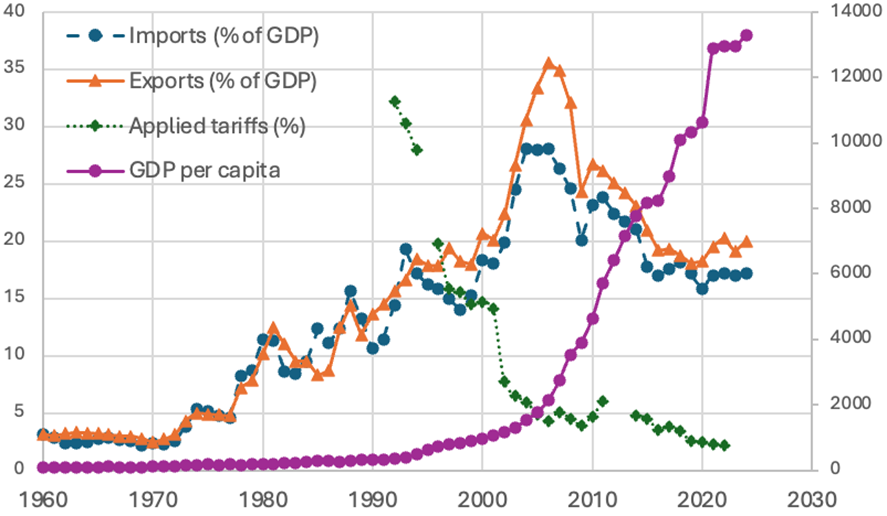
Notes: Imports and exports include both goods and services; applied tariff rates are weighted averages across all traded products; GDP per capita is in current USD. Source: World Bank Open Data.
The US normalised trade relations with China in 1980 and made them permanent in 1999, a shift that greatly reduced trade policy uncertainty and accelerated China’s trade expansion (Handley and Limão 2017, Alessandria et al. 2025). The simultaneous reduction in both import and export tariffs enhanced firm productivity, intensified domestic competition, and pushed markups downward (Yu 2015, Brandt et al. 2017).
A key aspect of the productivity growth and capital deepening was the dual-track approach, which preserved state control over SOEs while permitting private firms to flourish. However, this coexistence of market and state systems introduced institutional frictions, notably credit misallocation favouring SOEs that constrained private sector growth. Despite these inefficiencies, resource reallocation from low-productivity state sectors to high-productivity private firms boosted productivity, while high savings rates and FDI fuelled capital accumulation (Song et al. 2011).
Further reforms also dismantled key institutional barriers. SOEs lost their monopoly on trading rights (Bai et al. 2017), quotas were phased out (Khandelwal et al. 2013), and new trade agreements were signed (Li et al. 2016). These steps, combined with surging global demand, entrenched China’s role in world trade.
Place-Based Policies and Transportation Infrastructure
China’s liberalisation went far beyond tariff reductions. A central innovation was the introduction of processing trade in 1978, which allowed firms to import inputs duty-free, assemble or process them domestically, and then re-export the finished goods. This system enabled China to integrate quickly into global supply chains, particularly in labour-intensive industries such as electronics, textiles, and toys. Because it required little working capital, processing trade thrived in an economy constrained by financial frictions (Manova and Yu 2016). At its peak in the 1990s and 2000s, it accounted for more than half of China’s exports (Feenstra and Wei 2010). However, processing firms were typically less productive and captured less value than ‘ordinary’ exporters (Dai et al. 2016, Yu 2015). As domestic capital markets developed and firms became more sophisticated, the share of processing trade gradually declined.
Industrial and place-based policies reinforced trade growth. Starting in 1979, special economic zones proliferated, offering firms tax breaks, reduced duties, cheaper land, and easier access to credit. These policies increased investment and raised wages, output, and productivity, while encouraging firm entry (Wang 2013, Lu et al. 2019). At the same time, the state targeted strategic industries, such as shipbuilding and renewable energy with a broad toolkit of subsidies, R&D incentives, and consolidation policies. Evidence shows these interventions boosted innovation, productivity, and exports, though effectiveness varied across instruments (Banares-Sanchez et al. 2024, Barwick et al. 2025).
Critical to China’s industrial ascent was its massive investment in infrastructure, made possible by the state’s ability to mobilise resources at scale – through public finance, state-owned enterprises, and coordinated planning. Over the past four decades, the country has built world-class ports, highways, railways, and airports, drastically reducing trade costs and enabling firms to integrate into global production networks (Fan et al. 2023, Huang et al. 2025).
Institutions and Governance
China’s industrial policies have been embedded in a distinctive institutional framework. Unlike electoral democracies, Chinese officials are accountable to higher party-state authorities rather than voters. Career advancement is tied to a “regional tournament” system in which local leaders compete on measurable economic outcomes, historically GDP growth (Li and Zhou 2005, Xu 2011, Li et al. 2019, Qian et al. 2006). This system incentivised officials to actively support firms – by attracting foreign direct investment, expanding trade, or building economic zones – aligning political goals with corporate interests (Ang 2020, Bai et al. 2019, Jia et al. 2015, Lei 2021). Recent research adds nuance to this view: Chen (2025) shows that GDP growth targets – central to cadre evaluation – create strong incentives for local officials to induce firm-level production responses precisely at the threshold where targets are met, leading to spikes in output, inventories, energy use, and pollution, and thus driving real activity but also risking misallocation and overproduction.
Local governments played a central role by controlling access to land, capital, and subsidies. For example, Wuhu’s support for Chery Automobile – with land, credit, and infrastructure – enabled the firm to become a leading exporter (Bai et al. 2019).
Policy design followed an “experimentation under hierarchy” model (Heilmann 2008). Top-down pilot programmes tested centrally driven initiatives, though they often suffered from political bias and limited replicability (Wang and Yang 2025). Bottom-up innovations, in contrast, emerged from local experimentation, particularly in politically peripheral areas, and proved more effective for productivity growth (Chen et al. 2025). The interaction between these two pathways created a dynamic feedback loop, balancing central strategy with local adaptation (Fang et al. 2025).
Taking Stock
China’s ascent has been powered by a distinctive nexus of policy and institutions – a blend of trade liberalisation, industrial and place-based interventions, massive infrastructure investment, and a bureaucratic system structured around strong growth incentives. Like earlier East Asian tigers, China relied on export-led growth and technology adoption, but its sheer scale and adaptive institutions set it apart.
Looking forward, China faces a more challenging environment, with heightened trade frictions and geopolitical tensions. Sustaining growth will require deepening trade integration, diversifying export markets, and reorienting bureaucratic incentives to help firms navigate rising economic nationalism in the US and other high-income countries.
Although China’s governance model is not fully transferable, other emerging economies can draw valuable lessons from both its successes and its pitfalls. The “regional tournament” system, which rewarded local officials for rapid economic expansion, has also encouraged the pursuit of measurable short-term targets at the expense of unmeasured externalities, such as pollution (Zheng et al. 2014, Carattini et al. 2025) and inequality (Han et al. 2012). Frequent official turnover has further fostered short-termism, fuelling local deficits through debt-funded projects (Song and Xiong 2024).
Yet China’s policy experimentation under hierarchy offers an alternative model for balancing innovation with control. By encouraging local governments to pilot new reforms within a framework of central oversight, China has institutionalised a process for testing and scaling policy innovations while mitigating systemic risk (Wang and Yang 2025, Chen et al. 2025, Fang et al. 2025). While local short-term pressures persist, centralised long-term planning has ensured strategic continuity in areas such as infrastructure and sectoral upgrading. Other economies – facing distinct institutional constraints – can adapt this experimental, iterative approach to their own contexts. The key lesson lies not in replicating China’s system, but in crafting mechanisms that combine local learning with long-term vision, enabling sustained structural transformation and inclusive growth.
For full reference list see the end of the final chapter.
Contact VoxDev
If you have questions, feedback, or would like more information about this article, please feel free to reach out to the VoxDev team. We’re here to help with any inquiries and to provide further insights on our research and content.
Supporter Logos