



Equal land distribution in pre-industrial East Asia paradoxically drove poverty by enabling higher fertility among landowning households, creating population pressure that depressed wages. This dynamic explains why East Asia diverged from Western Europe before industrialisation, and why low wages may have discouraged the labour-saving innovations that powered the Industrial Revolution.
Editor’s note: For a broader synthesis of themes covered in this article, check out our VoxDevLit on Industrial Development.
Despite stagnation, societies have gradually evolved over many millennia preceding the dawn of modern economic growth in the 18th century. Recent work has shown that societies differed greatly in their living standards during this era. The Japanese, Indians, and Chinese had amongst the lowest wages. The sub-Saharan Africans and Southern Europeans were richer while the richest were those in Northwest Europe. These differing equilibria may have, over many centuries, shaped these societies through factors such as culture and institutions that have long-run persistence (Mokyr 2011, Acemoglu and Robinson 2012). Yet, we currently have no answer to the fundamental question why societies across the world had such diverse beginnings in 1800.
In a forthcoming study (Kumon 2026), I focus on the question of why pre-industrial Japan was so poor up to 1880. Despite being a highly sophisticated society and among the first non-Western countries to industrialise, it ranked among the poorest countries in the world by measures of unskilled male wages (Kumon 2022). I show that the unusually equal distribution of landownership paradoxically led it to become one of the poorest economies in history. These findings can also explain why much of East Asia had become poor and already diverged from Western Europe by 1800.
How rich was pre-industrial East Asia?
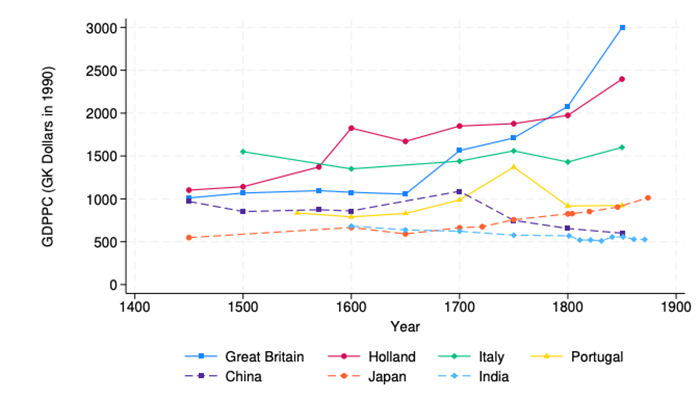
Across multiple indicators, including urban day wages and GDP per head, Japan and China lagged well behind north‑western Europe from at least the 17th century. In Japan, male labourers could sustain barely 2–3 adults on a ‘bare‑bones’ basket of goods using their wages. This was less than half the wage of those in England. GDP per capita, too, was markedly lower.
This had consequences for the economy. The Japanese obeyed a market signal, the price of labour, to use their abundant labour and save on capital. In contrast, the British had an incentive to save on labour, which can potentially explain the series of labour-saving innovations during industrialisation (Allen 2009). There are many examples of this affecting how societies solved problems. For example, preceding mechanisation, many strength-intensive tasks were done by either draft animals or humans – which one was used depended on the relative costs. A basic comparison shows that in a society with relatively scarce labour inputs, such as pre-industrial England, there were 50% more draft animals per person than in pre-industrial Japan. The Japanese were essentially using manpower to substitute draft animals because labourers were cheaper.
However, it was not just wages that differed across these regions. Another major difference was that unlike England’s largely landless rural workforce, most Japanese peasants owned land. Recent estimates of Japanese landownership inequality suggest roughly 85% of households owned land. The village‑level Gini coefficient for landownership was around 0.62, far below Western Europe where it was typically 0.7–0.9. Why were pre‑industrial Japanese wages so depressed?
Figure 1: Urban unskilled male wages
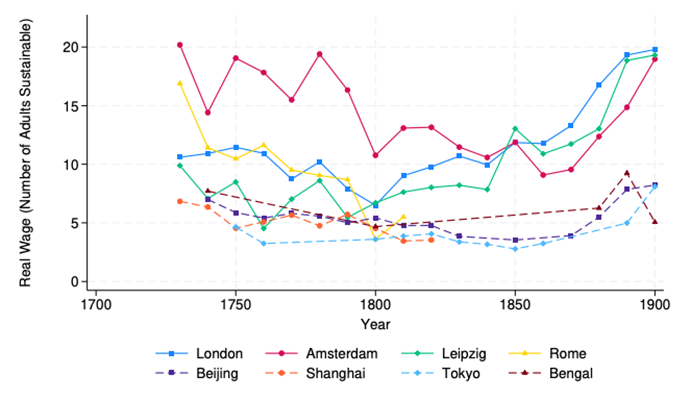
Figure 2: GDP per capita estimates
A Malthusian explanation with inequality
The Malthusian model is the dominant for why the pre-industrial world did not grow (Galor and Weil 2000). At its most basic level, the idea is that, much like bacteria or mice, humans used surplus resources beyond subsistence to raise more children. Since these societies were agricultural and land areas were largely fixed, the consequence of more children over the long run was reduced land-labour ratios and incomes. In a self-regulating system akin to nature, surplus incomes eventually reverted to subsistence level. Societies were in a poverty trap via a demographic mechanism.
I expand this model to include the effect of inequality in landownership. The idea is that the distribution of resources can affect societal level fertility and therefore population density. For example, English farmers typically farmed someone else's land. They paid around 40% of output to the landowner. The masses of landless labourers, who broadly determined societal fertility, had limited resources to reproduce. In contrast, the typical Japanese farmer was mostly farming their own lands and kept much of their own farm output. The masses of Japanese landowning peasants were using a substantially larger share of national incomes to reproduce. All else equal, the greater equality in East Asia led to higher fertility and greater population pressure. The consequence was higher population densities, higher supplies of labour, and lower wages.
Figure 3: Landownership and fertility in pre-industrial Japan
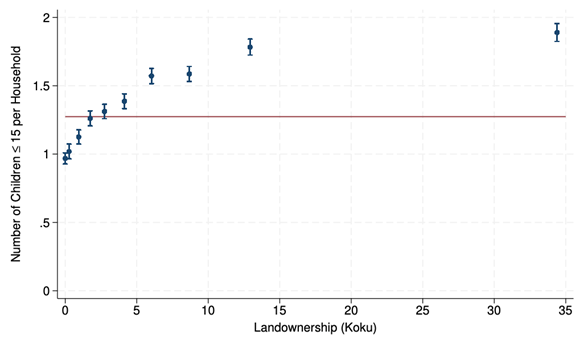
I show this mechanism in action using individual level microdata from 334 rural Japanese village censuses between 1600 and 1870. True to the mechanism, I observe that greater landownership (or more resources) led to higher fertility among households. I visualise this result in Figure 3, which plots the number of children per household aged less than 15 in a census by landownership, where the former measure is a proxy for fertility. We see there is a positive relationship between landownership and fertility. This seems to have been driven by earlier ages at marriage among richer households.
More interestingly, Japanese society was being sustained by the high fertility of the landowning households. A consequence of this was high population densities and low wages that could not sustain a large family. To see this, Figure 3 also plots a red line for the estimated number of children required per household for it to achieve net zero fertility. We can see that the landless and land poor had negative net reproduction. This is entirely consistent with the wage estimates. However, population was stable because the land poor were a minority of the population. Overall, there were sufficient land rich households that could counterbalance this with positive net fertility.
In contrast, pre-industrial England had a different system. Due to the unequal land distribution, the poor masses only had wage incomes. Population was in equilibrium because the landless labourers could achieve net zero fertility with only these wage incomes as shown by similar studies for pre-industrial England. The English were in a low population equilibrium where the masses owned no land but the extra resources accrued from landownership were not required for reproductive success.
Policy implications: The uneven starting line to modern economic growth
Using a simple simulation, I estimate that this mechanism can explain half of the wage gap between Japan and England. Therefore, differences in inequality between East Asia and Western Europe can explain much of the difference in population density and wages by 1800. My research therefore shows that economic structure, in the form of landownership, can have a great impact on living standards. In the pre-industrial case, equality unfortunately created poverty.
These findings illuminate why East Asia and Western Europe had diverged before industrialisation. Historians have often associated low wages with backwardness and therefore have denied that East Asian wages were lower than those in Western Europe. My research shows that low wages were a consequence of population pressure and had little to do with human capital. However, the low wage structure, through price-signals, may have disincentivised these societies from inventing labour-saving technologies that powered the Industrial Revolution on the other side of Eurasia.
References
Acemoglu, D, and J A Robinson (2012), Why nations fail: The origins of power, prosperity and poverty. London: Profile.
Allen, R C (2009), The British Industrial Revolution in global perspective. Cambridge: Cambridge University Press.
Galor, O, and D N Weil (2000), "Population, technology, and growth: From Malthusian stagnation to the demographic transition and beyond," American Economic Review, 90(4): 806–828.
Kumon, Y (2022), "The labor-intensive path: Wages, incomes, and the work year in Japan, 1610–1890," Journal of Economic History, 82(2): 368–402.
Kumon, Y (2026), "How equality created poverty in pre-industrial Japan, 1600–1870," American Economic Journal: Applied Economics, 18(2): 147–176.
Mokyr, J (2011), The enlightened economy: Britain and the Industrial Revolution, 1700–1850. London: Penguin UK.