




Agglomeration economies and the coordination of people’s expectations were pivotal to the recovery of central Hiroshima following the atomic bombing.
A version of this article first appeared on VoxEU.
Cities have faced a host of shocks throughout history. Wars, natural disasters, pandemics, and technological shocks have all impacted city structure–the spatial distribution of economic activities within cities.
Today, a major source of public policy debate is the resilience of cities in the face of those large-scale shocks. In particular, whether city structure would change substantially once a central location in a city with the highest population and employment density is destroyed by a large negative shock. There remains substantial debate about whether city structure is resilient to such large shocks and what mechanisms are behind this resilience (Glaeser 2022).
Although there is an influential line of existing research on wartime bombing in economics (Davis and Weinstein 2002, Miguel and Roland 2011, Feigenbaum et al. 2022), two important challenges remain in understanding the mechanisms that underlie the resilience of city structures. First, we rarely observe a large shock to city structure while having access to spatially granular data on economic activities over a long period of time. Second, we need a quantifiable model of the dynamics of internal city structure that allows us to disentangle the mechanisms underlying the resilience of city structure.
The economic dynamics of city structure and Hiroshima’s recovery
In new research (Takeda and Yamagishi 2025), we present theory and evidence on the resilience of city structure by analysing the most dramatic events in history, namely the atomic bombing of the city of Hiroshima in Japan. We combine:
- Newly digitised data on Hiroshima’s economic activities at a fine level of spatial disaggregation, covering both before and after WWII.
- Reduced-form analysis of the impact of the atomic bombing on the distribution of economic activities in the city.
- A dynamic quantitative urban economics model.
Together, we leverage these to explore the mechanisms that underlie the resilience of city structure.
Figure 1 illustrates the pattern of population density in relation to distance from the central business district (CBD) in Hiroshima for different years. In the period before WWII, Hiroshima had a monocentric city structure, with the highest employment and population densities concentrated in the city centre.
On August 6, 1945, the atomic bombing hit the city centre, inducing a nearly 100% death rate around the centre and destroying almost all structures within 2 km of the city centre. In the immediate aftermath of the atomic bombing, there was a complete reversal of this monocentric city structure, with the city centre devastated and the highest population densities found in the outskirts. Nevertheless, by as early as 1950, a monocentric city structure had re-emerged, with the highest concentrations of employment and population densities again in the city centre.
We then provide reduced-form evidence against a number of potential explanations, including fundamental location characteristics (first nature) and built and man-made environments, such as transportation access and land use regulation. Overall, the results suggest that the observable location characteristics we control for are unlikely to account for the strong recovery of the city centre and the re-emergence of the pre-war city structure.
Figure 1: Population density by distance to the city centre in Hiroshima for different periods
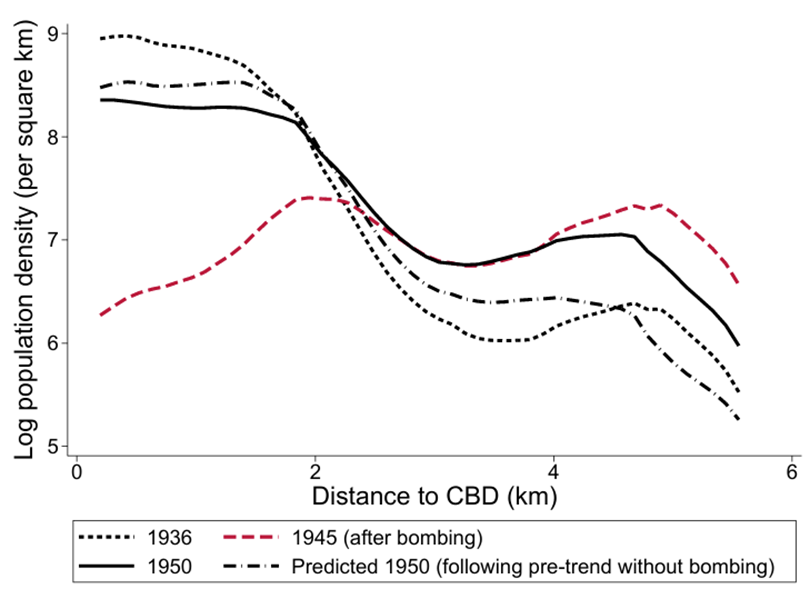
Note: The figure shows the local polynomial regression of the log population density on the distance to the CBD for different years. To eliminate the effect of changes in the total population, we normalise the total population each year to 100,000. The predicted population distribution of 1950 is computed based on the 1936 population distribution, assuming that each block experienced an annual population growth rate equal to the pre-war (1933–1936) rate.
Location characteristics and agglomeration economies
So, what mechanisms might explain the recovery of the city centre? We consider the following two potential mechanisms.
- There could be some unobserved locational advantages in the destroyed city centre that persisted through the bombing (e.g. scenic views) or had been developed after the bombing (e.g. durable infrastructure investment).
- People may have expected the recovery of the destroyed city centre when making location choices, and the incentive to live and work again in the city centre arises from agglomeration forces accompanied by the expected high density as in the pre-war period.
It is challenging to disentangle these possibilities in a reduced-form analysis. Therefore, we develop and calibrate a novel dynamic quantitative urban model (see Appendix 1) that incorporates both agglomeration forces and unobserved location characteristics as potential explanations for the recovery.
The key mechanisms behind Hiroshima’s recovery
We quantify our model (details in the appendix) using the observed data on population, employment, floor spaces, and bilateral travel times in Hiroshima. We follow these three steps.
- The worker commuting and mobility parameters are calibrated using historical data for Hiroshima.
- Given these parameters, the model can be inverted to recover overall productivities and amenities in each location, which in turn depend on agglomeration forces and location fundamentals.
- Given these solutions for productivities and amenities, the agglomeration parameters are estimated.
Then, our counterfactual analyses using these estimated parameters reveal the following:
- When there is no agglomeration force, the model no longer predicts the recovery of the population and employment in central Hiroshima, as illustrated in Figure 2(a).
- There exists another possible equilibrium, in which economic activity could have remained concentrated in the outskirts of the city, instead of coalescing around the pre-war centre, as illustrated in Figure 2(b).
The second point provides empirical underpinnings to the discussion of ‘history’ versus ‘expectation’—the initial conditions determined by history can be overcome by expectations when agglomeration forces are important—which traces back to Krugman (1991).
Figure 2: Population density of Hiroshima in different scenarios
(a) No agglomeration forces (b) No expectations for recovery
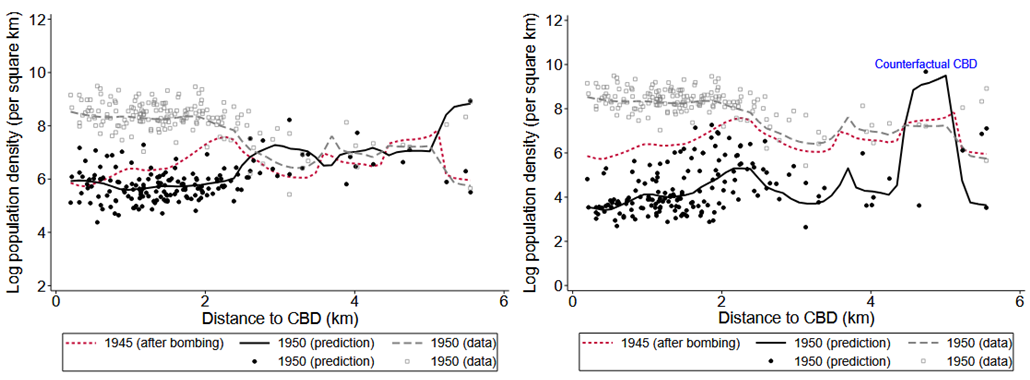
Note: Each figure plots the log population density with local polynomial regressions of each on the distance from the CBD. We run three separate regressions: one for the observed 1945 population and employment densities (small dashed line), one for the observed 1950 population and employment densities (long dashed line), and one for the inferred 1950 population and employment densities in an alternative equilibrium (solid line) when there are no agglomeration forces in productivity and amenities (panel a) and individuals expect that the pre-war CBD will not recover and an alternative block located at the vertical dashed line will grow. Each dot represents a block, with different colours for the predicted density and the observed density. In panel (b) the location with the growing population and employment density is labelled ‘Counterfactual CBD’.
Lessons from the recovery of Hiroshima
Our analysis of Hiroshima shows that strong agglomeration forces are required to explain the re-emergence of the city centre in the aftermath of the atomic bombing, and they imply the existence of multiple equilibria. Our findings provide further empirical support for the idea that the re-emergence of the pre-war city structure is driven by a coordination of expectations around this focal point. A key implication derived from the analysis is that the resilience of cities in the face of large-scale shocks depends critically on the expectations of agents. Therefore, coordinating agents’ expectations about the city structure with public policymakers would aid the reconstruction of war-torn cities, improve urban revitalisation efforts, and inform planning for future shocks.
Appendix 1: Our model of an internal city structure
Our new dynamic quantitative model of internal city structure incorporates commuting, forward-looking location choices of workers, durable floor space, migration frictions, agglomeration forces, and heterogeneous location fundamentals. The city consists of a discrete number of locations that correspond to city blocks in the data.
Blocks differ in terms of their productivity, amenities, land endowment, and bilateral commuting costs. In particular, productivity depends on both location fundamentals (e.g. access to natural water) and agglomeration forces, as determined by the surrounding concentration of employment; and amenities depend on both location fundamentals (e.g. scenic views) and agglomeration forces, as determined by the surrounding concentration of residents.
Workers commute from their residence to their workplace subject to commuting costs, as in Heblich et al. (2020). Bilateral commuting costs depend on the observed transport network, including both private and public transportation, as in Tsivanidis (2022).
In each period, upon receiving a moving opportunity, workers draw idiosyncratic preferences for each residence-workplace pair in Hiroshima and the wider economy and choose the pair that offers the highest utility. This introduces within city dynamics and gradual adjustment in worker mobility decisions, as in Caliendo et al. (2019).
References
Caliendo, L, M Dvorkin, and F Parro (2019), “Trade and labor market dynamics: General equilibrium analysis of the China trade shock”, Econometrica, 87(3): 741–835.
Davis, D R and D E Weinstein (2002), “Bones, bombs, and break points: The geography of economic activity”, American Economic Review, 92(5): 1269–1289.
Feigenbaum, J, J Lee, and F Mezzanotti (2022), “Capital destruction and economic growth: The effects of Sherman’s March, 1850–1920”, American Economic Journal: Applied Economics, 14(4): 301–342.
Glaeser, E L (2022), “Urban resilience”, Urban Studies, 59(1): 3–35.
Heblich, S, S J Redding, and D M Sturm (2020), “The making of the modern metropolis: Evidence from London”, The Quarterly Journal of Economics, 135(4): 2059–2133.
Krugman, P (1991), “History versus expectations”, The Quarterly Journal of Economics, 106(2): 651–667.
Miguel, E and G Roland (2011), “The long-run impact of bombing Vietnam”, Journal of Development Economics, 96(1): 1–15.
Takeda, K and A Yamagishi (2025), “The economic dynamics of city structure: Evidence from Hiroshima's recovery”, Centre for Economic Performance.
Tsivanidis, N (2022), “Evaluating the impact of urban transit infrastructure: Evidence from Bogotá’s TransMilenio”, Unpublished manuscript.