


How does organised crime take over a city – and can mayors act before it does?
You can listen to this podcast on Spotify, Apple Podcasts, or wherever else you get your podcasts. You can also watch this conversation on YouTube, and we've started a Substack for these episodes.
Organised crime is a core development challenge for a growing number of countries around the world. Where criminal groups gain a foothold, they have a host of destructive impacts on societies and economies, with many of these manifesting in urban areas.
In this episode of Ideas in Development, Chris Blattman joined us to unpack how organised crime evolves in cities, why it is so difficult to dislodge once entrenched, and what fast-growing cities can do to get ahead of this problem.
The ladder from street gang to criminal confederation
Chris is careful not to describe the rise of organised crime as an inevitable evolution. In many cities, crime remains atomised, split amongst individual burglars, car thieves, small clusters selling drugs.
But in a subset of cities, a pattern repeats. Fragmented youth gangs, rooted in particular neighbourhoods and ethnicities, begin to take on more hierarchical structures as local drug markets grow. What starts as a social grouping becomes something more like a firm. Those firms then tend to face a choice: keep fighting each other, or collude. Hundreds of small gangs competing violently for territory is a miserable business model.
“Nobody’s making money in the middle of a drug war.”
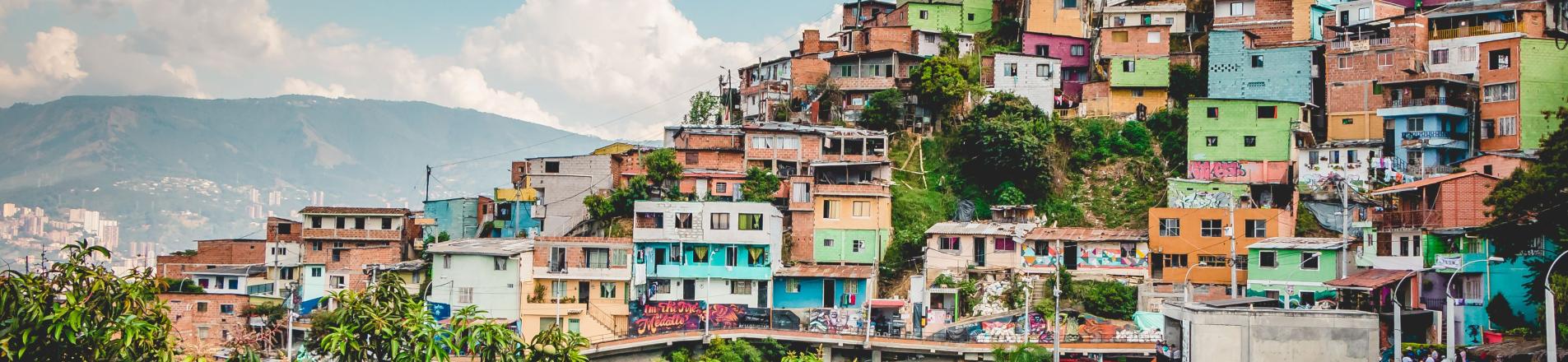
The common solution, in the cities that get this far, is confederation. Neighbouring gangs are organised, often by an outside actor, into larger alliances that fix prices, allocate territory, and police each other’s violence. Medellín has around 400 ‘combos’ operating under roughly 17 ‘razones’, each of which Chris describes as something like a franchise system sitting beneath a couple of major alliances. At the top sits an informal institution the criminals themselves sometimes call La Oficina, the office. Combos that want to go to war must ask permission.
The terrible trade-off
A city with a homicide rate in the teens is, by the standards of most large cities in Latin America, a success story. Medellín now sits at roughly 10 or 11 murders per 100,000 people, lower than Chicago, and a fraction of what it was 15 years ago, when the city was one of the most violent places on the planet. And yet, on any given street in any neighbourhood in Medellín, someone is selling drugs for a combo. Someone is being extorted for a local monopoly on gas canisters. Every square inch of the city has been claimed.
That is the puzzle at the centre of organised crime as a development problem. Peace and capture can co-exist. Violence can fall while criminal power rises. And the policies that reduce one sometimes deepen the other.
“There’s sort of three things you want as a mayor. You’d like the gangs to be poor and not very powerful. You’d like there to be peace. And you don’t want the whole polity to be completely corrupted by organised crime. And you never really get all three. You can basically choose two.”
Medellín’s story is unusual. The city’s transition from chaotic violence to criminal peace was partly a product of its particular history, the civil war, the paramilitaries, the legacy of Pablo Escobar, and partly a product of deliberate tolerance by the state. Don Berna, a former paramilitary leader, built the first version of La Oficina. When he was extradited to the United States in 2008, a four-year war of succession followed. Only in 2012, with the Pacto del Fusil (the Pact of the Machine Gun) did the current criminal peace begin to stabilise.
Subsequent Medellín governments, Chris argues, have been quietly disciplined about maintaining this arrangement. They do not extradite senior criminal leaders. They tolerate, or at least do not actively prevent, leaders governing the street from prison. When violence starts to escalate, rival bosses are found to have been coincidentally moved into the same holding area to figure things out.
Chicago has taken the opposite approach. Decapitate, decapitate, decapitate. The confederations that once stitched together the city’s gangs, organisations the Black P. Stones and others called ‘nations’, have been broken up. What remains is a landscape of hundreds of fragmented youth gangs, and the escalatory spirals of violence that have returned in recent years.
This, Chris argues, is the terrible trade-off facing any mayor confronting organised crime. Three things you might want, low violence, weak criminal groups, and an uncorrupted political system, are incredibly challenging to achieve simultaneously, especially once crime has already taken root. Medellín chose one corner of the triangle. Chicago chose another.
“I don’t envy the politicians who have to make these decisions.”
Why low violence can still mean deep capture
A city at ten homicides per 100,000 can still be a city being hollowed out. Combos in Medellín generate most of their rents from retail drugs, but perhaps 20 to 30% comes from extortion. This includes local monopolies on gas canisters used for cook stoves. A cut of the eggs, the arepas, the yoghurt, the bar shots sold on the street. Tiny markups individually, which add up rapidly when applied across an entire city. And drug profits must then be laundered, which pulls whole swathes of the retail sector into the orbit of organised crime.
Political corruption follows, as at elections, gangs can deliver turnout for favoured candidates.
Diagnosis, not prescription
The most common mistake Chris sees among policymakers is the search for a transferable template, a silver bullet, or a case study to copy. A mayor looks at New York’s homicide decline and wants CompStat and hotspots policing. Another looks at Chicago and wants violence interruption. Another looks at El Salvador and wants to emulate Bukele.
You wouldn’t trust a doctor who skips the diagnosis, and goes straight to prescribing you the exact same treatment as their last patient. But somehow, when it comes to crime, policymakers are turning off that part of their brain.
Bukele’s mass-incarceration approach to reduce crime worked (to the extent it did, as it’s still early days and there are many related legal/human rights issues), because El Salvador’s gangs were structurally weak. They were dependent on extortion, had no significant retail drug market, and no base of citizens clamouring for their return. Apply the same strategy to a city with an established drug trade and the demand for drugs remains untouched.
“If you did that in Medellín or in Chicago, and you just could wave a magic wand and pop all of these people into a Megamax prison somewhere, you would have thousands, tens of thousands of people who were buying their drugs who were like, ‘Where do I get my fix?’ And they’re going to be clamouring for somebody to come back and someone will fill that gap.”
What’s needed is proper diagnosis. And what’s striking is how few cities seriously invest in it. Senior security officials, mayors and police chiefs often do not grasp what is actually happening in their own cities, particularly in places like Ecuador, Peru and Chile, where violence has erupted in the past two years after long periods of relative calm.
Chris and his colleagues are now building what are in effect criminal diagnosis labs, in Medellín, Rio and Mexico City. By pooling interviews with gang leaders, middle managers and thousands of schoolchildren into open-source, anonymised datasets, the goal is to systematise how cities understand their own crime problems before the next mayor rotates in.
The warning signs for African cities
“My worry is that in 30 or 40 years, Lagos looks like Rio.”
Several African cities are becoming attractive transshipment points for cocaine and pills moving between South America and Europe. Nascent gang structures, from scamming operations in Lagos to groups like the Mungiki in Kenya, look eerily similar to the decentralised youth gangs that eventually consolidated into Latin America’s confederations. Meanwhile, the state apparatus in Africa is often highly centralised, with security attention focused on rural insurgencies, and mayors having little real power.
The lesson from Medellín, Bogotá and Santiago is that retail drug markets are built slowly over a couple of decades, but once entrenched are almost impossible to dislodge. That time horizon is also the window for action. This involves keeping ports unattractive to traffickers, disrupting the spillover from transshipment into local retail, and, above all, investing in the kind of granular diagnosis that lets a city properly understand its own problem.
“These retail drug (markets) – they’re a little bit like herpes. Once you’ve got them, you’ve got them.”
If that window closes, the choice African mayors will not get to decide whether to tolerate organised crime, but only which corner of the trilemma they must accept.