

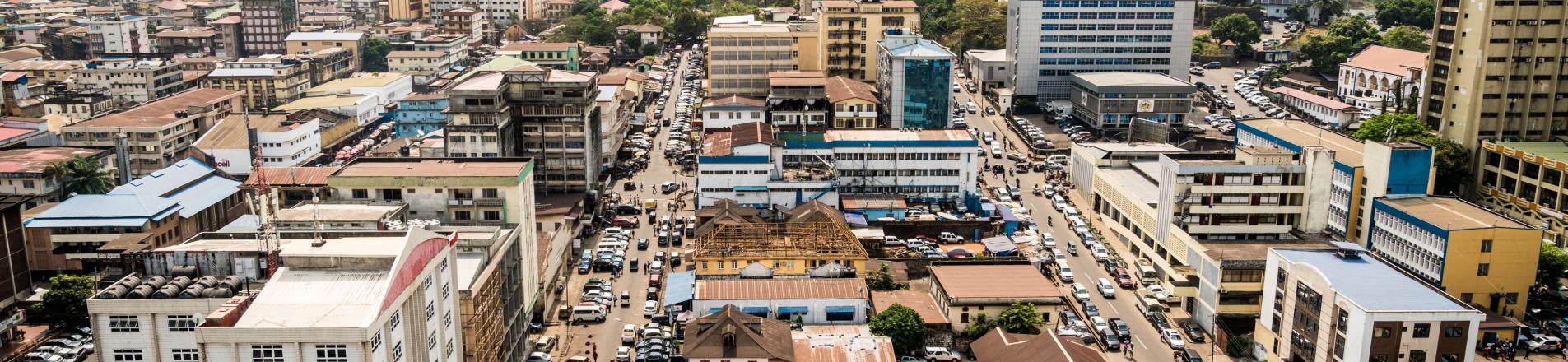



Astrid Haas joins Ideas in Development to discuss why African cities are so fiscally constrained, and what reforms in Mexico, the Philippines, and Sierra Leone can teach us.
You can listen to this podcast on Spotify, Apple Podcasts, or wherever else you get your podcasts. You can also watch this conversation on YouTube, and we've also started a Substack for these episodes.
Africa’s cities are growing at an unprecedented rate. So, understandably, African mayors currently have a long shopping list. They need to build roads, drainage, water, power connections, housing infrastructure, public transport, waste systems, and the other basic public services that make dense urban life actually liveable. But there is an important paradox here.
Despite the pressure on mayors to deliver on all of these priorities, in many places they don’t actually control the big fiscal levers. City revenues are low, transfers from the central government can be unpredictable, and city borrowing is either legally restricted or wildly expensive. But hard is not impossible. Other countries have been able to build the institutions that allowed subnational governments to access long-term finance, raise revenues, and invest at scale.
In this episode of Ideas in Development, we are joined by Astrid Haas to discuss why African cities are so fiscally constrained, what reforms have worked elsewhere, and what it would take to unlock the finance that fast-growing African cities urgently need.
Being an African mayor is hard!
Astrid starts by outlining just how hard being the mayor of an African city is. Imagine managing a city of four million people on an annual budget of $25 million. Astrid recently attended a panel discussion where this was the reality described by the mayor of a large African city – their European counterpart on the panel could not comprehend such a low budget. It captures the central paradox of urban governance across much of Africa: mayors are locally accountable for delivering infrastructure but they don’t control the fiscal levers needed to pay for any of it.
The fiscal paradox of African cities
African cities occupy an awkward position in the architecture of the state. On paper, they are legally recognised entities with responsibility for infrastructure and services. In practice, they are decentralised entities trapped in fiscally centralised systems. They carry enormous delivery obligations but have limited powers to raise revenue, borrow, or plan with confidence.
“You are responsible and you are locally accountable, but you don’t have the money to do so”
The result is that most African mayors function less as CEOs of their cities and more as delivery managers for budgets they didn’t set and can’t control.
But Astrid argues that the best city leaders refuse to accept scarcity as the endpoint. The successful ones treat it as a starting point, working to build coalitions, expand fiscal space, and find ways to do more with what they have. That requires leadership skills more commonly associated with entrepreneurs than bureaucrats: coalition-building, communication, and the ability to generate trust.
The social contract in cities
The ability to raise revenue locally is fundamental to the social contract. If a city is responsible for delivering services but someone else raises the money, the accountability link between citizens and their local government breaks down. Conversely, when cities raise their own revenues, citizens can see what they’re paying for and hold leaders to account.
There is also a practical benefit. A steady stream of own-source revenue is the foundation for borrowing. Without it, cities cannot demonstrate the creditworthiness needed to access longer-term finance for infrastructure investment.
That said, Astrid is careful to note that no city can survive on own-source revenue alone. City tax bases are inherently smaller than national ones, so intergovernmental transfers will always be part of the picture. The question is getting the balance right between the different sources, and making sure transfers are predictable enough that cities can actually plan around them.
Why cities aren’t borrowing – and when they should
Given the scale of Africa’s infrastructure needs, it might seem obvious that cities should be borrowing more. But Astrid pushes back on the assumption that borrowing is always desirable. Cities need the fiscal capacity to repay without compromising service delivery. And not all projects are suitable for debt finance. Public goods are public goods for a reason, and not everything can be packaged into a bankable project.
But for those cities that can and should borrow, the barriers are formidable. City finances are often opaque, with weak auditing and financial reporting that make them unattractive to investors. National legislation can be overly restrictive. Political dynamics can play a role too, as national governments sometimes resist cities becoming financially independent, particularly where cities are opposition strongholds. And critically, there is a shortage of local currency finance – cities should not be borrowing in hard currency because, unlike national governments, they cannot hedge against foreign exchange risk.
On the supply side, domestic financial markets in many African countries are simply too shallow. Pension funds and savings exist but are not being channelled towards local infrastructure. So Astrid argues for strengthening financial intermediaries institutions that can take on foreign currency loans and convert them into local currency lending for cities, while also bringing an understanding of the domestic market.
Lessons from Mexico, the Philippines, and France
The good news is that other countries have faced similar problems and found institutional solutions.
In Mexico, the key reform was stabilising intergovernmental transfers. Once subnational governments knew their transfers would arrive predictably, on time and in a known amount, they could borrow against them. Investors, in turn, had confidence they would be repaid, because the first portion of each transfer was ringfenced for debt service. The reform unlocked a new source of finance by simply making an existing revenue stream reliable.
The Philippines took a differentiated approach in its 1996 local government framework, recognising that not all cities are in the same position. Large, fiscally sound cities were allowed to go to market. Mid-sized cities with emerging creditworthiness could borrow from national financial intermediaries. Small cities that were not yet creditworthy were prioritised for national transfers and subsidies. This freed up the public budget to support the places that genuinely needed it, rather than spreading resources thinly across all cities regardless of capacity. Alongside this, the Philippines created a municipal development fund office and a local guarantee unit that provided government guarantees to crowd in private finance and, crucially, conducted local credit ratings, assessing cities against each other rather than against international standards.
France’s ‘caisse des dépôts et consignations’ model offers another template. This is an institution linked to the national treasury that accumulates domestic savings and lends them locally. Variants of this model exist across Francophone Africa, and similar principles underpin Morocco’s FEC and the Development Bank of Southern Africa, which has one of the largest municipal lending portfolios in the developing world.
Freetown proves it can be done in Africa
The most striking example in the episode comes from Freetown, Sierra Leone, where Mayor Yvonne Aki-Sawyerr inherited a city with high urbanisation rates, crumbling infrastructure, and a broken fiscal contract. She needed money to enact reform, but citizens had no reason to trust that their taxes would be well spent.
Her approach started not with raising more revenue, but with spending existing money more effectively, through a plan called Transform Freetown, which was built with extensive input from residents. Only once citizens had bought into what their money would be used for did she push through a property tax reform – often called the tax people love to hate, given its visibility. She did so during COVID, when most cities worldwide were waiving or reducing taxes, overcame resistance from the national government, and ultimately succeeded.
“People are actually willing to pay tax if they know what they’re going to get from that tax”
The lesson is that revenue reform cannot be separated from expenditure reform as the two go hand in hand.
“You don’t need a perfect system… you need to be able to do reforms that build credible momentum over time and then build on that momentum.”
Freetown is now in the process of raising finance for the city’s first cable car, which reflects how early fiscal credibility can compound over time and open up larger possibilities.
What Africa can, and can’t, learn from urban finance in China
China is often held up as the gold standard of rapid urbanisation. And Astrid identifies some genuine lessons. For example, China allowed local governments to experiment within centrally set parameters, rather than imposing a single model; it leveraged land-based financing tools to fund infrastructure; and it built infrastructure ahead of settlement, avoiding the far higher costs of retrofitting.
But hindsight reveals serious some risks. Land was over-leveraged in many places, and once it was leased there were few alternative revenue sources. China still does not have a property tax, and introducing one now, when property values are already high, is politically far harder than it would have been at the outset. African cities should take note of this – delaying a property tax makes it more difficult, not less. And China’s growth path was built on carbon-intensive infrastructure that African cities cannot afford to replicate in a climate-constrained world.
What national and city governments should do now
Astrid’s concluding recommendations run in two directions.
For national governments, the priorities are threefold:
- Make intergovernmental transfers predictable in both timing and amount, so cities can plan and potentially borrow against them.
- Create differentiated frameworks that allow creditworthy cities to borrow while directing subsidies to those that cannot.
- Develop or strengthen financial intermediaries that can channel domestic and international capital into local-currency lending for cities.
For city governments, the task is to get their own house in order, by improving financial transparency, investing in administrative capacity, and demonstratin that they can raise and spend money effectively. Creditworthiness needs to be built, incrementally, through credible fiscal management.