



Extending maternity leave from 12 to 24 weeks in Chile increased mothers' formal employment for up to three years after childbirth, with no negative medium-term effects. This suggests that maternity leave expansions can strengthen labour market attachment in middle-income countries, particularly for mothers with limited access to childcare and weak pre-birth employment records.
Editor’s note: For a broader synthesis of themes covered in this article, check out Issue 2 of our VoxDevLit on Female Labour Force Participation.
Parental leave policies are designed to insure families against income loss and allow mothers to take time off work to recover from childbirth and care for newborns (Rossin-Slater 2018). While many countries have adopted or expanded government-funded maternity leave – often granting mothers at least 54 weeks after birth (Dahl et al. 2016) – most low- and middle-income countries offer shorter leave durations, limited benefits, and almost no leave for fathers (Banerjee et al. 2024). In these contexts, female labour force participation remains low, partly for lack of family-friendly policies supporting mothers’ employment (Heath et al. 2024). As a result, researchers have understudied the effects of maternity leave policies on women’s labour market outcomes.
In 2011, after decades without major reforms to parental leave, the Chilean government extended maternity leave from 12 to 24 weeks for women contributing to social security. In recent work (Rojas-Ampuero 2026), I examine the effects of this reform on mothers’ labour market outcomes up to seven years after childbirth. I find that the reform increased women’s formal employment during the first three years after birth, with no negative effects in the medium term.
Chile’s 2011 maternity leave reform
Before the reform, eligible mothers received six weeks of paid leave before childbirth and twelve weeks (84 days) after birth, with full wage replacement up to the 90th percentile of the female earnings distribution. Job protection extended for one year after leave ended, and fathers had no comparable benefits.
Policymakers justified the reform based on women’s weak labour market attachment – especially among low-income mothers – the lack of quality childcare options, and the widespread use of alternative sick leave claims. In particular, many women extended their time away from work by claiming other types of leave, such as sick-child leave or mental health leave.
On October 17, 2011, the reform doubled postnatal leave from 12 to 24 weeks and introduced five days of paid paternity leave. Eligibility for the extension depended on the child’s date of birth. Mothers of children born on or after July 25, 2011, qualified for the full 84-day extension, while those whose children were born before May 2, 2011, were not eligible. Mothers of children born between these thresholds received a partial extension. My empirical analysis compares the outcomes of eligible and ineligible mothers. First, to examine the use of maternity and sick leave, I employ a regression discontinuity design in which the child’s date of birth serves as the running variable. Second, to analyse women’s labour market outcomes, I estimate a difference-in-differences model that compares eligible and ineligible mothers before and after the birth of their child.
Mothers’ use of maternity leave and sick leave claims
Eligible mothers substantially increased their use of maternity leave. Figure 1 shows evidence that on average, mothers who qualified for the extension (childbirth after July 25) extended their leave by approximately 80 days relative to ineligible mothers (childbirth before May 2).
Figure 1: Average number of days of maternity leave by child’s date of birth
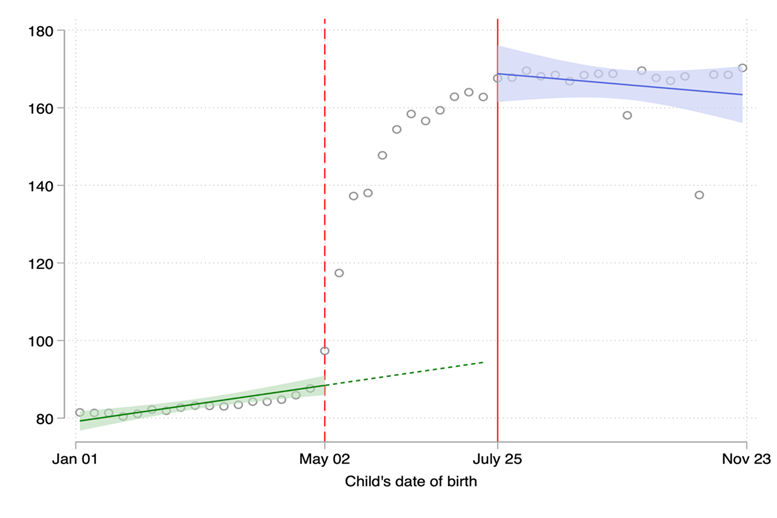
Notes: This figure plots the average number of days of maternity leave by child’s week of birth for women on maternity leave in 2011 along with 95% confidence intervals for the linear estimates, shown separately for ineligible women in green and eligible women in blue. Source: Rojas-Ampuero (2026).
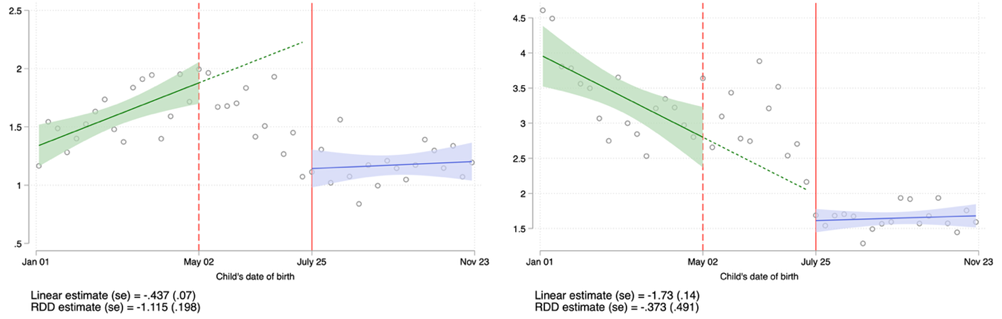
At the same time, eligible mothers reduced both the probability and duration of other types of leave during the first year after childbirth. Figure 2 shows the number of days on leave due to different diagnosis, including leave taken for illness, sick-child leave, and mental health reasons. The patterns in Figure 2 suggest that extended maternity leave substituted for other forms of leave that mothers previously used to prolong their time at home.
Figure 2: Average number of days of other sick leave claims by child’s date of birth
(a) Leave due to accident or illness (b) Leave due to sick child
(c) Leave due to pregnancy-related illness (d) Leave due to mental health
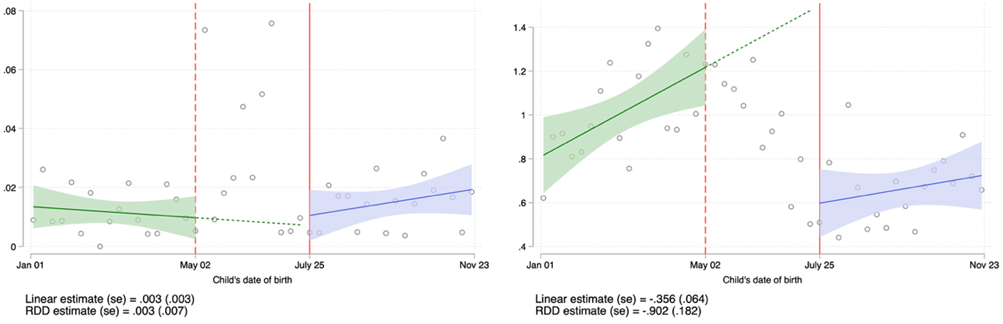
Notes: These figures plot the average number of days of different types of sick leave by child’s week of birth for women on maternity leave in 2011 along with 95% confidence intervals for the linear estimates, shown separately for ineligible women in green and eligible women in blue. Source: Rojas-Ampuero (2026).
Mothers’ formal labour market outcomes
The reform led to meaningful improvements in women’s labour market trajectories. Eligible mothers experienced higher probabilities of formal employment for at least three years after childbirth, with differences between eligible and ineligible mothers fading between years four and seven. The labour market trajectories of eligible and ineligible women are in Panel (a) of Figure 3, and the difference is in Panel (b).
Employment among eligible mothers increased by approximately 15.2–16.1% in the first three years after leave ended, but the effects fade out after year three because ineligible mothers eventually catch up.
Figure 3: Medium-term effects of the reform on women’s formal employment
(a) Employment series (b) Difference-in-difference estimates
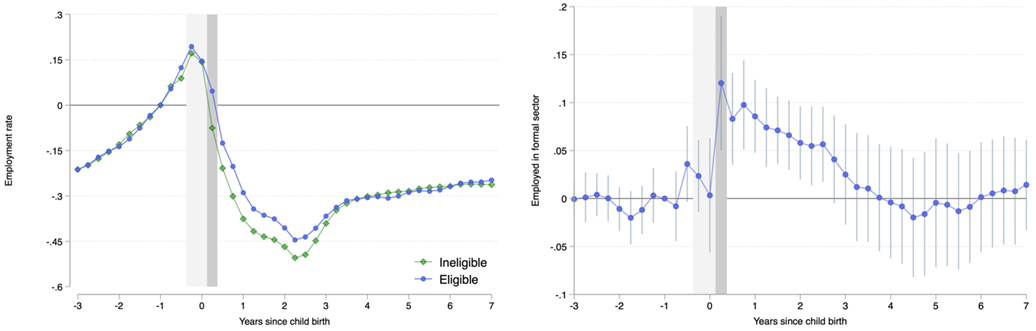
Notes: Panel (a) plots the employment trajectories of women in the formal sector for the eligible group in blue and the ineligible group in green. Panel (b) plots the difference-in-difference estimates and their 95% confidence intervals. The light grey area corresponds to the time of maternity leave from -6 to 12 weeks relative to childbirth. The dark grey area corresponds to the weeks an eligible woman can extend her maternity leave from 12 to 24. Source: Rojas-Ampuero (2026).
Despite the temporary nature of these effects, they generate lasting benefits through increased work experience (Kuka and Shenhav 2024). I estimate that eligible mothers accumulate an additional 0.296 years of experience by year three and 0.945 years by year seven. These gains translate into higher formal wages in the short run due to increased employment among women who would otherwise have remained out of the labour force in the absence of the reform.
Who benefits the most from maternity leave extension?
I examine whether the reform’s effects vary across demographic groups. I find no significant differences by marital status, age at birth, education, or pre-birth wages. However, the effects differ substantially by pre-birth labour market attachment.
Women with low tenure prior to childbirth – defined as having less than 10 months of formal employment in the year before maternity leave – benefit the most from the extension. These women experience larger increases in formal employment, particularly in municipalities with limited access to childcare. This suggests that maternity leave expansions may be especially effective for mothers who are weakly attached to the labour market and face constraints in balancing work and childcare.
Children’s outcomes in the first year of life
The reform also benefits children. Previous research on the same reform has documented improvements in early-life outcomes among children whose mothers were eligible for extended leave. Albagli and Rau (2019) find that eligible mothers report lower stress levels upon returning to work and that their children exhibit better health between 6 and 12 months of age. Duarte et al. (2024) show that infants of mothers who extend their leave require fewer paediatric visits, suggesting improvements in early health conditions.
Policy implications: Maternity leave in developing countries
The effects of maternity leave extensions on women’s labour supply are theoretically ambiguous. Longer leave may facilitate labour market attachment by allowing mothers to remain connected to their jobs, or it may reduce employment by increasing time away from work (Olivetti and Petrongolo 2017). Evidence from high-income countries suggests that maternity leave extensions do not harm employment and may have short-lived positive effects (Rossin-Slater 2018).
My findings indicate that these results do not necessarily generalise to middle-income settings. Structural differences – such as limited childcare availability, weaker job protection, and higher labour market informality – can lead to different outcomes. In Chile, extending maternity leave strengthens labour market attachment, particularly among more vulnerable mothers.
My results also align with the motivations behind the reform: addressing low maternal employment and compensating for limited childcare options. Moreover, the magnitude and persistence of the employment effects for three years exceed those documented in many developed countries, suggesting that maternity leave policies of less than one year may help reduce the motherhood employment penalty in a middle-income context (Kleven et al. 2024).
A key limitation of my study is that Chile restricts maternity leave eligibility to women already employed in the formal sector prior to childbirth. These women are positively selected on earnings and labour market attachment. My findings may therefore not generalise to more disadvantaged women, pointing to the need for further research on employment protection and childcare policies in developing economies.
References
Albagli, P, and T Rau (2019), "The effects of a maternity leave reform on children's abilities and maternal outcomes in Chile," The Economic Journal, 129(619): 1015–1047.
Banerjee, A, R Hanna, B A Olken, and D Sverdlin-Lisker (2024), "Social protection in the developing world," Journal of Economic Literature, 62(4): 1349–1421.
Dahl, G B, K V Løken, M Mogstad, and K V Salvanes (2016), "What is the case for paid maternity leave?" The Review of Economics and Statistics, 98(4): 655–670.
Duarte, F, V Paredes, C Bennett, and I Poblete (2024), "Impact of an extension of maternity leave on infant health," Journal of Population Economics, 37(11).
Heath, R, A Bernhardt, G Borker, A Fitzpatrick, A Keats, M McKelway, A Menzel, T Molina, and G Sharma (2024), "Female labour force participation," VoxDevLit, 11(1).
Kleven, H, C Landais, and G Leite-Mariante (2024), "The child penalty atlas," The Review of Economic Studies, 92(5): 3174–3207.
Kuka, E, and N Shenhav (2024), "Long-run effects of incentivizing work after childbirth," American Economic Review, 114(6): 1692–1722.
Olivetti, C, and B Petrongolo (2017), "The economic consequences of family policies: Lessons from a century of legislation in high-income countries," Journal of Economic Perspectives, 31(1): 205–230.
Rojas-Ampuero, F (2026), "Who benefits from a maternity leave extension? Evidence from Chile," Journal of Development Economics, 182: 103763.
Rossin-Slater, M (2018), "Maternity and family leave policy," in S L Averett, L M Argys, and S D Hoffman (eds), The Oxford Handbook of Women and the Economy, Oxford University Press.