







Twenty years after the Lord's Resistance Army conflict ended in northern Uganda, women who were abducted as children during the war and subsequently released show significantly higher rates of depression and perceived stress, reduced social support, and heightened stress reactivity. In striking contrast, standard economic measures suggest rough parity with non-abducted peers. Recovery from conflict cannot be measured in income alone.
Violent conflict leaves marks that far outlive the conflict itself. A growing body of research documents the long-run effects of war on health, education, and economic outcomes (e.g. Akresh et al. 2023, Bertoni et al. 2019, Blattman and Annan 2010, León-Ciliotta 2012). But less is known about long-term impacts, especially for women, on mental health, non-cognitive traits, and behavioural responses to stress. Yet these outcomes may be as consequential for welfare as income. We address this gap using original data from northern Uganda, where, between the mid-1980s and mid-2000s, the Lord's Resistance Army (LRA) abducted tens of thousands of children.
In new research, we follow approximately 550 women in the Kitgum district in northern Uganda, nearly half of whom were abducted as children or adolescents (Cassar, Kandpal, Lambert, Mbabazi Mpyangu, and Serra 2026). Crucially, we combined a detailed household survey with four incentivised behavioural games, a relatively novel feature in conflict research of this kind. This data allows us to assess outcomes across three domains: mental health, socioeconomic well-being, and non-cognitive traits and preferences. Our data was collected in 2022, roughly 20 years after the conflict ended.
Figure 1 illustrates that abductions were concentrated in early adolescence, a critical stage of development. Over 50% of the abducted women spent over a year in captivity, although even limited exposure at these ages could leave lasting scars.
Identifying the effects of abduction
The core empirical challenge in studying the consequences of conflict victimisation is constructing a valid counterfactual, i.e. a comparison group showing what outcomes of interest would have looked like for the abducted girls in the absence of abduction. We build on Blattman and Annan (2010), who demonstrated that LRA abductions were largely indiscriminate within villages. Raids occurred primarily at night, across communities, and targeted whoever happened to be present. Factors like proximity, household wealth, or parental status did not determine risk.
Re-validating this assumption using three independent data sources – the original Blattman and Annan (2010) data for our sample areas and two surveys fielded concurrently by our team in adjacent sub-counties – we find little evidence of systematic selection into abduction on observable pre-war characteristics. One imbalance worth noting is age: abducted women in our sample are on average five years older than non-abducted women. However, the age imbalance reflects different cohort exposures to the conflict rather than age-specific targeting at the time of the war: older cohorts were children during the peak years of LRA abductions, while younger cohorts were children when abductions had already declined. All analyses control for age, and entropy-balancing on age leaves results essentially unchanged.
Figure 1: Age when abducted and time spent in captivity
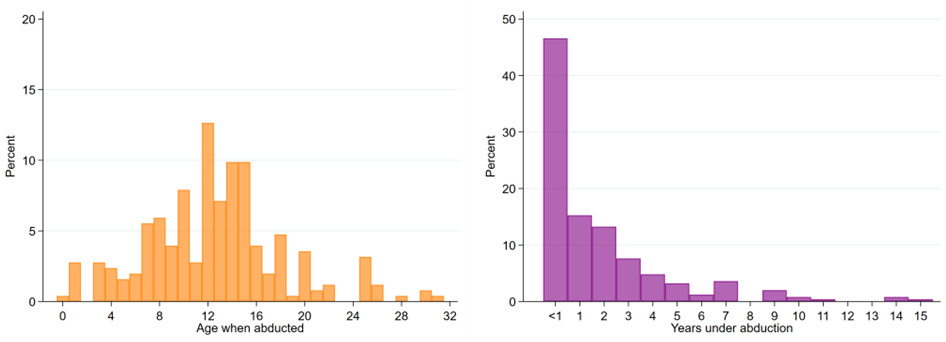
Note: The figure on the left displays the age distribution at the time of abduction for the 264 formerly abducted women in our sample. The figure on the right displays the number of years they spent in captivity.
Economic outcomes: Muted effects in a uniformly deprived setting
We begin with socioeconomic outcomes. Perhaps the most notable finding is the lack of abduction impact: formerly abducted women are no more likely to earn zero income, experience food insecurity, or go without water than never-abducted women. Nor do they differ significantly in current marital status. The only exception is a markedly lower perceived social support, especially if abduction was during childhood.
Abduction was not entirely economically neutral. Formerly abducted women are less likely to have completed primary school, a gap of roughly 6.7 percentage points relative to a mean of 40%, and have on average one more biological child (partly reflecting children born during captivity). But in a setting where subsistence farming employs nearly 90% of women and paid employment is rare, the loss of schooling does not translate visibly into income differences. The setting itself sets an upper bound on economic impacts.
This finding echoes Annan et al. (2011), who found similarly muted economic effects shortly after the end of the conflict. The persistence of this pattern 20 years on reinforces a broader point: standard economic measures of reintegration can mask meaningful differences in wellbeing.
Figure 2: Socioeconomic outcomes
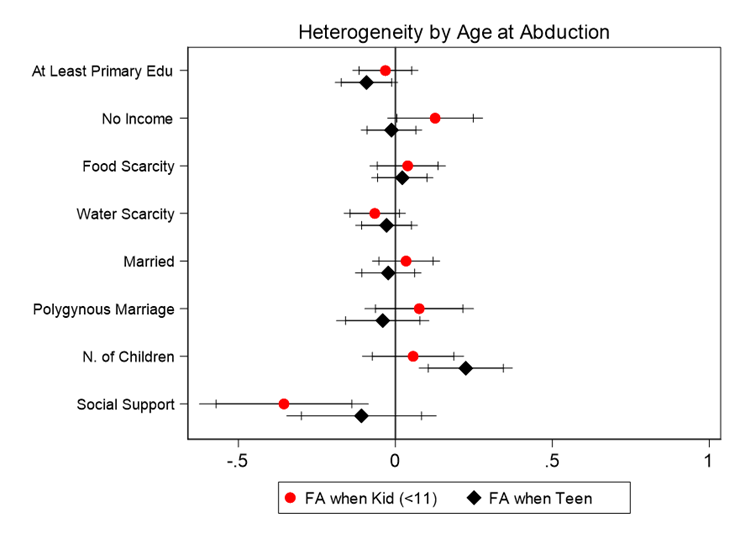
Note: The figure displays the estimated coefficients obtained for each of the listed socioeconomic outcomes, along with their 90% confidence intervals, as derived from the regression analyses reported in the paper.
Mental health: Persistent, pronounced, and largest for those abducted youngest
Our starkest findings concern mental health. Using the Edinburgh Postnatal Depression Scale (EPDS) and the Cohen Perceived Stress Scale (PSS-10) – both validated in low-income and conflict-affected settings – we document large and persistent gaps between formerly abducted and never-abducted women.
A striking baseline: even among women who were never abducted, depression rates are alarming. Roughly 60% of never-abducted women score above the EPDS threshold for likely depression. This is a reminder that the non-abducted also lived through years of LRA violence, displacement, and loss.
But formerly abducted women are 17.5 percentage points more likely to be depressed than the never-abducted, and show substantially higher perceived stress. These correspond to roughly 29% and 40% increases over the non-abducted means, respectively. These effects survive correction for multiple hypothesis testing.
Figure 3: Kernel densities of measures of mental health
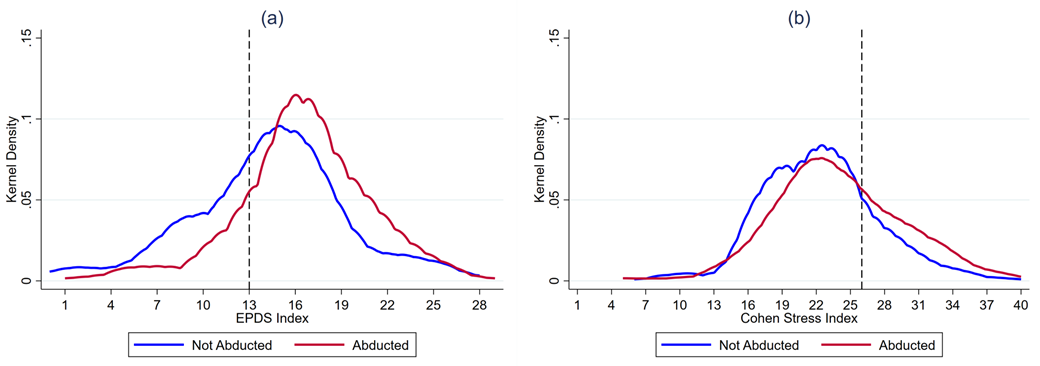
Notes: The figure displays the Edinburgh Postnatal Depression (EPDS) and the Cohen Stress Scale (PSS-10), respectively. The vertical dashed lines indicate the threshold levels used to identify high likelihood of clinical depression for the EPDS index, and severe stress for the Cohen index.
Heterogeneity analysis shows effects are qualitatively larger among women abducted at younger ages – before puberty, in many cases. This is consistent with evidence from developmental psychology that early disruptions to attachment and caregiving relationships carry disproportionate long-run psychological costs.
Figure 4: Mental health and stress responses
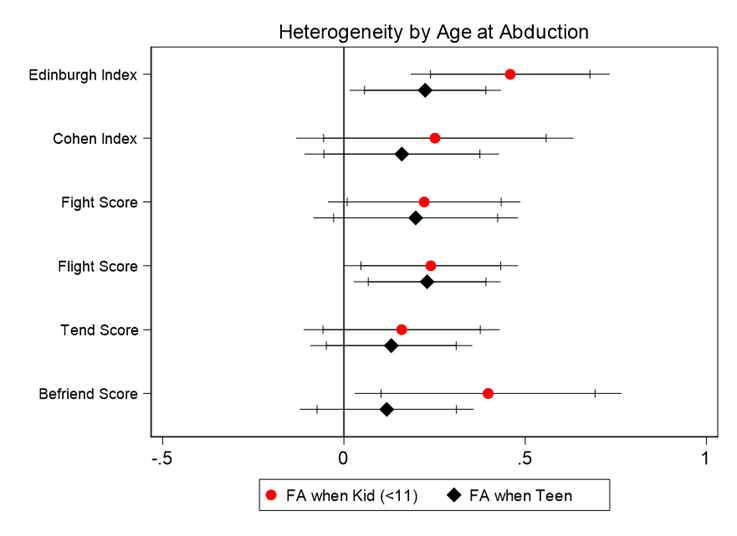
Note: The figure displays the estimated coefficients obtained for each of the listed psychological outcomes, along with their 90% confidence intervals, as derived from the regression analyses reported in the paper.
How abduction reshapes stress responses
Our main contribution is the examination of how women respond to stress, beyond the level of distress they experience. We adapt an established psychological instrument to measure four response types: tend, befriend, fight, and flight.
Consistent with theory and prior evidence, tend-and-befriend responses – seeking closeness with others, caring for children, building social ties – are more common than fight-or-flight reactions among women in our sample. Formerly abducted women score significantly higher on fight, flight, and befriend indices; effect sizes are similar across the three significant responses, at roughly 0.2 standard deviations. The tend response is also elevated but not significantly different between formerly abducted and not abducted women.
The combined effects on multiple stress responses deserve attention: abduction appears to leave women more reactive – simultaneously vigilant and affiliative – decades after the original threat has passed.
Non-cognitive traits: Grit, but lower prosociality
Our incentivised behavioural games provide various revealed-preference measures. The most robust finding is on grit. Formerly abducted women choose to engage with a harder, higher-reward puzzle much more often than never-abducted women. A second measure of grit (choosing a hard task in a pre-commitment stage) shows a similar, smaller positive effect. We also find suggestive evidence of increased competitiveness among formerly abducted women. Together, these patterns are consistent with post-traumatic growth theory and Annan et al. (2011)'s observation of social resilience among returnees.
At the same time, we find suggestive evidence of lower prosociality: abducted women allocate a somewhat smaller share of their endowment to others in a dictator game. We find no significant effect on risk tolerance, which contributes to a contested evidence base documenting both increases and decreases in risk-taking following conflict exposure.
Figure 5: Behavioural measures
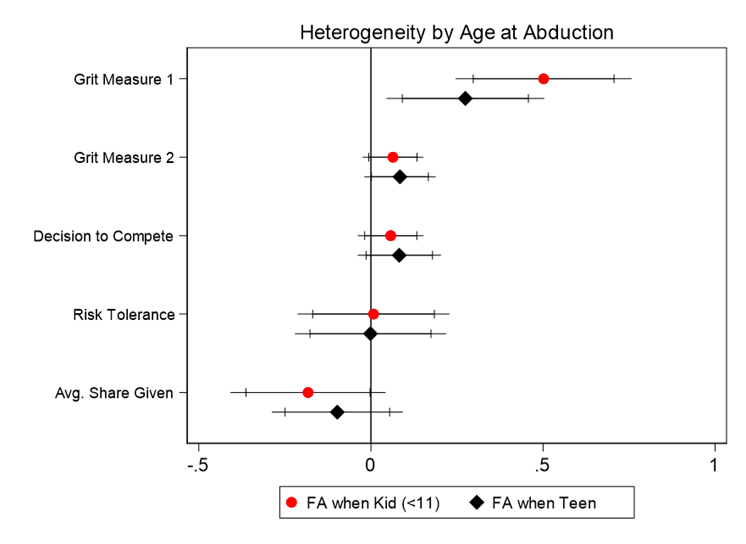
Note: The figure displays the estimated coefficients obtained for each of the listed behavioural outcomes, along with their 90% confidence intervals, as derived from the regression analyses reported in the paper.
What does this mean for policy?
Two decades after the LRA left northern Uganda, its legacy persists in the daily emotional lives of the women it abducted as children. The economic convergence we observe obscures the degree to which psychological and social deficits continue to shape well-being, parenting, and community life.
Several implications follow:
- Reintegration success cannot be assessed on economic grounds alone. Measures of mental health and social support should be standard in post-conflict programme evaluation.
- The elevated grit of formerly abducted women is evidence of resilience, not of recovery. Programmes that draw on women's perseverance while neglecting mental health may inadvertently exploit unaddressed trauma.
- The effects tend to be larger for those abducted at younger ages, pointing to the importance of early and sustained intervention rather than one-off post-conflict programmes.
Finally, this is not a historical curiosity. According to the UN, more than 4,000 children were abducted in conflict settings globally in 2023 alone. The women of northern Uganda show what two decades without adequate mental health support can look like. That trajectory is not inevitable, but changing it requires treating psychological recovery as a development priority, not an afterthought.
Authors' note: This research was funded by the World Bank's Research Support Budget, the University of San Francisco, Texas A&M University and Chapman University. The paper is published in the Journal of Development Economics. Data and replication files are available here.
References
Akresh, R, S Bhalotra, M Leone, and U Osili (2023), "First- and second-generation impacts of the Biafran war," Journal of Human Resources, 58(2): 488–531.
Annan, J, C Blattman, D Mazurana, and K Carlson (2011), "Civil war, reintegration, and gender in Northern Uganda," Journal of Conflict Resolution, 55(6): 877–908.
Bertoni, E, M Di Maio, V Molini, and R Nistico (2019), "Education is forbidden: The effect of the Boko Haram conflict on education in North-East Nigeria," Journal of Development Economics, 141: 102249.
Blattman, C, and J Annan (2010), "The consequences of child soldiering," Review of Economics and Statistics, 92(4): 882–898.
Cassar, A, E Kandpal, M Lambert, C Mbabazi Mpyangu, and D Serra (2026), "From childhood abduction to adulthood: Enduring consequences for women in Uganda," Journal of Development Economics, 182: 103766.
León-Ciliotta, G (2012), "Civil conflict and human capital accumulation: The long-term effects of political violence in Perú," Journal of Human Resources, 47(4): 991–1022.