


The majority of women in Pakistan do not access paid, formal work. They are trapped in low-productivity agriculture and the informal sector by social norms that impose heavy domestic burdens and stigmatise working outside the home. Effective policy must go beyond skills training and care provision to directly target these normative barriers.
Editor's note: This article is part of a series of posts reflecting on how the evidence from VoxDevLits applies to specific contexts, and is published in collaboration with the International Economic Association's Women in Leadership in Economics initiative. This post explores how evidence on Female Labour Force Participation relates to Pakistan.
Pakistan consistently records the lowest female labour force participation (FLFP) in the region, barring Afghanistan. At only 24% (PBS 2025), it has been estimated that the country loses approximately 30% of GDP due to low female labour force participation rates (IMF 2016). Aside from substantive economic losses, low FLFP has also been linked to reduced women's status within the household with multiplier effects on children's outcomes (Doss 2013). Raising women's labour force participation rates thus remains an urgent policy priority.
Women's labour force participation in Pakistan
Despite a current low rate of 24%, women's LFP in Pakistan has more than doubled since 1990 (Majid 2020). What is striking is the contrast between sectors that have seen the largest growth in women's employment over the last three decades, and those where women have been largely excluded.
Figure 1: Sectoral employment shares by gender, 1991 vs. 2025 (% of total employment)
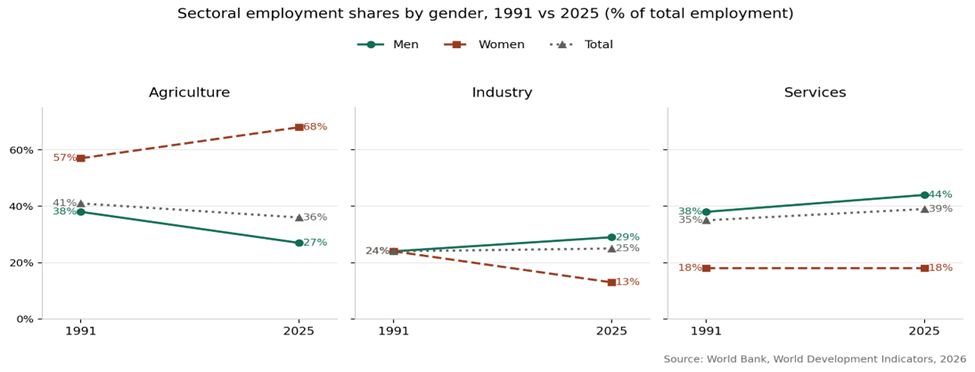
Between 1991 and 2025, the share of women working in agriculture increased substantially, from 57% to 68% (Figure 1). During this time, employment in industry also shifted dramatically, with only 13% of working women employed in the sector as of 2025. Additionally, there has been virtually no change in the share of women working in the services sector (Figure 1). The last three decades have thus witnessed a systematic movement of working men out of agricultural employment and into industry and services, while women's participation in agriculture continues to rise. It is worth noting that, relative to jobs in the manufacturing sector, work in agriculture and related sectors is generally considered to be less productive, prestigious, and empowering (Siegmann and Majid 2021).
Agriculture itself is a sector in decline, with agricultural employment as a percentage of total employment falling from 41% to 36% between 1991 and 2025 (World Bank 2026). At the same time, the services sector has grown, while employment growth in industry remains almost flat at about 25% (Figure 1). Women have hence been unable to take advantage of the structural shift in the economy through employment in the fastest-growing sector, while actively losing ground in a stagnant industrial sector.
Nature of women's work and the role of social norms
The trends in women's employment across sectors are rooted in several interlinked factors. One key variable is women's education and skill level, and the associated demand for their labour. Gender parity stands at 0.88 and 0.87 in primary and secondary gross enrolment, respectively (World Bank 2026), indicating a worse enrolment situation for girls relative to boys; demand for women's labour in more skill-intensive jobs and sectors therefore remains low. Indeed, evidence from Lahore, Pakistan shows that the demand-side gap in employment opportunities closes for 'white-collar' jobs as female education levels rise (Gentile et al. forthcoming). Even so, while gender parity at the tertiary level stands at 1.03 in favour of girls in Pakistan (World Bank 2026), only 22% of women in paid work have a tertiary-level education (PBS 2025). This indicates a possible 'opting out' of more educated women from the labour market, and is in line with the participation paradox in other similar contexts such as India.
Wage discrimination and a hostile public space can partially explain this potential opt-out. Women earn only about 72% of men's wages (Majid and Siegmann 2021), with the gap persisting at the same education level and in similar occupations regardless of the sector of employment (Majid 2016). Harassment at and en route to work, and a lack of adequate public transport systems have also been reported as impediments to employment (Garlick et al. 2025). Yet, the key factor underlying all these dynamics is the social norms surrounding the gendered division of labour in Pakistan.
Described as the 'classic' case of patriarchy (Kandiyoti 1988), Pakistan sees a strict division of productive and reproductive tasks between men and women. This is reflected in the country's time-use surveys, which record a daily average of more than five hours spent by women in household maintenance and care work and only about half an hour spent by men in domestic labour, with women gaining only 37 minutes of relief from domestic chores if they work (Najam-us-Saqib and Arif 2022). This heavy domestic burden is cited as one of the primary reasons why women do not work: about 55% of women aged 20 and above state domestic responsibilities as the primary reason why they are unable to work (Majid 2016).
When women do work, they tend to occupy positions that allow for an easier balance between their productive and reproductive tasks, and where stigma associated with work, particularly by stepping out of the home, tends to be lower. Working from home thus tends to take precedence. For example, nearly 79% of women in the manufacturing sector work from home (Majid 2016). Similarly, the bulk of working women – about 78% – are estimated to be employed in the informal sector (UN Women 2026). The informal sector typically not only allows for the absorption of a range of skill levels, and flexibility in time and place of work, but also for easy entry into and exit from the labour market. All of these are necessary attributes in a labour market with a strong male breadwinner bias where women's labour supply is largely treated as a reserve and their employment viewed as 'survival jobs' (Chun 2016).
The secondary status of women's work also means that women tend to be the first to be laid off during economic downturns (Siegmann and Majid 2021), which explains the high incidence of unpaid and casual work among women – 76% of women in agriculture work as unpaid family workers while 60% of women in paid work are employed on casual contracts, with no employment benefits, across all sectors (Majid 2016).
Interventions for improving women's employment outcomes
Government-led initiatives aimed at raising women's engagement with the labour market have tended to focus largely on skills training and reduction in reproductive burdens.
The 2023 Day Care Centres Act mandates the provision of a daycare at all public and private establishments with at least 70 employees (The Pakistan Code 2026). Punjab, the most populous province in the country, facilitates this provision by disbursing funds to organisations seeking to establish such centres (WDD 2026). Yet, access to and use of daycare facilities do not necessarily translate into improved employment outcomes. Even when using childcare facilities, working women highlight that the majority of the domestic burden, including coordination with the daycare, remains in their domain (Majid 2025). As a result, women report taking career breaks (or exiting the labour market altogether), switching to less demanding sectors, or passing up on promotions or roles that are more time-intensive, particularly while children are young (Majid 2025).
The Punjab Skills Development Project has provided vocational training since 2010, training 700,000 youth to date with 40% women graduates (PSDF 2026). The aim is to upskill women and grow their employment. However, evaluations of in-demand skills-training programmes show limited positive effects, particularly if competing constraints are ignored. Women report that taking dedicated time out during the day to attend training sessions, even where these are run online, is difficult in the face of high reproductive burdens (Majid et al. 2025). Similarly, Cheema et al. (2026) show that women in rural Punjab are a quarter as likely to complete skills training if it requires crossing village boundaries, even by a few kilometres. Here, it is not just mobility restrictions but also social stigma that limit take-up, completion, and subsequent labour supply.
A randomised controlled trial studying the impact of transport options on women's labour supply in Lahore found that women-only transport had the biggest impact on driving job applications among both labour force participants and non-participants (Garlick et al. 2025). This points to the importance of safety and propriety considerations underlying women's labour market decisions. Similar concerns regarding social sanctions from outside the household help clarify other labour market outcomes too. Said et al. (2022) show that with respect to women-owned microenterprises, not only are both men and women willing to sacrifice almost 60% of median profits in their existing business to run it from home, but even when expert (outside) advice can increase earnings, women avoid taking it in favour of advice from men within the household.
Women are not just constrained in whether and where they work, or even in how they get to work, but also with regard to the type of work that they do. Women in Pakistan generally occupy sectors that are extensions of their caregiving roles and social reproductive duties, such as teaching, nursing, or agriculture, with little representation in blue-collar work, such as factory or construction work, that is actively stigmatised (Siegmann and Majid 2021, Goldin 1994). However, bids to change the acceptability of male-dominated occupations for women through 'role-model' interventions have seen little success (Ahmed et al. 2024).
Simultaneously, Ahmed et al. (2024) find that exposure to a macro-fiscal shock, such as COVID-19, created a growth mindset in the treatment group, which increased labour supply among women from lower-income households. And while this is in line with the added worker effect that dominates women's employment choices in Pakistan (Siegmann and Majid 2021), the evidence base also highlights that as women's share of employment rises, social norms around gendered division of work change, albeit with a lag. Indeed, economic crises that reduce men's access to income and push women into the labour market have been found to shift attitudes regarding gendered divisions between productive and reproductive tasks and to increase the acceptability of women working even when jobs are scarce (with a 5-to-7-year lag) in Pakistan (Seguino 2007). The latter is especially important as it signals a reduction in the treatment of women's work as secondary.
Policy implications for female labour force participation
One in four non-working women in Pakistan says they are willing to work (Garlick et al. 2025). Simultaneously, women recognise the importance of access to earned income for agency and status within the household (Majid 2025). Secure earnings in productive sectors have had the greatest impact on women's power, particularly for improved distribution of household resources (Seguino and Grown 2006). A potential doubling of FLFP alongside substantive changes in the nature of women's work, however, requires interventions that go beyond skills and care provision to directly engage the normative barriers that shape women's labour market choices. Shifting the balance must then come through policy that treats social norms not as background context but as the central constraint to be addressed. The task is to do deliberately, and at lower social cost, what economic crises have so far achieved only by accident.
References
Ahmed, H, M Mahmud, F Said, and Z Tirmazee (2024), "Encouraging female graduates to enter the labor force: Evidence from a role model intervention in Pakistan," Economic Development and Cultural Change, 72(2): 919–957.
Cheema, A, A Khwaja, M F Naseer, and J N Shapiro (2026), "Glass walls: Experimental evidence on constraints faced by women in accessing valuable skilling opportunities," Journal of Political Economy, 134(6).
Chun, J J (2016), "Organizing across divides: Union challenges to precarious work in Vancouver's privatized health care sector," Progress in Development Studies, 16(2): 173–188.
Doss, C (2013), "Intrahousehold bargaining and resource allocation in developing countries," World Bank Research Observer, 28(1): 52–78.
Garlick, R, E Field, and K Vyborny (2025), "Women's mobility and labor supply: Experimental evidence from Pakistan," Unpublished manuscript.
Gentile, E, N Kohli, N Subramanian, Z Tirmazee, and K Vyborny (forthcoming), "Barriers to entry: Decomposing the gender gap in job search in urban Pakistan," Journal of Labor Economics.
Goldin, C (1994), "The U-shaped female labor force function in economic development and economic history," Unpublished manuscript.
IMF (2016), "Pakistan: Selected issues paper."
Kandiyoti, D (1988), "Bargaining with patriarchy," Gender & Society, 2(3): 274–290.
Majid, H (2016), "Female labor supply in Pakistan: Mapping the last three decades," Unpublished manuscript.
Majid, H (2020), "Female labor force participation in Pakistan," in E J Flatt, V S Murali, and S Tier (eds), Voices on South Asia: Interdisciplinary Perspectives on Women's Status, Challenges and Futures, World Scientific, 385–408.
Majid, H (2025), "Productive vs. reproductive work: Rethinking the relationship," Third World Quarterly: 1–19.
Majid, H, and K A Siegmann (2021), "The effects of growth on women's employment in Pakistan," Feminist Economics, 27(4): 29–61.
Majid, H, M Mustafa, and M Nazar (2025), "Digital access and women's work in Pakistan: Constraints, use patterns, and policy directions," Development Policy Review, 43(6): e70042.
Najam-us-Saqib, N, and G M Arif (2022), "Time poverty, work status and gender: The case of Pakistan," Pakistan Development Review, 51(1): 23–46.
PBS (2025), "Pakistan Labour Force Survey."
The Pakistan Code (2026), "The Day Care Centres Act, 2023."
PSDF (2026), "Punjab Skills Development Fund."
Said, F, M Mahmud, G d'Adda, and A Chaudhry (2022), "Home-based enterprises: Experimental evidence on female preferences from Pakistan," Economic Development and Cultural Change, 71(1): 185–221.
Seguino, S, and C Grown (2006), "Gender equity and globalization: Macroeconomic policy for developing countries," Journal of International Development, 18(8): 1081–1104.
Seguino, S (2007), "Plus ça change? Evidence on global trends in gender norms and stereotypes," Feminist Economics, 13(2): 1–28.
Siegmann, K A, and H Majid (2021), "Empowering growth in Pakistan?" Indian Journal of Labour Economics, 64(2): 309–331.
UN Women (2026), "Vulnerability in employment."
WDD (2026), "Punjab Day Care Fund Society."
World Bank (2026), "World Development Indicators."