




When Brazil let neglected districts break away and form new municipalities, peripheral areas gained services, jobs, and growth at no visible cost to the rest of the country.
Over the past three decades, many countries have redrawn their political boundaries to push power downward. India, Indonesia, Kenya, the Philippines, Uganda, and Vietnam have all carved existing subnational units into smaller ones, and Grossman and Lewis (2014) document that the trend continues.
The economic logic for 'splitting' cuts both ways. Smaller units encourage competition and let policy track local preferences (Tiebout 1956, Oates 1972). The case is strongest for remote and underserved areas. Critics counter that proliferation invites capture by special interests, fragments scale, and produces units too small to fund themselves (Alesina and Spolaore 1997, Boffa et al. 2016). Whether splitting helps or hurts development is ultimately an empirical question.
In recent work (Dahis and Szerman forthcoming), we tackle this question using a large redistricting episode in Brazil. Between 1988 and 1997, the country went from 4,124 to 5,507 municipalities, a 34% rise. The reform devolved administrative, fiscal, and political authority to over a thousand new local governments. We track these municipalities for 15 years and compare them to municipalities that tried to split but did not succeed.
A natural experiment in Brazil
Brazilian municipalities hold real power. They oversee primary education, basic health care, sanitation, trash collection, and street lighting. They collect property and service taxes, and administer their own fiscal revenues, including federal transfers. Each municipality is divided into one or more districts, but only municipalities have decision-making authority. A district that secedes becomes a municipality and gains that authority overnight.
The 1988 Federal Constitution gave states wide latitude to authorise new municipalities. Our newly digitised archives indicate that 39% of eligible districts requested a split between 1989 and 1996. In a 1992 survey of mayors (Bremaeker 1993), 63% cited neglect by their parent municipality while 24% cited large territorial size as the main reason for seeking a split. A 1996 constitutional amendment then halted the process, leaving many requests pending and ultimately unapproved.
Comparing splits to almost-splits
Areas that ask to split are not a random sample. They tend to be less developed and feel neglected by their parent municipality. They also stand to gain from a federal transfer formula that pays more per person to smaller municipalities (Tomio 2002). A simple comparison of split versus non-split municipalities would conflate the effect of splitting with the reasons areas wanted to split in the first place.
To overcome this selection problem, we built a novel dataset of split requests and classified each as ratified or unapproved. Our difference-in-differences design compares ratified requests with almost-split requests – districts that applied but were blocked by the political process or the 1996 reform. Before the splits, the two groups follow nearly identical trajectories in economic outcomes. A separate research design exploiting close-call referendum results in Minas Gerais yields similar conclusions.
A bigger public sector and better services
Splitting expands the local public sector. Municipalities that split increased capital expenses by 27% and current expenses by 17% relative to their counterfactual, persisting for over a decade.
The extra spending was not wasted. Household access to sewage rose by 1 percentage point and access to trash collection by 4.4 percentage points. Children aged 8 to 14 at the time of the split show the largest gains in school attendance and literacy, consistent with new municipalities investing in schools. Older cohorts gain less.
These improvements are concentrated in services exclusively under municipal control. Activities co-administered with the state or federal government, such as health care, show no comparable gains.
The distribution of economic gains
A clearer picture emerges when we look inside a splitting municipality rather than at the municipality as a whole. The gains in nighttime lights, a proxy for local economic activity, are concentrated almost entirely in the applicant districts that actually broke away. Headquarters districts gain modestly. Other districts that stayed inside the parent municipality show essentially no change. Within applicant districts, the rise in luminosity is broadly distributed and not confined to the new town hall, suggesting the gains reach beyond a narrow urban core.
Figure 1 traces nighttime luminosity separately for the three types of districts. Applicant districts diverge sharply from their counterfactual after the split, with gains stabilising at around 40% over fifteen years. Headquarters districts gain modestly, and remaining districts barely move.
Figure 1: Effect of splitting on nighttime luminosity, by district type
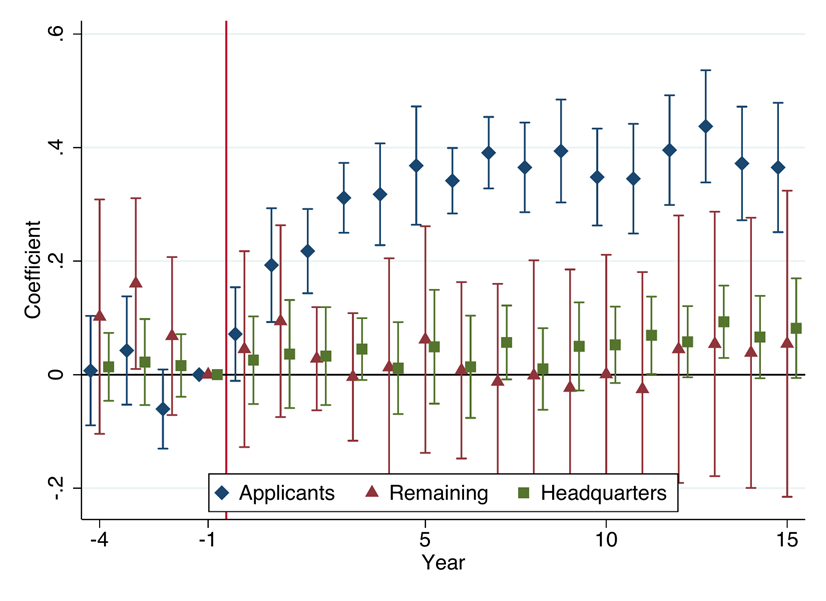
Notes: Year 0 marks the split. 95% confidence intervals shown.
This pattern matches a sharp prediction. Splitting helps most where capture and neglect were most binding: in small, rural, and remote areas on the periphery of their former municipality.
Mechanisms: Revenues and autonomy
Two forces explain these effects.
First, fiscal revenues rise. New municipalities receive an average 15% increase in revenues, mainly from larger federal transfers under Brazil's transfer formula, which pays more per person to smaller municipalities. Some of the gains are mechanical: more revenue funds more bureaucracy and infrastructure. Yet revenues alone do not account for the full impact.
Second, decision-making power is decentralised – and autonomy appears to matter independently of revenues. Two patterns we have already noted support this view: improvements concentrate in services exclusively under municipal control, and economic gains are largest in small, rural, and remote areas most likely to have been neglected. In addition, after splitting, new municipalities frequently elect mayors from different parties than the parent municipality, suggesting that policy preferences had diverged before the split.
Does the rest of the country pay?
Federal transfers in Brazil are a zero-sum game within each state: when one district splits off, the others see their share drop. We exploit state-level variation in transfer losses to ask whether non-splitting municipalities suffered. We find no detectable negative effects on public jobs, private jobs, establishments, or nighttime lights. The sample is small, so this is suggestive rather than definitive. This is consistent with the idea that the lost transfers may have been funding low-value spending in headquarters areas – outlays whose marginal value fell below the social cost of public funds (Liebman and Mahoney 2017).
What did the gains cost?
We estimate a cost per public-sector job of US$3,635 per year, well below the US$8,000 estimated by Corbi et al. (2019) for the marginal job created by federal-transfer increases in Brazil. Our implied output multiplier is 2.06 to 4.34, slightly above the median of 1.9 that Chodorow-Reich (2019) reports in the fiscal spending literature. Both numbers suggest that splitting delivers more economic activity per dollar of federal transfer than simply expanding existing transfer programmes – a pattern consistent with autonomy, not just money, driving the results.
Policy implications: Decentralisation and development
Three lessons emerge from our analysis.
First, where local governments are very large, subsidised and voluntary splits can deliver development gains without visibly burdening the rest of the country.
Second, the gains land where they are most needed: in peripheral, remote, and underdeveloped places that were captured or neglected by their headquarters.
Third, expansions of state capacity need not always require new spending from higher tiers of government. Reallocating existing resources towards areas that need them most can be enough.
This does not imply that more splits are always better. We do not estimate the optimal size of local governments, and the benefits we measure are conditional on a generous transfer system that subsidises new units. But the Brazilian case offers clear evidence that, in settings with large and unequal local governments, devolving authority, not just budgets, to smaller units can make state capacity more responsive to local needs (Bardhan 2002).
References
Alesina, A, and E Spolaore (1997), "On the number and size of nations," Quarterly Journal of Economics, 112(4): 1027–1056.
Bardhan, P (2002), "Decentralization of governance and development," Journal of Economic Perspectives, 16(4): 185–205.
Boffa, F, A Piolatto, and G A M Ponzetto (2016), "Political centralization and government accountability," Quarterly Journal of Economics, 131(1): 381–422.
Bremaeker, F E J de (1993), "Os novos municípios: surgimento, problemas e soluções," Revista de Administração Municipal, 40(206): 88–99.
Chodorow-Reich, G (2019), "Geographic cross-sectional fiscal spending multipliers: What have we learned?" American Economic Journal: Economic Policy, 11(2): 1–34.
Corbi, R, E Papaioannou, and P Surico (2019), "Regional transfer multipliers," Review of Economic Studies, 86(5): 1901–1934.
Dahis, R, and C Szerman (forthcoming), "Decentralizing development: The economic impacts of government splits," American Economic Journal: Applied Economics.
Grossman, G, and J I Lewis (2014), "Administrative unit proliferation," American Political Science Review, 108(1): 196–217.
Liebman, J B, and N Mahoney (2017), "Do expiring budgets lead to wasteful year-end spending? Evidence from federal procurement," American Economic Review, 107(11): 3510–3549.
Oates, W (1972), Fiscal Federalism, Harcourt Brace Jovanovich.
Tiebout, C (1956), "A pure theory of local expenditures," Journal of Political Economy, 64(5): 416–424.
Tomio, F R de L (2002), "A criação de municípios após a Constituição de 1988," Revista Brasileira de Ciências Sociais, 17(48): 61–89.