




When tax enforcement depends on geography, firms may choose to locate where taxes are easier to evade rather than where they are most productive. A Chinese reform that standardised VAT enforcement across rugged and flatter counties reduced this misallocation, raising aggregate productivity by an estimated 5%.
Editor’s note: For a broader synthesis of themes covered in this article, check out our VoxDevLit on Taxation.
Building effective tax systems is a central challenge for developing countries. Governments need revenue to finance infrastructure, education, healthcare, and the administrative machinery of the state. Yet raising revenue is not just a question of setting tax rates. It also depends on whether the state can enforce those rates consistently across firms and places.
A large evidence base argues that weak fiscal capacity limits tax collection and shapes economic development (Gordon and Li 2009, Besley and Persson 2014). Another body of work shows that resources are often misallocated across firms in developing economies: productive firms may be too small, while less productive firms may use too much capital (Restuccia and Rogerson 2008, Hsieh and Klenow 2009). Our research connects these two debates. In recent research, we show that uneven tax enforcement across space can distort where firms locate, how much capital they use, and ultimately how productive the economy is (Liu and Zhao 2026).
Why geography matters for tax enforcement
China introduced a value-added tax in 1994. The statutory VAT rate was set nationally, but enforcement was delegated to county-level tax authorities. In principle, firms in different counties faced the same tax schedule. In practice, they did not face the same enforcement environment.
Before the Golden Tax Project (GTP), VAT enforcement relied heavily on paper invoices and physical inspections. Local tax officials often needed to visit firms to verify sales, purchases, and invoice records. This made enforcement costlier in places where firms were harder to reach. Mountainous and rugged counties posed a particular challenge: travel was slower, inspections were more expensive, and local tax agencies had less ability to monitor firms in their area. This created a wedge between statutory and effective tax rates, particularly in more rugged counties.
The Golden Tax Project changed this enforcement technology. It required firms to use computerised VAT invoices and enabled tax agencies to cross-check transaction information electronically across firms. For our purposes, the key feature of the reform is that it reduced the importance of physical distance and terrain in tax enforcement. Counties where onsite inspections had previously been more costly – that is, more rugged counties – therefore experienced larger improvements in enforcement capacity.
Our empirical strategy does not ask whether the Golden Tax Project raised VAT compliance on average. Instead, we ask whether the reform changed the spatial unevenness of enforcement. We use data from China’s Annual Survey of Industrial Firms from 1998 to 2007, combined with measures of county terrain ruggedness, and compare changes before and after the reform across counties where enforcement had previously been more or less constrained by geography.
We find that a one-standard-deviation increase in county ruggedness increased firms’ post-reform effective VAT rate by about 0.1 percentage points relative to the pre-reform period (Figure 1). This is about 3.1% of the national median effective rate. The result is consistent with the reform narrowing enforcement gaps between rugged and flatter counties.
Figure 1: Impact of GTP on effective VAT rate (rugged vs. flatter counties)
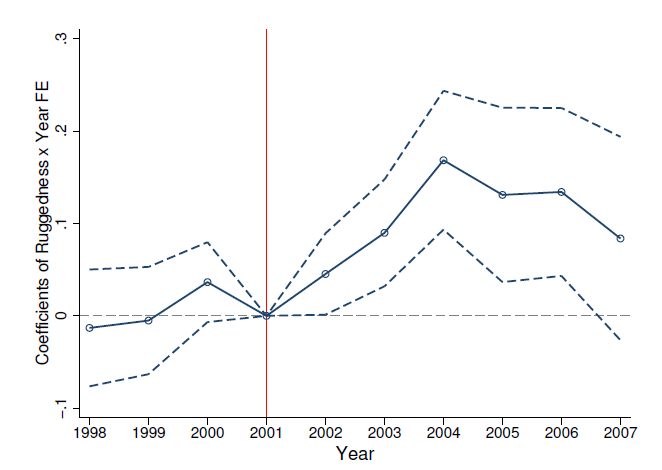
Notes: This figure shows the impact of the GTP on firms’ effective VAT rate over time. The x-axis denotes the year; the y-axis denotes the estimated coefficients. The referenced benchmark year is 2001, one year before the GTP. The solid line connects all the estimated coefficients, and the dashed lines describe the 95% confidence intervals.
Tax enforcement changes where firms locate
The next question is whether stronger and more uniform tax enforcement affected firms’ real decisions, rather than only their tax payments. Our evidence suggests that it did. After the Golden Tax Project, capital moved away from rugged counties, where the reform generated larger increases in effective VAT rates. A one-standard-deviation increase in county ruggedness reduced county capital stock after the reform by about 5% (Figure 2), reflecting both a decline in the number of firms and lower capital stock among incumbent firms.
Figure 2: Impact of GTP on capital allocation (rugged vs. flatter counties)
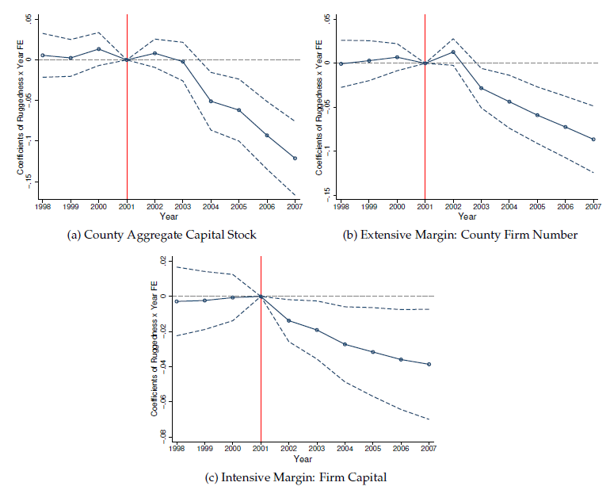
Notes: This figure shows the impact of the GTP on county capital stock over time. Subplot (a) shows the total capital stock in a county, and subplots (b) and (c) then examine, respectively, the number of firms (extensive margin) and within-firm capital (intensive margin). The x-axis denotes the year; the y-axis denotes the estimated coefficients. The referenced benchmark year is 2001, one year before the GTP. The solid line connects all the estimated coefficients, and the dashed lines describe the 95% confidence intervals.
These patterns are consistent with firms responding to the disappearance of local tax advantages created by weak enforcement. Before the reform, weaker enforcement in rugged counties made those locations more attractive, even for firms that might have been more productive elsewhere. Once the Golden Tax Project made enforcement less dependent on geography, firms had less reason to locate or invest in places simply because taxes were easier to avoid.
These findings imply that uneven tax enforcement before the Golden Tax Project likely reduced aggregate productivity by inducing some firms to operate where they were not most productive. Rather than locating where they could maximise productivity, these firms chose locations that offered weaker tax enforcement. Consistent with this interpretation, we find that stronger tax enforcement following the reform led to a significant rightward shift in the distribution of firms’ productivity.
Uneven enforcement creates capital misallocation
Beyond lowering firms' productivity by distorting their location choices, uneven tax enforcement can further reduce aggregate productivity by distorting the allocation of capital across firms.
In an efficient allocation, capital should flow towards firms where it has the highest return until marginal returns are roughly equalised. When firms face different effective tax rates, this condition breaks down. Firms in low-enforcement areas can profitably operate with more capital even if they are not especially productive. Firms in high-enforcement areas may use less capital even when they could use it more productively.
We test this mechanism by examining firms’ marginal revenue product of capital. Before the reform, firms’ returns to capital differed systematically across counties in ways consistent with uneven tax enforcement. After the Golden Tax Project, these differences narrowed. Firms in rugged counties, where enforcement increased more, experienced a relative increase in their marginal revenue product of capital. For the average firm, a one-standard-deviation increase in ruggedness raised post-reform marginal revenue product of capital by about 7%.
Following Sraer and Thesmar (2023), we estimate that the reduction in capital misallocation generated by the Golden Tax Project increased aggregate total factor productivity among Chinese industrial firms by about 5%.
Implications for tax policy
The usual argument for strengthening tax administration is fiscal: better enforcement raises revenue. Our findings point to an additional economic rationale. When governments lack the capacity to enforce tax laws uniformly, aggregate productivity suffers through two important channels. First, opportunities for tax evasion encourage firms to locate where taxes are easier to avoid rather than where they are most productive. Second, differences in effective tax rates across firms distort investment decisions, directing capital towards firms with lower tax burdens rather than those that use it most productively.
Information technology can help governments strengthen tax administration and mitigate the economic costs of uneven tax enforcement. By digitising invoices and enabling easier cross-checking across firms, the Golden Tax Project made tax enforcement less dependent on geography and improved the efficiency of firms’ location and investment decisions in China. Similar reforms may be valuable in other developing countries where tax administrations still rely heavily on paper records, discretionary inspections, or geographically uneven monitoring.
The broader lesson is that investments in administrative technology can do more than raise government revenue. By making tax enforcement more uniform across regions and firms, they can strengthen firms’ incentives to locate and invest where they are most productive and reduce cross-firm resource misallocation. Building fiscal capacity is therefore not only about collecting more taxes. It is also about removing distortions created by uneven tax enforcement and improving economic efficiency.
References
Besley, T, and T Persson (2014), "Why do developing countries tax so little?" Journal of Economic Perspectives, 28(4): 99–120.
Gordon, R, and W Li (2009), "Tax structures in developing countries: Many puzzles and a possible explanation," Journal of Public Economics, 93(7–8): 855–866.
Hsieh, C-T, and P J Klenow (2009), "Misallocation and manufacturing TFP in China and India," Quarterly Journal of Economics, 124(4): 1403–1448.
Jensen, A, A Brockmeyer, and L Gadenne (2024), "Taxation and development," VoxDevLit, 12(1).
Liu, Y, and X Zhao (2026), "Fiscal capacity and capital misallocation: The economic costs of tax evasion," Journal of Public Economics, 255: 105581.
Restuccia, D, and R Rogerson (2008), "Policy distortions and aggregate productivity with heterogeneous establishments," Review of Economic Dynamics, 11(4): 707–720.
Sraer, D, and D Thesmar (2023), "How to use natural experiments to estimate misallocation," American Economic Review, 113(4): 906–938.