



In the Brazilian Amazon, large landholders strategically donate to local politicians, who promote agriculture in return – with negative environmental consequences.
Editor’s note: The authors have made slides available here. For a broader synthesis of themes covered in this article, check out our VoxDevLit on Deforestation.
Land and politics are intertwined in the Brazilian Amazon. Agriculture, particularly cattle ranching and soy, is the primary driver of deforestation in the region, contributing to CO2 emissions, extreme temperatures, and biodiversity loss (Pendrill et al. 2022, Zeppetello et al. 2020, Giam 2017, van der Werf et al. 2009). Electoral incentives, political capture, and lobbying all enable this deforestation (Costa and Hsiao 2025). Large ranchers and farmers are 28 times over-represented among Amazon mayors and 2.6 times over-represented among campaign donors. This pattern reflects a global phenomenon, where landholding elites capture local political institutions to advance their interests (Anderson et al. 2015, Acemoglu et al. 2007, Bardhan and Mookherjee 2000).
In the Amazon, soy cultivation offers higher returns than cattle ranching, but converting pasture to soy requires overcoming significant barriers, including access to credit, infrastructure, inputs, and technical expertise (Moffette and Gibbs 2021). Landholders can intervene in local politics to overcome these barriers, either by donating to mayoral campaigns or running for office themselves. In turn, mayors can pay back their supporters directly through targeted favours or special treatment, or indirectly by governing in favour of landholders' broader interests. This could include spending on extension services and agricultural infrastructure, favourable land-use policies, or facilitation of rural credit through cooperatives with ties to local government. Previous research has documented patronage in public employment and procurement in Brazil (Toral 2024, Colonnelli et al. 2020, Boas et al. 2014). We provide the first evidence of agricultural patronage, a form of political favouritism that may prevail in rural contexts where agricultural favours are particularly valuable (Katovich and Moffette 2025).
Linking land registries, campaign finance, and satellite data
We combine three datasets spanning 2000 to 2020: georeferenced property boundaries with owner IDs for over 611,000 properties, registries of mayoral candidates and campaign donors across five municipal elections, covering 7,000 candidates and 277,000 donors, and satellite-based remote sensing data measuring annual land-use transitions at the property level. To identify causal effects, we compare land-use outcomes on properties belonging to donors whose preferred candidate narrowly won versus narrowly lost close mayoral elections, where victory is effectively random. We apply an analogous strategy at the municipal level, comparing governance and land-use outcomes in municipalities where landholder-financed mayors narrowly win versus narrowly lose.
Large landholders adopt soy after their candidate wins
As shown in Figure 1, donors to winning mayoral candidates expand soy cultivation on their properties by an average of 7.2 hectares per year while the candidate they donated to is in office. Pasture declines by a proportional amount and deforestation remains unaffected, indicating agricultural intensification on already-cleared land. This intensive-margin response is consistent with deforestation enforcement being under federal jurisdiction, and thus largely outside mayors’ control.
Figure 1: Land use on donors’ properties before and after their candidate wins a close election
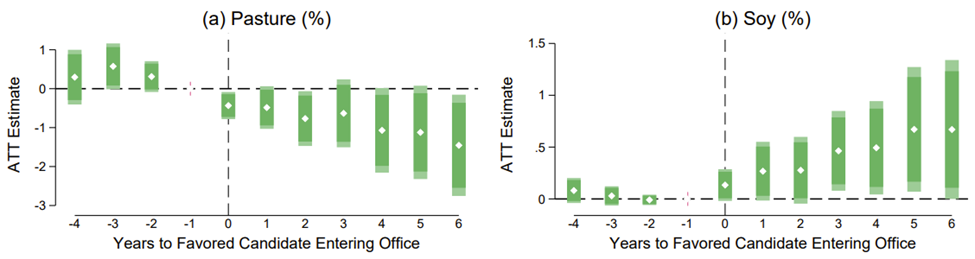
Note: Estimates compare properties of donors to winning versus losing candidates in elections decided by 5% or less. Shaded bands show 90% and 95% confidence intervals. Outcomes measure pasture and soy as a percentage of property area.
Soy expansion is concentrated on large properties and among first-time soy adopters. Furthermore, only 19% of successful donors donate more than once, suggesting donations act as a one-time strategic investment to overcome barriers to soy adoption. On mayors’ own properties, soy cultivation increases modestly and environmental violations decrease during their time in office, though neither effect is statistically significant.
Landholder-financed mayors govern in favour of agriculture
Municipalities where landholder-financed mayors win close elections see broad changes in governance and land use. As shown in Figure 2, agricultural promotion spending, rural credit, soy cultivation, and environmental violations all increase with the share of campaign donations coming from landholders. In municipalities where landholders contribute at least 25% of a mayor's campaign funding, soy cultivation rises by 434 hectares and environmental violations increase by 15% during that mayor's time in office.
Figure 2: Municipal outcomes by share of mayor's campaign donations from landholders
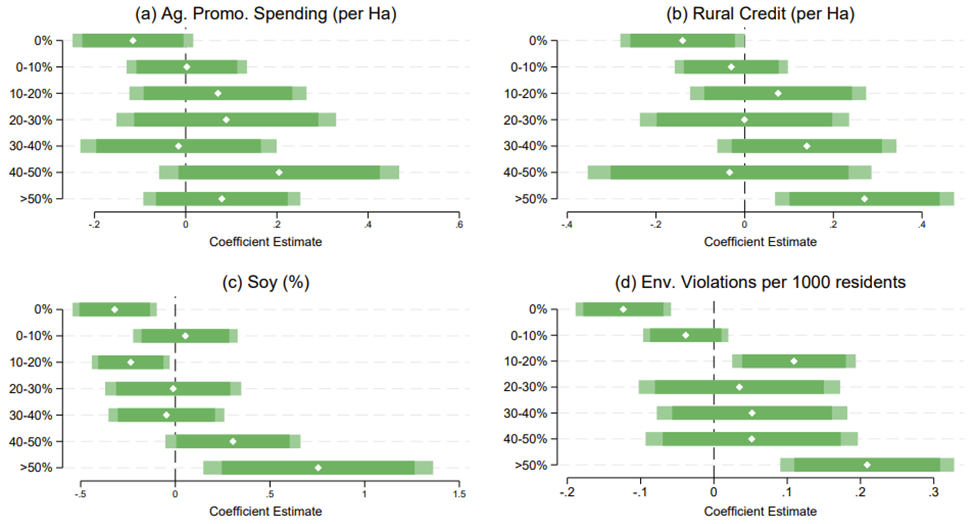
Note: Estimates compare municipalities in close mayoral elections (decided by 5% or less) where the winning mayor received varying shares of donations from landholders. Shaded bands show 90% and 95% confidence intervals.
Notably, these effects spill over onto lands not registered to any donor or candidate, indicating that landholder-financed mayors pay back their supporters through broad agricultural promotion rather than precisely targeted favours. This contrasts with patronage in public employment and procurement, where mayors can assign jobs and contracts directly to specific individuals or firms. Agricultural patronage may be inherently harder to target, generating wider environmental consequences and distortions.
Implications for agricultural development, sustainability, and inequality
What should we make of landholders’ revealed demand for agricultural intensification? Cattle ranching in the Amazon is notoriously unproductive, and converting pasture to soy can raise land productivity and support economic development (Bragança et al. 2022, Marin et al. 2022). Yet soy brings costs of its own: soy production in the Amazon leads to increased agrochemical use, which has been linked to elevated rates of childhood cancer (Skidmore et al. 2023), and pasture-to-soy conversion in one place can provoke deforestation for new pasture elsewhere (Gollnow et al. 2018). Our results reveal a political mechanism underlying this indirect land-use change: political pressure to help large landholders convert pasture to soy leads mayors to promote agriculture broadly, providing funds that enable deforestation on other properties.
Moreover, the largest landholders benefit most from agricultural patronage. This dynamic could exacerbate inequality and create a self-reinforcing cycle in which politicians empower large landholders, enabling further political influence. More equitable access to rural credit, inputs, and alternative development opportunities could reduce landholders' demand for political influence, weakening this cycle and enabling more inclusive and sustainable development in the Amazon.
References
Acemoglu, D, M A Bautista, P Querubin, and J Robinson (2007), “Economic and Political Inequality in Development: The Case of Cundinamarca, Colombia,” Technical report.
Anderson, S, P Francois, and A Kotwal (2015), “Clientelism in Indian Villages,” American Economic Review, 105(6): 1780–1816.
Bardhan, P and D Mookherjee (2000), “Capture and Governance at Local and National Levels,” American Economic Review, 90(2): 135–139.
Boas, T, D Hidalgo, and N Richardson (2014), “The Spoils of Victory: Campaign Donations and Government Contracts in Brazil,” The Journal of Politics, 76(2).
Bragança, A, P Newton, A Cohn, J Assunção, C Camboim, D de Faveri, et al. (2022), “Extension services can promote pasture restoration: Evidence from Brazil’s low carbon agriculture plan,” Proceedings of the National Academy of Sciences, 119(12): e2114913119.
Colonnelli, E, M Prem, and E Teso (2020), “Patronage and Selection in Public Sector Organizations,” American Economic Review, 110(10): 3071–3099.
Costa, F and A Hsiao (2025), “Deforestation,” VoxDevLit.
Giam, X (2017), “Global Biodiversity Loss from Tropical Deforestation,” Proceedings of the National Academy of Sciences, 114(23): 5775–5777.
Gollnow, F, L de Barros Viana Hissaa, P Rufin, and T Lakes (2018), “Property-Level Direct and Indirect Deforestation for Soybean Production in the Amazon Region of Mato Grosso, Brazil,” Land Use Policy, 78: 377–385.
Katovich, E and F Moffette (2025), “Does Local Politics Drive Tropical Land-Use Change? Property-Level Evidence from the Amazon,” The Economic Journal: ueaf123.
Marin, F R, A J Zanon, J P Monzon, J F Andrade, E H Silva, G L Richter, L A Antolin, B S Ribeiro, G G Ribas, R Battisti, A B Heinemann, and P Grassini (2022), “Protecting the Amazon forest and reducing global warming via agricultural intensification,” Nature Sustainability, 1–9.
Moffette, F and H Gibbs (2021), “Agricultural Displacement and Deforestation Leakage in the Brazilian Legal Amazon,” Land Economics, 97(1).
Pendrill, F, T A Gardner, P Meyfroidt, U M Persson, J Adams, T Azevedo, M G B Lima, M Baumann, P G Curtis, V D Sy, R Garrett, J Godar, E D Goldman, M C Hansen, R Heilmayr, M Herold, T Kuemmerle, M J Lathuillière, V Ribeiro, A Tyukavina, M J Weisse, and C West (2022), “Disentangling the Numbers Behind Agriculture-Driven Tropical Deforestation,” Science, 377(6611).
Skidmore, M, K Sims, and H Gibbs (2023), “Agricultural Intensification and Childhood Cancer in Brazil,” Proceedings of the National Academy of Sciences, 120(45).
Toral, G (2024), “How Patronage Delivers: Political Appointments, Bureaucratic Accountability, and Service Delivery in Brazil,” American Journal of Political Science, 68(2): 797–815.
van der Werf, G R, D C Morton, R S DeFries, J G J Olivier, P S Kasibhatla, R B Jackson, G J Collatz, and J T Randerson (2009), “CO2 Emissions from Forest Loss,” Nature Geoscience, 2: 737–738.
Zeppetello, L R, L A Luke’s, J T Spector, R L Naylor, D S Battisti, Y J Masuda, and N H Wolff (2020), “Large scale tropical deforestation drives extreme warming,” Environmental Research Letters, 15(8).