






Evidence from Zimbabwe suggests that dialogue-based engagement campaigns can be effective in increasing enrolment and learning, which is consistent with improving perceptions around the value of girls’ education. These campaigns can also be offered alongside other more prominent interventions—such as teacher training or literacy programmes—offering a potential cost-effective solution to encouraging women’s education.
Youth around the world face barriers to education; in many contexts, these barriers are larger for girls, who, relative to their male peers, may receive less support from parents and teachers (Alan et al. 2018, Lavy and Sand 2018), complete less schooling (Bonfert and Wadhwa 2024), and underperform in subjects such as mathematics (Fryer and Levitt 2010). Persistent attitudes, beliefs, and norms contribute to these gender gaps, which may cause teachers, parents, and students themselves to undervalue girls' education (Guiso et al 2008, Jensen 2010, Robinson-Cimpian et al. 2014, OECD 2015).
Recognising these challenges, development agencies frequently incorporate facilitated discussions about girls’ education and rights into their education projects (GEC 2018, Cislaghi et al. 2019). These kinds of ‘dialogue-based engagement’ campaigns combine information provision and discussions to encourage open conversations about the importance of, challenges, and opportunities around girls’ education to increase knowledge and potentially shift norms. For example, the Girls’ Education Challenge (GEC), implemented across 41 projects in 17 countries, included dialogue-based engagement campaigns as a component in most of their projects, alongside other more prominent interventions, such as infrastructure improvements, bicycle provision, teacher training, and literacy programmes (GEC 2018).
These activities tend to be implemented alongside other interventions, making it usually impossible to fully disentangle their impacts from other aspects of the programme. This means that despite the frequency with which such activities are implemented, there has been little empirical evidence of their effectiveness.
Isolating the impact of a dialogue-based engagement campaign
In Cotton et al. (2024), we take advantage of the staggered implementation of a GEC project in Zimbabwe to isolate the impact of facilitated dialogues from other programme components. We measure the impact that dialogue-based interventions with mothers, fathers, students, teachers, and other community members have on girls’ education outcomes.
Between 2013 and 2016, the Improving Girls’ Access through Transformative Education (IGATE) programme was implemented across Zimbabwe. The project was evaluated using a location-based randomised controlled trial, comparing outcomes of initially primary-school-aged girls across 37 treatment and 37 control locations.
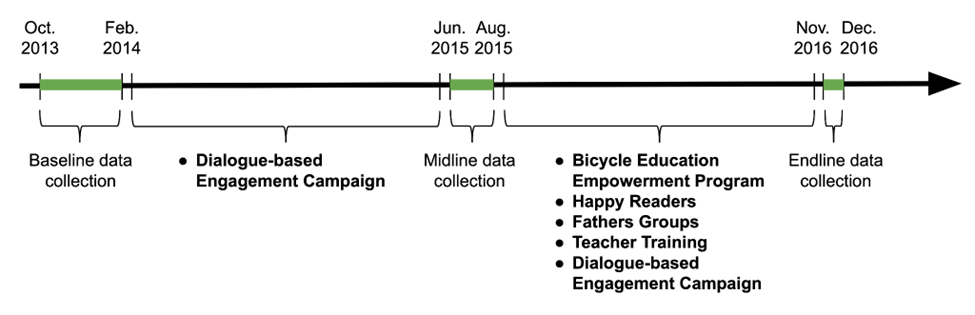
In the treatment group, the programme initially offered multiple types of dialogue-based engagement interventions with caregivers, teachers, students, and other community members. As shown in Figure 1, these all took place before midline data collection, allowing us to measure the initial impact of these discussions in isolation. After midline data collection, the project began rolling out its curriculum and resource-based interventions. Because the project only involved dialogue-based engagement during the initial phase, we can attribute changes at midline to the dialogues alone.
Figure 1: Timing of dialogue-based engagement campaigns and data collection
Measuring the impact of dialogue-based engagement campaigns
To evaluate the immediate impact of the dialogue-based engagement campaign, we measure the change in enrolment and test scores (literacy and numeracy) at midline in the treatment group compared to the control group. We also consider the impact of the entire IGATE programme, which included providing bicycles, additional literacy materials, and teacher training, by looking at the change in enrolment and test scores at endline.
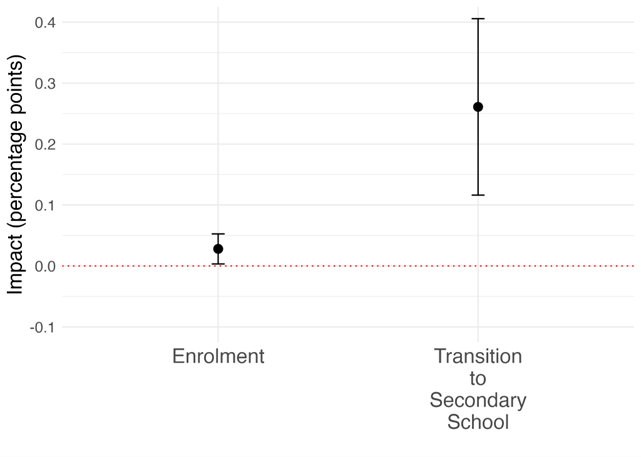
As shown in Figure 2, we find that girls in treatment areas are 2.8 percentage points more likely to be enrolled in school than girls who did not receive treatment by midline. This difference between baseline and midline is statistically significant and also intrinsically meaningful when we consider that less than 1% of the sample was not enrolled in school. At midline, non-enrolment increased to 3.9% in the control group, compared to only 1.5% in the treatment group. This suggests that the IGATE programme led to fewer students dropping out of school after the intervention.
This is particularly true among students who are approaching secondary school, when traditional gender norms, distance to school, and tuition fees all become more substantial barriers to girls' education. Figure 2 also presents the enrolment outcomes for students expected to progress to secondary school by midline. Girls in the treatment group who were transitioning into secondary school were approximately 26 percentage points more likely to have stayed in school. This suggests that IGATE’s dialogue-based engagement campaign mitigated school dropout at a time when girls were particularly vulnerable.
Figure 2: Impact of dialogue interventions on enrolment compared to the control group
Beyond enrolment: Are girls learning?
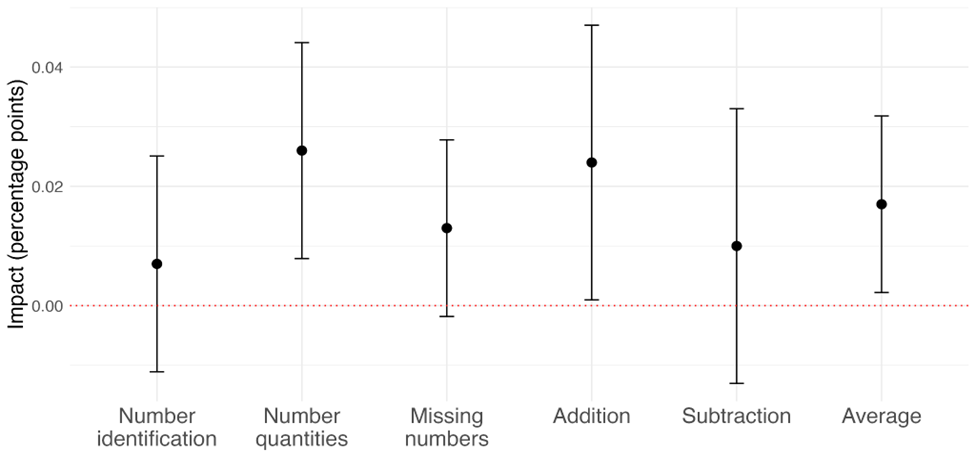
In light of concerns that global increases in enrolment are not translating into meaningful improvements in learning (World Bank 2022, Angrist et al. 2023), we also want to consider whether girls are learning more. Figure 3 shows that, compared to girls in the control group, girls improved on math tests by 1.7 percentage points (0.06 SD) overall. These gains come from improvements in their ability to successfully compare the magnitude of different numbers (‘number quantities’) and in completing simple addition tasks.
Figure 3: Impact of dialogue interventions on mathematics compared to the control group
We cannot distinguish whether the improvements in mathematics performance caused by the dialogue-based interventions come from improvements in understanding or changes in attitudes or confidence, leading to an improved ability to apply their understanding. However, there are several reasons that a general campaign to encourage girls’ education may have this kind of impact on math performance. The campaign may have encouraged more effort or focus by girls on tasks that others have shown are sometimes not prioritised because they are viewed as difficult, masculine, or irrelevant to their daily lives (Gudyanga 2016). It may also have increased teacher or parental attention for girls after community members gained awareness of gender gaps. Indeed, we find some evidence that caregivers demonstrate more supportive behaviours after exposure to the IGATE programme.
We find that the dialogue-based engagement campaign did not substantially impact literacy by midline. This may be because the programme did not have an impact on literacy; it may also be that the impact on literacy takes longer to materialise.
What is the added impact of the other intervention components?
Once the other interventions were implemented after midline, there were no additional impacts on enrolment or mathematics-related outcomes. This suggests that dialogue-based engagement was likely responsible for the programme’s overall impact on math and enrolment, even after the other components were rolled out. However, following the addition of the other programme components, including a reading programme, students witnessed a significant increase in reading comprehension, which we did not see after implementing the dialogue components alone.
Policy implications for dialogue-based engagement campaigns
Our research shows that dialogue-based engagement campaigns can lead to meaningful improvements in school enrolment and mathematics outcomes for girls. We see that they are not just an add-on intervention that strengthens the effectiveness of other programme components. Instead, we see that they may be the primary driver behind the gains in mathematics and enrolment from much broader programmes.
These results emphasise the critical role of community attitudes and awareness in supporting girls’ education. Policymakers from development agencies and NGOs should consider dialogue-based engagement as a promising intervention worth considering on its own or as a component of a broader programme.
It is important, however, to recognise the limitations of this study. First, the absence of short-term effects on literacy suggests that dialogues alone may not be sufficient for improving all learning outcomes. Additional interventions—such as providing resources, teacher training, or targeted literacy programmes—may be necessary to achieve comprehensive educational gains. Second, our study represents the results from a single randomised experiment in a specific context. Further research in other contexts is needed to know the extent to which the promising impact we observe for primary-school-aged girls in Zimbabwe carries over to other settings.
References
Alan, S, S Ertac, and I Mumcu (2018), “Gender stereotypes in the classroom and the effects on achievement”, Review of Economics and Statistics, 100(5): 876–890.
Angrist, N, E Aurino, H A Patrinos, G Psacharopoulos, E Vegas, R Nordjo, and B Wong (2023), “Improving learning in low- and lower-middle-income countries”, Journal of Benefit-Cost Analysis, 14(S1): 55–80.
Bonfert, A and D Wadhwa (2024), “Tracing global trends in education: A tale of old and new gender gaps”, World Bank.
Cislaghi, B, E K Denny, M Cissé, P Gueye, B Shrestha, P N Shrestha, G Ferguson, C Hughes, and C J Clark (2019), “Changing social norms: The importance of ‘organized diffusion’ for scaling up community health promotion and women empowerment interventions”, Prevention Science, 20(6): 936–946.
Fryer, R G Jr and S D Levitt (2010), “An empirical analysis of the gender gap in mathematics”, American Economic Journal: Applied Economics, 2(2): 210–240.
GEC (2018), “Thematic review: Community based awareness attitudes and behavior”, UKaid Girls’ Education Challenge, London.
Gudyanga, A (2016), “Zimbabwean female participation in physics: Factors of identity formation considered as contributing to developing an orientation to physics by female students”, Journal of Education and Practice, 7(26): 159–171.
Guiso, L, F Monte, P Sapienza, and L Zingales (2008), “Culture, gender, and math”, Science, 320(5880): 1164–1165.
Jensen, R (2010), “The (perceived) returns to education and the demand for schooling”, Quarterly Journal of Economics, 125(2): 515–548.
Lavy, V and E Sand (2018), “On the origins of the gender human capital gap: Short- and long-term consequences of teachers’ biases”, Journal of Public Economics, 167: 263–279.
OECD (2015), "The ABC of Gender Equality in Education: Aptitude, Behaviour, Confidence".
Robinson-Cimpian, J P, S T Lubienski, C M Ganley, and Y Copur-Gencturk (2014), “Teachers’ perceptions of students’ mathematics proficiency may exacerbate early gender gaps in achievement”, Developmental Psychology, 50(4): 1262–1281.
World Bank (2022), "The State of Global Learning Poverty: 2022 Update".