




Higher education played a key role in Southeast Asia’s long-run development – much earlier than most policy accounts and research suggest.
Southeast Asia’s take off
Few regions in the world have seen a more dramatic economic transformation than Southeast Asia in the last half century. Since 1970, per capita GDP rose sevenfold, poverty fell from 70% to under 5%, and the region shifted from being overwhelmingly agrarian to industrial and service based. Countries like Malaysia, Vietnam, and Thailand have become centres of industrial production and global trade hubs. Even though not all Southeast Asian countries have done equally well (e.g. the Philippines) and some have seen notable retrogression (e.g. Burma), the take-off remains impressive in historical comparative terms. After all, many sub-Saharan African economies experienced comparable low-income levels in the 1950s-60s and have also coped with colonial coercion and long-term specialisation in tropical export agriculture.
Most policy accounts thus attribute Southeast Asia’s success to post-1960 policy reforms focusing on pro-poor, pro-rural development strategies, trade liberalisation, macro-economic stability and post-colonial state building (World Bank 1993, Henley 2015). But this leaves a critical question unanswered: why were Southeast Asian policies so effective, and were the ‘enlightened’ autocracies really ‘development’ oriented, or were the economic fundamentals better than hitherto assumed?
We argue that part of the answer lies in the long-term accumulation of human capital, especially higher education, beginning in the early twentieth century. The schooling revolution had a direct impact on the region’s growth potential and translated into declining relative costs of skilled labour (Frankema and van Waijenburg 2023). Moreover, growing clusters of higher educated workers may also have improved the overall ‘quality’ of public policy in terms of design and implementation. To explore these hypotheses, we (de Pleijt and Frankema 2025) use IPUMS microdata on 123 million individuals, which are grouped into decadal birth-cohorts. Using sub-national variation across 277 provinces (regions) in eight countries including Cambodia, Indonesia, Laos, Malaysia, Papua New Guinea, the Philippines, Thailand, and Vietnam, allows us to trace the development of educational attainment levels per region, and per decade over the course of the twentieth century.
Education before ‘late’ industrialisation
Across Southeast Asia, mass education expanded in the first half of the twentieth century – when all Southeast Asian countries (except Thailand) were under colonial rule. Educational investments were highly uneven though (Booth 2007). By the 1920s, over 80% of adults in the Philippines had received some schooling, compared to just 10% in Papua New Guinea. Attainment levels also varied widely within countries, shaped by colonial strategies, geography, religion, and community initiatives. The disparities in higher education attainment of the 1920s birth cohort are illustrated in figure 1. The map reveals a clustering of human capital in regions which would later industrialise faster.
Figure 1: The share of persons born in the 1920s with completed higher education
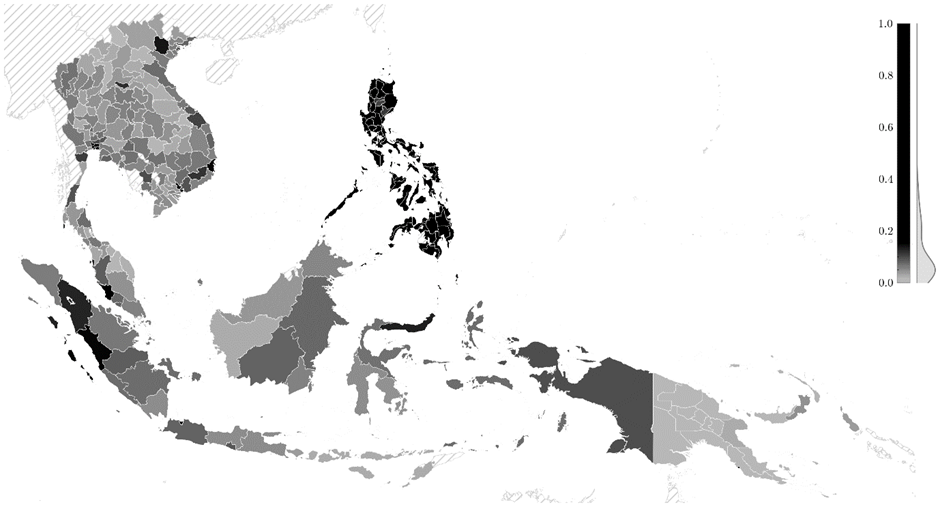
Notes: Darker is higher. The highest value is 0.55; the lowest value is 0.00; the mean is 0.07.
Next, we relate early education levels to economic development in 2000, which we measure via satellite-based night-time lights, while controlling for a range of potential confounding factors. Nightlight densities are regarded as a good proxy for regional income levels and are closely associated with industrialisation (Henderson et al. 2012). In our regression analyses we find that:
- Regions where more people completed secondary or tertiary education by the 1920s are significantly more developed in the early twenty-first century.
- The effect of basic schooling is much weaker though, suggesting that mass education alone was not sufficient to drive regional development.
- These results hold after accounting for historical variation in urbanisation, geographical factors, colonial cash-crop specialisation, and mineral wealth.
The predictive power of early education on later development supports insights from Unified Growth Theory, which stresses human capital as a long-run driver of structural change (Galor 2011). But our conclusion that smaller clusters of higher educated workers were crucial, may be especially relevant for ‘late’ industrialising economies, that is, economies who are competing at a much further extended global technology frontier than the early industrialisers of the nineteenth century.
Migration as a key mechanism for educational attainment
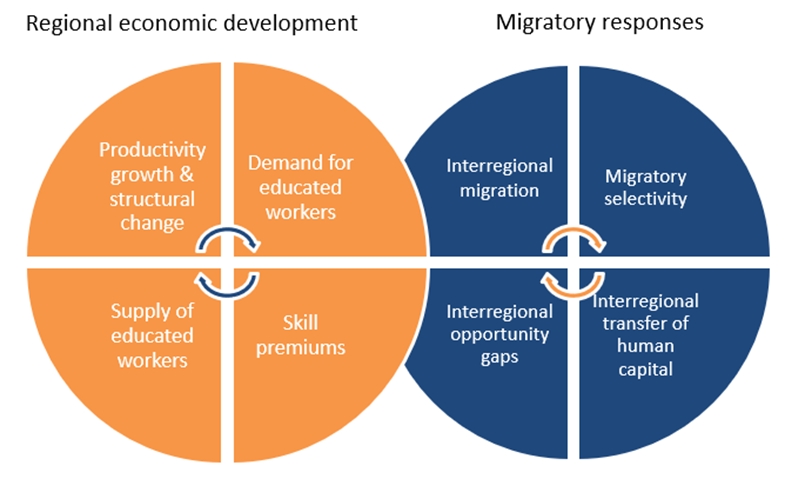
Why do we find the clustering of more educated people in particular regions? The main reason is significant internal migration. Our data shows that better-educated individuals were much more likely to move to economically dynamic regions – capital cities, industrial zones, and trade hubs. These migration patterns, in turn, amplified regional disparities and concentrated skills in regions where they were most productive. As visualised in Figure 2, these migration patterns are partly self-reinforcing. We find that inter-regional migrants raised the average educational attainment of the region of destination by 2.5 to 3.5 percentage points – a substantial effect in development terms. This finding resonates with earlier work on agglomeration and skills (Glaeser 1999, Young 2013).
Figure 2: Feedback loops in regional economic development and migration
Policy implications: Look beyond mass education
Several lessons emerge for today’s policymakers:
- Long-term policy horizon: The roots of Southeast Asia’s development miracle were laid decades before industrial growth took-off. Early investments in education – even under imperfect colonial systems – paid off in the long-run.
- Invest in depth, not just breadth: While primary schooling is essential, our results show that higher education had a stronger long-run effect on regional growth. This mirrors findings from other Asian ‘late’ industrialisers like South Korea and Taiwan (Amsden 1989).
- Enable mobility: Internal migration allowed human capital to flow to dynamic areas. Policies that support urban infrastructure, mobility, and education access for migrants can thus enhance development outcomes.
The Southeast Asian growth miracle was not just a story of good policies in the 1970s. It was also the result of quiet, cumulative changes in human capital over the 20th century – especially the rise of secondary and tertiary education.
Understanding these deeper roots is essential for countries seeking to emulate the region’s success. As development debates increasingly focus on skills and education, Southeast Asia offers a powerful lesson: investing in higher education today shapes the prosperity of tomorrow.
References
Amsden AH (1989), “Asia’s next giant: South Korea and late industrialization,” Oxford University Press.
Booth A (2007), “Colonial legacies: Economic and social development in East and Southeast Asia,” University of Hawai’i Press.
de Pleijt AM and E Frankema (2025), “The deeper roots of human capital formation and economic development in Southeast Asia, 1900–2000,” Journal of Development Economics 176: 103506.
Frankema E and M van Waijenburg (2023), “What about the race between education and technology in the global South? Comparing skill premiums in colonial Africa and Asia,” Economic History Review 76(3): 941–978.
Galor O (2011), “Unified growth theory,” Princeton University Press.
Glaeser E (1999), “Learning in cities,” Journal of Urban Economics 46(2): 254–277.
Henderson V, T Squires, A Storeygard, and D Weil (2012), “Measuring economic growth from outer space,” American Economic Review 102(2): 994–1028.
Henley D (2015), “Asia-Africa development divergence: A question of intent,” Zed Books.
World Bank (1993), “The East Asian miracle: Economic growth and public policy,” Oxford University Press.
Young A (2013), “Inequality, the urban-rural gap, and migration,” Quarterly Journal of Economics 128(4): 1727–1785.