




The nationwide reshuffling of universities in China during the 1950s sheds light on the long-run effects of higher education on industrial development.
Editor's note: The authors have made slides available to accompany this research here.
Governments regularly invest in universities hoping they will boost innovation, attract firms, and stimulate local development. But rigorous evidence on whether universities leave long-lasting economic footprints is surprisingly scarce. Do they create persistent local advantages, or do their effects fade like many physical capital investments?
A remarkable historical episode in China allows us to revisit this policy question. In the early 1950s, the Chinese government performed one of the largest reorganisations of higher education in modern history. Entire university departments – faculty, students, and equipment – were uprooted and reassigned across the country to build a Soviet-style specialised system. More than two-thirds of all departments were moved, and one-third were moved to entirely new cities. Our research (Fan, Tang, and Zhang forthcoming) uses this shock to show that universities can generate powerful and persistent local industrial growth – but only when markets allow knowledge and skills to be used productively after China’s economic reform since 1978. Our findings highlight the importance of human-capital-based place policies, especially in developing countries undergoing structural transformation.
A massive and abrupt relocation of higher education resources
Between 1952 and 1957, the Chinese government fundamentally restructured its higher education system, dismantling the pre-1949 model of comprehensive universities and replacing it with specialised colleges focused on fields like engineering, agriculture, medicine, and applied sciences. This transformation was driven by both ideological and practical imperatives. Ideologically, Western-style universities were seen as bastions of the old elite, and the state sought to consolidate control by physically relocating academic staff, abolishing departments – particularly in humanity-related fields – and remoulding the entire system according to the Soviet model. Practically, the nation faced a critical shortage of technical personnel; the existing stock of qualified engineers and technicians in 1952 was less than half of what industrial planners deemed necessary, making the explicit goal of this reorganisation to "cultivate urgently needed science and engineering talent".
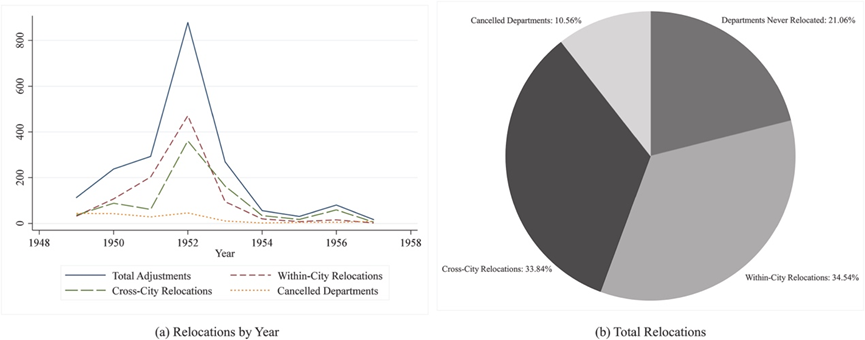
The scale of this overhaul was extraordinary, with 68% of all departments being restructured and 33.8% physically relocated across cities. The Science, Technology, Engineering, and Mathematics (STEM) fields, especially engineering and technology, were at the forefront of this movement, experiencing both the highest rates of relocation and the largest number of inter-city moves. To build specialised institutions, the government frequently merged departments from multiple universities. The civil engineering department at Tongji University in Shanghai, for example, was created by consolidating eleven such departments from across East China. Similar consolidations created new aeronautics, mining, and industrial colleges.
Critically for causal inference, extensive archival and statistical checks show that the chosen host cities did not have systematically stronger industrial bases before 1949, nor did they receive disproportionately large planned-economy industrial investments later. This supports the interpretation that the relocation served political and educational purposes – rather than reflecting pre-existing industrial strength.
Figure 1: University department relocations, 1949–1957
Identifying which industries gain most from a relocated department
To identify the spillover effects of university relocations, we examine whether local industries that are technologically related to the relocated academic departments experienced faster growth, moving beyond the simpler question of whether merely having a university matters. This is achieved by constructing explicit linkages between academic fields and specific manufacturing sectors. The connection is built using patent data from the CNKI systems in China, which reveal the patent classes most frequently associated with different academic disciplines, combined with official crosswalk tables that map these patent classifications to standardized three-digit manufacturing industry codes. An industry is deemed related to a relocated department if the patent classes linked to that industry show substantial overlap with the knowledge output of the department's academic field. For instance, physics connects to electronics equipment manufacturing, chemistry to basic chemicals, and civil engineering to construction materials. This finely grained measurement strategy enables a robust research design, allowing us to compare economic outcomes across different industries within the same county, isolating the effect of exposure to a relocated department from other local advantages.
Main findings: What grew and when
The study integrates detailed department-level relocation histories with three major national datasets – the 1985 Industrial Census, the 1995 Economic Census, and the 2004 Economic Census – to analyse outcomes for each county-industry pair, focusing on employment, firm numbers, and value added per worker.
Consistent with the proposed mechanisms, the analysis reveals no significant growth advantage for industries related to relocated departments in the 1985 data. This null finding aligns with the institutional context of China's planned economy, where graduates were administratively assigned jobs nationwide and private firm formation was severely constrained, preventing local knowledge spillovers from materialising.
As market reforms took hold after 1978, granting firms greater autonomy and enabling labour mobility, strong positive effects emerged. By 1995, industries technologically related to relocated departments exhibited a 36% increase in employment and a 20% increase in the number of firms compared to unrelated industries within the same county. These effects strengthened further by 2004, with related industries showing 38% higher employment, 17% more firms, and a 15% increase in value added per worker. These are substantial impacts, equivalent to shifting a median county-industry into the top quartile of the national performance distribution.
The analysis of establishment-level microdata confirms that these expansions were accompanied by significant productivity gains. Firms in related industries achieved 4–6% higher total factor productivity (TFP) in 1995 and 2004, depending on the estimation methodology. This indicates that the presence of specialised academic fields enhanced not just the scale but also the quality and efficiency of production.
How do these university impacts compare to physical-capital-based policies?
Our study provides a revealing contrast between the long-run effects of university relocations and two major industrial policies: the 1950s Soviet-assisted "156 Projects" in heavy industries and the 1960s-70s defence-driven "Third Front Movement". Despite enormous state investment in physical capital, both industrial programmes show substantial mean reversion, with targeted areas failing to retain their initial industrial advantages over the long term (Giorcelli and Li 2023, Heblich et al. forthcoming). The university relocations, by contrast, produced benefits that not only persisted but actually grew stronger over time. This pattern aligns with evidence from other historical contexts, including the establishment of US land-grant colleges, suggesting that investments in human capital and knowledge generation create more durable foundations for local economic development than investments in factories and physical infrastructure alone.
Policy implications
Universities can be powerful place-based development tools: The study demonstrates that targeted investments in higher education, especially specialised, STEM-oriented departments, can create long-run agglomeration benefits in technologically related industries.
But enabling markets is essential: Knowledge spillovers and skilled labour matter only when firms can form, hire, innovate, and compete. China’s experience shows that reforms enabling market entry and labour mobility were key to unlocking the university effects.
Human-capital strategies may outperform physical-capital subsidies: For governments debating whether to subsidise factories or expand higher education capacity, this study offers clear evidence that human capital leaves a more persistent imprint.
References
Fan, J, W Tang, and F Zhang (2026), “Persistent effects of universities on local economic growth: Evidence from China’s policy-induced college relocation in the 1950s,” Journal of Development Economics, 179: 103628.
Giorcelli, M, and B Li (2023), “Technology transfer and early industrial development: Evidence from the Sino-Soviet Alliance,” Unpublished manuscript.
Heblich, S, M Seror, H Xu, and Y Zylbergberg (forthcoming), “Industrial clusters in the long run: Evidence from Million-Rouble plants in China,” Review of Economic Studies.