

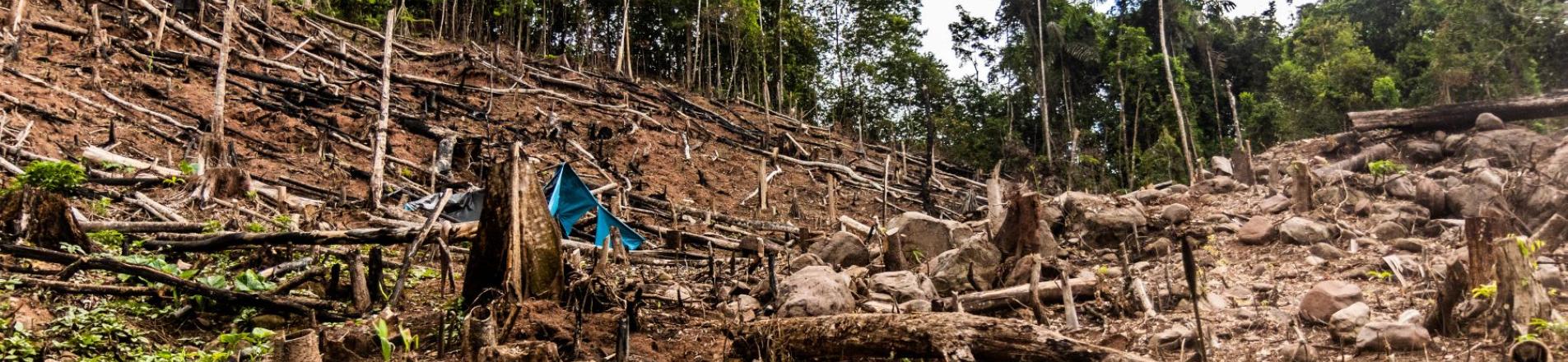



In the Brazilian Amazon, young mayors are associated with less deforestation, lower greenhouse gas emissions, and higher local income.
Editor’s note: For a broader synthesis of themes covered in this article, check out our VoxDevLits on Bureaucracy and Deforestation.
The people who govern us make decisions that shape our world for decades: they build infrastructure that will stand for generations, set policies that will outlast their own time in office, and manage natural resources that affect us all. But not all leaders face those decisions the same way. Among the many characteristics that may shape how a politician governs – their party, their background, their interests – age stands out as a particularly intriguing one. Among other things, age shapes how long a leader expects to live with the consequences of their decisions, and therefore how much they may care about long-term policy. When it comes to the environment, a domain where the costs of action are felt today but the benefits may take decades to materialise, that influence may have an important effect.
Previous research has explored the relationship between age and government policy. Alesina (2019) and Bertrand et al. (2015) argue that younger politicians have stronger career concerns, giving them greater incentives to perform. More recent work shows that age also shapes what politicians focus on: young legislators tend to focus on different issues than their seniors (Fiva et al. forthcoming), and tend to allocate public spending differently (McClean 2023, Baskaran et al. 2024).
Our recent research (Dahis, de las Heras, and Saavedra forthcoming) approaches this question in one of the most consequential environmental settings on the planet: the Brazilian Amazon. It contains 60% of the world's largest tropical rainforest, and its fate matters far beyond Brazil's borders. It also contains more than 700 municipalities, each with its own elected mayor. These features make it an ideal setting to study how local political leadership shapes environmental outcomes.
We focus on a carefully designed comparison. Rather than comparing all young mayors to all older ones, we focused on close elections: races where a young candidate and an older one went head-to-head, and one of them won by a small margin. In this setting, who ended up in the mayor's office was close to random chance. That means the municipalities governed by young mayors and those governed by older ones were, on average, similar in every other way, allowing us to isolate the effect of the mayor's age alone. We define a young candidate as one in the bottom 20% of the age distribution among candidates in a given election, which corresponds roughly to 35 years old or younger.
Having a young mayor in office decreased deforestation and greenhouse gas emissions
We find that municipalities governed by a young mayor experience significantly less deforestation (about 56% less) compared to otherwise similar municipalities where the young candidate narrowly lost against a candidate considered a non-young candidate. This effect is even larger when we compare municipalities where the young mayor won against a senior one, defined as a candidate in the top 20% of the age distribution, roughly 54 years old or older.
Beyond deforestation, we also find a reduction of around 46% in total greenhouse gas emissions per capita when a young mayor is in office. A significant part of this reduction comes from the land use category, which accounts for nearly 67% of the total emissions, falls by nearly 64% compared to similar municipalities governed by older mayors.
Younger mayors also achieved better economic performance
A common concern about environmental protection is that it comes at an economic cost. Our findings suggested that this was not the case. Those municipalities governed by young mayors experienced an increase in GDP per capita, driven by growth in the industrial sector. At the same time, the agricultural sector, one of the main drivers of deforestation in the Brazilian Amazon, shrank as a share of local economic activity. Therefore, we find no negative effect on the overall economy.
When a senior mayor governs, we find an increase in agricultural output, including a significant rise in cattle ranching. This pattern is consistent with stronger ties between older mayors and the agricultural interests that have historically driven forest clearing in the region.
How can a mayor affect these outcomes?
The next natural question is how a mayor can actually influence deforestation. We tested three possible mechanisms.
- Local government spending. Municipalities governed by young mayors show a broadly similar pattern of spending to those governed by older ones. We find no significant differences in the share of the budget allocated to different sectors. What we do find, however, is that senior mayors actively reduce environmental spending – a contrast that helps explain the divergence in outcomes.
- Supply of rural credit. We find no significant difference in the amount of rural credit flowing to farmers in municipalities governed by young mayors compared to those governed by older ones. Credit does not appear to be the channel through which young mayors influence deforestation.
- Composition of the bureaucracy. This is where the clearest mechanism emerges. Young mayors significantly reshape the local government workforce: total staff turnover increases by about 22% compared to similar municipalities with non-young mayors. Crucially, the new hires tend to be younger. This suggests that young mayors surround themselves with a bureaucracy that is more aligned with their priorities.
What drives younger mayors to protect the environment?
Our findings clearly show that having a young mayor in office matters. But explaining precisely why is harder given the current data limitations. Several mechanisms could be at play, and the data alone cannot separate them cleanly. Young politicians may simply have longer lives ahead of them, giving a greater weight to long-term decisions. They may belong to a generation that grew up with greater awareness of climate change and biodiversity loss, shaping their preferences in ways that persist as they age and rise through political ranks. The effects we find reflect something about the leaders themselves, not just the communities that elected them. Determining whether what we observe is driven by age itself, the generation these politicians belong to, or some combination of both is a question we leave open for future research.
References
Alesina, A, T Cassidy, and U Troiano (2019), “Old and young politicians”, Economica 86(344): 689–727.
Baskaran, T, Z Hessami, and S Schirner (2024), “Young versus old politicians and public spending priorities”, Journal of Economic Behavior and Organization 225: 88–106.
Bertrand, M, R Burgess, A Chawla, and G Xu (2015), “Determinants and consequences of bureaucrat effectiveness: Evidence from the Indian Administrative Service”, Unpublished manuscript.
Costa, F, A Hsiao, H Pellegrina, and E Souza-Rodrigues (2025), “Deforestation”, VoxDevLit 18(1).
Dahis, R, I de las Heras, and S Saavedra (forthcoming), “Young local politicians and deforestation in the Brazilian Amazon”, Journal of the Association of Environmental and Resource Economists.
Fiva, J H, O Nedregard, and H Øien (forthcoming), “Group identities and parliamentary debates”, Journal of Politics.
McClean, C T (2023), “Does the underrepresentation of young people in political institutions matter for social spending?”, Unpublished manuscript.
Xu, G, E Deserranno, D Moreira, and E Teso (2023), “Bureaucracy”, VoxDevLit 8(1).