






Despite the potential of solar power in sub-Saharan Africa, many rural households opt for low-quality solar products due to lack of affordability and information. A field experiment in Senegal shows that third-party certificates and warranties increase willingness to pay for high-quality solar lamps by 12–14%.
Why aren’t more households in rural Africa buying better solar lamps?
In many parts of sub-Saharan Africa, rural households live without access to reliable grid electricity (Lee et al. 2019). In Senegal, for instance, the rural electrification rate remains below 65% (Gouvernement de la République du Sénégal 2025), and the power that is available is often expensive or unreliable (Meeks 2025). In these settings, off-grid solar lamps can make a big difference—offering a clean, low-cost alternative for traditional lighting sources that improves children’s study conditions, reduces household energy costs, and cuts down on pollution (e.g. Grimm et al. 2017).
Despite their benefits and falling prices, solar lamps—especially high-quality ones—remain surprisingly underused. Several potential explanations for this—such as affordability and lack of information about the technology’s benefits—have been identified. However, relaxing these constraints alone is not sufficient to raise willingness to pay (WTP) for high-quality solar lamps to a level that covers market prices (e.g. Abdul-Salam and Phimister 2019, Grimm et al. 2020, Yoon et al. 2016, Mahadevan et al. 2023, Mekonnen et al. 2023). In Coville et al. (2025), we explore another potential reason for this using a field experiment in rural Senegal: consumers often cannot tell whether a lamp is high or low quality and, as a result, hesitate to pay higher prices for better products.
The (low-quality) solar lamp market in Senegal
In Senegal, as in many sub-Saharan African countries, the market for solar products is largely unregulated. While a handful of reliable, durable solar lamps exist, many low-cost versions quickly break or underperform (Lighting Global 2020). There are often no clear signals at the point of sale to distinguish low-quality from high-quality products.
This leads to a classic ‘market for lemons’ (Akerlof 1970), a concept in economics where uncertainty over product quality drives down demand for better options. If buyers cannot tell a high-quality lamp from a low-quality one, they are unlikely to pay more for either. Over time, this weakens incentives for suppliers to offer high-quality products at all.
Can quality signals solve the problem?
Our research assesses whether providing credible quality signals can help overcome this problem and increase demand for high-quality solar lamps among rural households in Western Senegal.
A door-to-door campaign offered participants the chance to buy two solar lamps: a high-quality, Lighting Global-certified lamp or a lower-quality, uncertified alternative. We randomly assigned participants to one of four groups:
- A control group that saw the high-quality lamp with no extra information.
- A group shown the high-quality lamp with a third-party certificate from Lighting Global (a World Bank initiative) that discloses information about the lamp’s durability and performance features.
- A group shown the same lamp with a two-year warranty from Total Senegal (a trusted local supplier) that allowed them to replace the lamp if it breaks within the warranty period.
- A group offered a money-back guarantee with the high-quality lamp that allowed them to return it for a full refund if they were unhappy after six weeks.
While both the Lighting Global certificate and the Total Senegal’s two-year warranty already existed prior to the experiment, the money-back guarantee was created specifically for the experiment.
We then asked each participant how much they would be willing to pay for each lamp.
Key findings: Certification and warranties increase demand
Our results reveal three main insights:
1. Certification and warranties raise WTP: Participants offered the high-quality lamp with a third-party certificate or warranty were willing to pay 12–14% more for the high-quality lamp, compared to the control group. This suggests that buyers are indeed concerned about product quality—and that clear signals of durability can rebuild their trust. In turn, the money-back guarantee has no effect on participants’ demand. Figure 1 illustrates the demand curves for the high-quality lamp in each group of participants. The mean WTP is approximately 303-342 CFA francs (US$ 0.53-0.6) higher in groups presented with the high-quality lamp that had the certificate or warranty.
Figure 1: Demand curves and WTP for the high-quality lamp
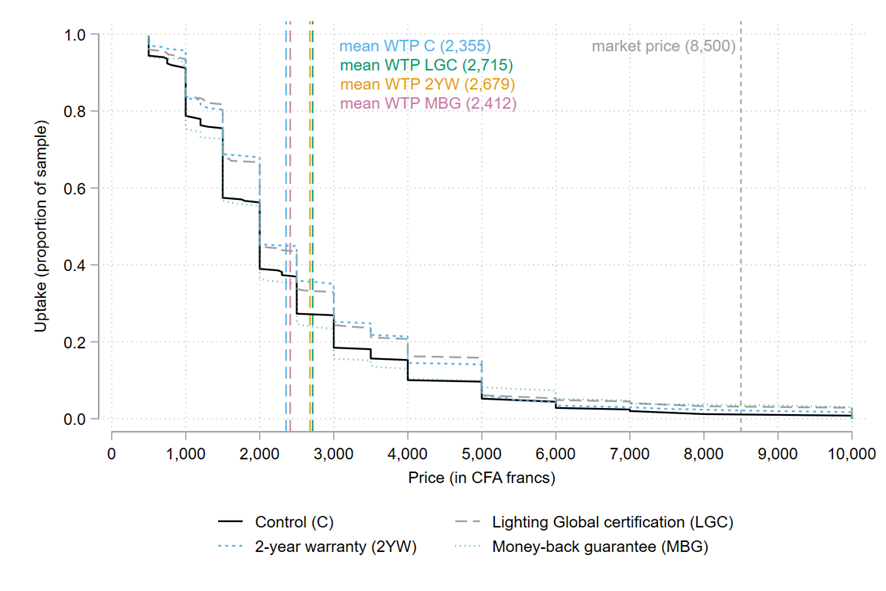
Note: The solid lines indicate the demand curves for each group of participants (see legend). The dashed lines indicate the mean WTP of each group of participants. The grey dashed line indicates the market price of the high-quality lamp.
2. Quality signals influence WTP across the board: Interestingly, the effective quality signals did not just increase interest in the certified lamp. Participants also increased willingness to pay for the lower-quality lamp—possibly because the certificate or warranty led them to update their beliefs about solar lamps in general. In other words, the quality signal changed perceptions of the entire product class, not just the targeted product.
3. Consumer experience matters: We found that the second effect—rising WTP for the lower-quality lamp—was concentrated among inexperienced consumers who had never owned a solar lamp. Experienced consumers, by contrast, responded differently to the effective quality signals. They increased their WTP for the high-quality lamp and lowered it slightly for the low-quality one (see Figure 2). Consistent with this, experienced consumers who are presented with the Lighting Global certificate or the two-year warranty state that they perceive the high-quality lamp to be good or excellent quality and the low-quality lamp to be lower quality (Figure 3).
Figure 2: Effect of certificate and warranty on WTP for high- and low-quality solar lamp by solar lamp experience
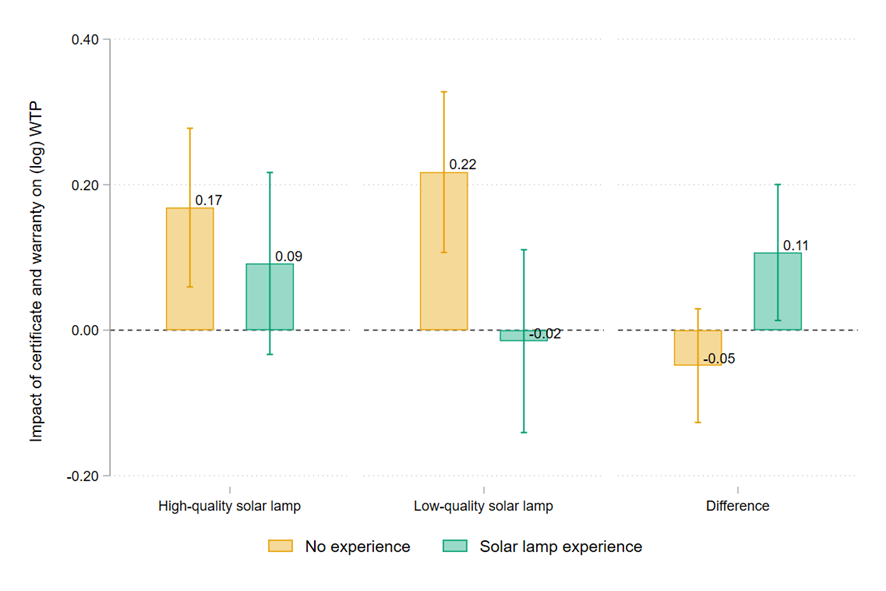
Note: The bars indicate the increase or decrease in willingness to pay for the high-quality lamp, the low-quality lamp and difference between both lamps (high-quality minus low-quality solar lamp) if the high-quality lamp is presented with a certificate or a warranty. The yellow bars show the effect for inexperienced participants and the turquoise bars for participants with prior solar lamp experience. Taken times 100, the impacts can be interpreted as percentage changes in willingness to pay. The vertical lines indicate 90% confidence intervals.
Figure 3: Effect of certificate and warranty on quality perceptions
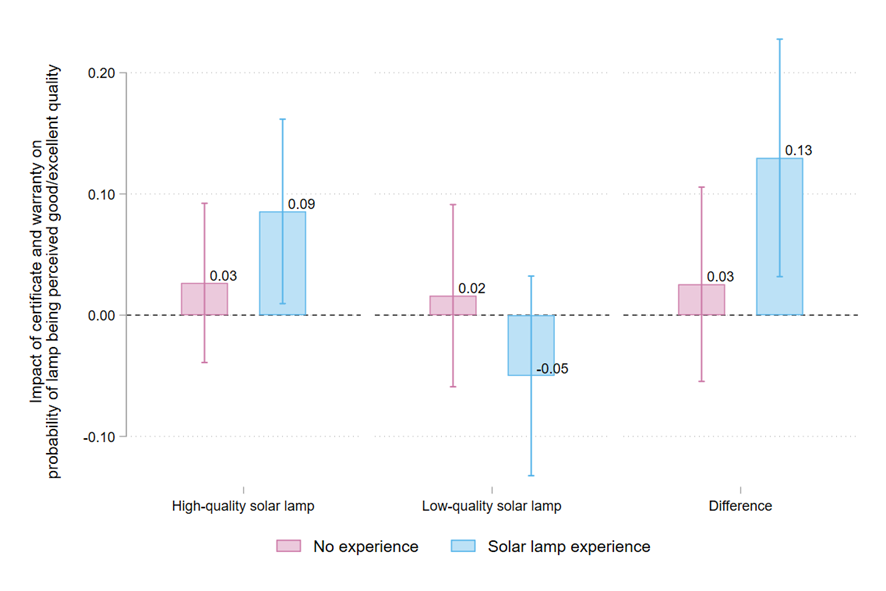
Note: The bars indicate the increase or decrease in the probability that the participants perceive the respective solar lamp to be good or excellent quality when the high-quality lamp is presented with a certificate or a warranty. The last two bars indicate the difference in quality perceptions between the two lamps. The pink bars show the effect for inexperienced participants and the blue bars for participants with prior solar lamp experience. The vertical lines indicate 90% confidence intervals.
Implications for energy policy and practice
Our study shows that demand for high-quality lamps significantly increases when consumers are credibly informed about a product’s durability through third-party certification or are assured durability through a warranty.
However, these effects may not translate into actual purchases by the average household. Even when offered a warranty or certificate with the high-quality lamp, most households were only willing to pay around 2,700 CFA francs—well below its market price of 8,500 CFA francs (Figure 1). That gap points to other persistent barriers, such as liquidity constraints or limited access to credit. On the one hand, to truly unlock the market, quality signals likely need to be complemented by subsidisation schemes (Berkouwer and Dean 2022). On the other hand, prices for solar products overall are expected to fall over time due to declining production costs.
The third-party certificate and warranty are scalable interventions, which are appealing to retailers in markets (Bernard et al. 2017). They are especially promising in rural areas, where informal vendors often travel from village to village selling products of unknown quality. While not costless, potential sellers could partner with credible organisations to sell certified products, or with firms to build or join a warranty scheme.
However, the demand for products of lower quality among inexperienced consumers presents a potential challenge. If a product class is new or information about it is not widely available, retailers may be reluctant to invest in certificates or warranties if retailers of competing products continue to benefit from changed perceptions of the entire product class.
References
Abdul-Salam, Y. and Phimister, E. (2019), “Modelling the Impact of Market Imperfections on Farm Household Investment in Stand-Alone Solar PV Systems”, World Development, 116: 66–76.
Akerlof, G. A. (1970), “The Market for Lemons: Qualitative Uncertainty and the Market Mechanism”, Quarterly Journal of Economics, 84: 488–500.
Berkouwer, S. B. and Dean, J. T. (2022), “Credit, Attention, and Externalities in the Adoption of Energy Efficient Technologies by Low-Income Households”, American Economic Review, 112(10): 3291–3330.
Bernard, T., de Janvry, A., Mbaye, S. and Sadoulet, E. (2017), “Expected Product Market Reforms and Technology Adoption by Senegalese Onion Producers”, American Journal of Agricultural Economics, 99(4): 1096–1115.
Coville, A., Graff, J., Reichert, A., and Reitmann, A.-K. (2025), “Quality Signaling and Demand for Renewable Energy Technology: Evidence from a Randomized Field Experiment”, Journal of Development Economics, 176: 103514.
Gouvernement de la République du Sénégal (2025), “Pacte National Pour l’Énergie”.
Grimm, M., Lenz, L., Peters, J. and Sievert, M. (2020), “Demand for Off-Grid Solar Electricity: Experimental Evidence from Rwanda”, Journal of the Association of Environmental and Resource Economists, 7(3): 417–454.
Grimm, M., Munyehirwe, A., Peters, J. and Sievert, M. (2017), “A First Step up the Energy Ladder? Low Cost Solar Kits and Household’s Welfare in Rural Rwanda”, World Bank Economic Review, 31(3): 631–649.
Lee, K., Miguel, E. and Wolfram, C. (2020), “Experimental Evidence on the Economics of Rural Electrification”, Journal of Political Economy, 128(4): 1523–1565.
Lighting Global (2020), “Off-Grid Solar Market Trends Report 2020 (Report Summary)”.
Mahadevan, M., Meeks, R. and Yamano, T. (2023), “Reducing Information Barriers to Solar Adoption: Experimental Evidence from India”, Energy Economics, 120: 106600.
Meeks, R. and Mahadevan, M. (2025), “Electricity Infrastructure”, VoxDevLit, 15(1), May.
Mekonnen, A., Hassen, S., Jaime, M., Toman, M. and Zhang, X. B. (2023), “The Effect of Information and Subsidy on Adoption of Solar Lanterns: An Application of the BDM Bidding Mechanism in Rural Ethiopia”, Energy Economics, 124: 106869.
Yoon, S., Urpelainen, J. and Kandlikar, M. (2016), “Willingness to Pay for Solar Lanterns: Does the Trial Period Play a Role?”, Review of Policy Research, 33(3): 291–315.