



Despite strong public concern for climate change and pollution in Indonesia, politicians underestimate the demand for policy responses and fail to act – even when informed of voter preferences. Politicians’ misperceptions, elite capture, and political costs sustain inaction, underscoring the multiplicity of challenges for climate policy.
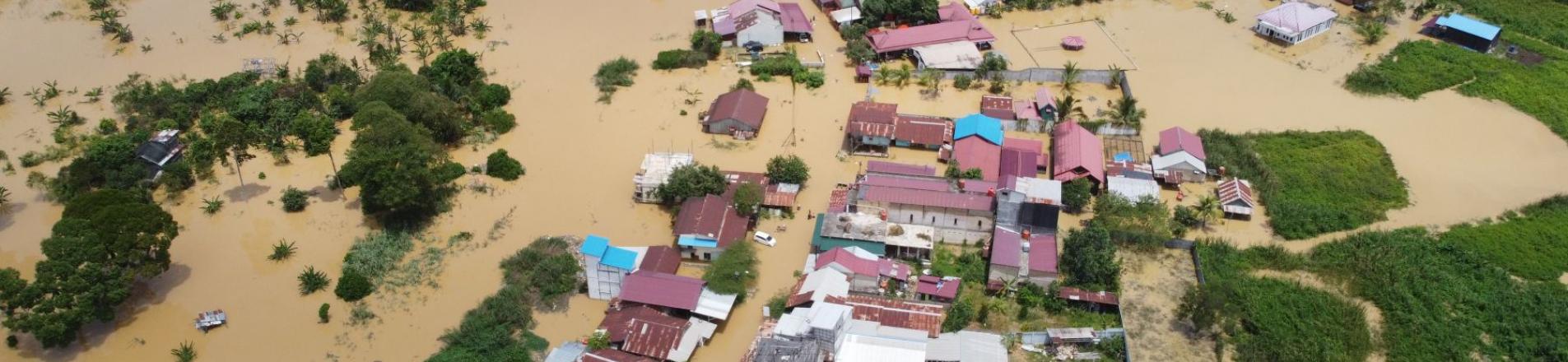
Indonesia faces major environmental challenges. Slash-and-burn agriculture sparks wildfires, and rapid industrialisation pollutes the air and the water (Balboni et al. 2025). Climate change will exacerbate extreme heat and heavy rain, and sea level rise will threaten coastal populations (Hsiao 2025). At the same time, policy action remains limited on these fronts. In Hsiao and Kuipers (2025), we study the multiple causes of policy inaction in Indonesia.
Measuring the demand for climate action in Indonesia
We begin by documenting inaction. Environmental policy is managed primarily by local government, following decentralisation reforms in the early 2000s, and we compile data on local politicians and regulations. We find that less than 3% of local candidates’ campaign platforms mention environmental concerns in 2024, and less than 1% of local regulations address environmental concerns from 1980 to 2012. Against this backdrop, deforestation rates have risen in a reversal of previous progress (Global Forest Watch 2024), and Jakarta ranks consistently among the most polluted cities in the world (IQAir 2023).
We measure demand for environmental progress among voters and politicians. We do so with original survey data collected in advance of the 2024 legislative and presidential elections. We elicited voters’ preferences across a range of policies, including environmental policies, through mass public surveys with 6,886 online respondents. Quota-based sampling ensures representation by age, gender, and region. We elicited politicians’ perceptions of voters’ preferences through a panel survey of 800 candidates for local legislative office in Indonesia (DPRD-II). We obtained a representative sample by stratification, randomly drawing 80 districts (kabupaten/kota) and sampling 10 candidates from each district.
Voters are concerned about climate change, but politicians underestimate this concern
Indonesian voters report broad concern over issues of climate change and pollution. In our sample, 46% and 57.5% of voters indicate that climate change and pollution, respectively, are ‘very important’ issues. Voters report even stronger concern over the concrete, climate-related issues of extreme heat, flooding, drought, and wildfire in their own communities. Moreover, a large majority of voters support environmental protection even when pressed with its potential economic costs.
Even so, we find that politicians underestimate voters’ concern for the environment. Only 29% and 35.1% of politicians indicate that climate change and pollution are very important issues for voters. By contrast, we document better alignment on issues of health, education, and the economy. In these more traditional domains, voters hold strong preferences, and politicians hold accurate perceptions of these preferences.
Politicians updated their views on the demand for action, but not their support for environmental policies
We study the impact of politicians’ perceptions with a randomised informational experiment, which we conducted several weeks before the election. For a treatment group of politicians, we provided information about voters’ preferences in the form of an oral presentation and a written report. We then measured politicians’ own preferences and their perceptions of voters’ preferences in a follow-up survey. For a control group of politicians, we delivered the presentation and report after the follow-up survey, rather than before.
We find evidence of learning: politicians updated their views on the importance that voters attach to environmental issues, and politicians also updated their own views on these issues. Relative to control politicians, treatment politicians were 8.7 percentage points more likely to indicate that climate change and pollution were very important issues for voters. Politicians were also 8.7 percentage points more likely to hold these beliefs themselves.
But politicians were not called to action. We detected no additional support for specific environmental policies, including a carbon tax or deforestation ban. Forest protections are particularly important in the Indonesia context, where the palm oil industry drives large-scale land clearing (Hsiao 2024). We also asked politicians whether extreme heat, flooding, sea level rise, deforestation, and pollution were issues that ‘merited policy attention’, which is a much lower bar than the difficult task of policy implementation. We still detected no additional support along these margins.
That is, we find that politicians are reticent to act, even when voters demand action and we communicate this demand to politicians. Our final set of results highlight the costs of policy action:
- Our intervention only induced policy support among politicians that grossly underestimated voter demand. Politicians otherwise find it too costly to change policy platforms.
- Our intervention only induced policy support in regions with limited elite capture. Agribusiness interests otherwise create political headwinds for environmental protection.
- Voters and politicians do align in their rank ordering of policy issues. If policy action faces fiscal constraints, then environmental inaction may allow progress in other domains. Inaction is inefficient in the first and second cases, but it need not be in the third.
Global lessons for climate policy
Our research connects to ongoing debates on the drivers of environmental inaction and the desire to spur change. Our main contribution is to show that existing explanations related to preferences, perceptions, and policy costs are independently insufficient. Climate action requires progress on all fronts. In this moment of heightened political tension, Indonesia offers global lessons and potential solutions.
References
Balboni, C, R Burgess, and B Olken (2025), “The origins and control of forest fires in the tropics,” Review of Economic Studies.
Global Forest Watch (2024), “Tree cover loss in Indonesia.”
Hsiao, A (2024), “Coordination and commitment in international climate action: Evidence from palm oil.”
Hsiao, A (2025), “Sea level rise and urban adaptation in Jakarta.”
Hsiao, A and N Kuipers (2025), “Climate crisis and policy inaction in Indonesia,” American Journal of Political Science.
IQAir (2023), "World air quality report: Region and city PM2.5 ranking."