






High institutional and regulatory barriers make it unusually costly for manufacturing firms to exit in India – discouraging entry, keeping inefficient firms afloat, and lowering productivity.
India’s manufacturing puzzle
Earlier this year, the Supreme Court of India delivered a startling verdict: it reversed the liquidation of a steel company buyout that had been completed four years earlier (Venugopal 2025). The decision sent shockwaves throughout the industry, not only because it upended a long-settled transaction, but because it served as a stark reminder of how uncertain and costly the process of exiting a business can be in India. Protracted insolvency resolution, cumbersome administrative clearances, and strict labour laws – particularly in manufacturing – raise the cost of adjusting labour and winding down operations.
These frictions are part of a broader institutional environment that has shaped India’s unusual structural transformation (Fan et al. 2023, Rodrik 2016). Despite an abundance of low-skilled labour, India never experienced the kind of take-off in labour-intensive manufacturing seen in other countries at similar income levels (Chatterjee and Subramanian 2020). Instead, the manufacturing sector is dominated by a long tail of inefficient firms, limited job creation, and unexpectedly capital-intensive production (Hsieh and Klenow 2009, Padmakumar 2024).
Paradoxically, India has excelled in high-skill services – such as software exports – despite its low average education level, aided by the presence of elite institutions such as the Indian Institutes of Technology and Indian Institutes of Management. Meanwhile, manufacturing remains more capital-intensive than one might predict, both on average and conditional on industry characteristics, given India’s GDP per capita.
In Chatterjee, Krishna, Padmakumar, and Zhao (2025), we argue that a central reason for these patterns lies in the institutional exit barriers facing manufacturing firms. We show that such barriers not only slow firm exit but also deter entry, keep unproductive firms alive, and depress aggregate output and productivity in manufacturing. Their impact is most pronounced in states with high institutional frictions and in labour-intensive sectors, where rigid labour adjustment limits firm growth. Our findings suggest that well-designed reforms to lower exit costs could deliver large gains in productivity, output, and employment.
Why is firm exit so hard in India?
India’s manufacturing exit rates are among the lowest in the world, especially in the formal sector. Figure 1 below shows that while the US manufacturing sector sees an annual exit rate of around 9%, the corresponding rate in Indian formal manufacturing is just 3.1%. This low level of churn suggests significant frictions in the exit process especially in formal manufacturing, which may be dampening the reallocation of resources to more productive firms.
Figure 1: Firm exit rates
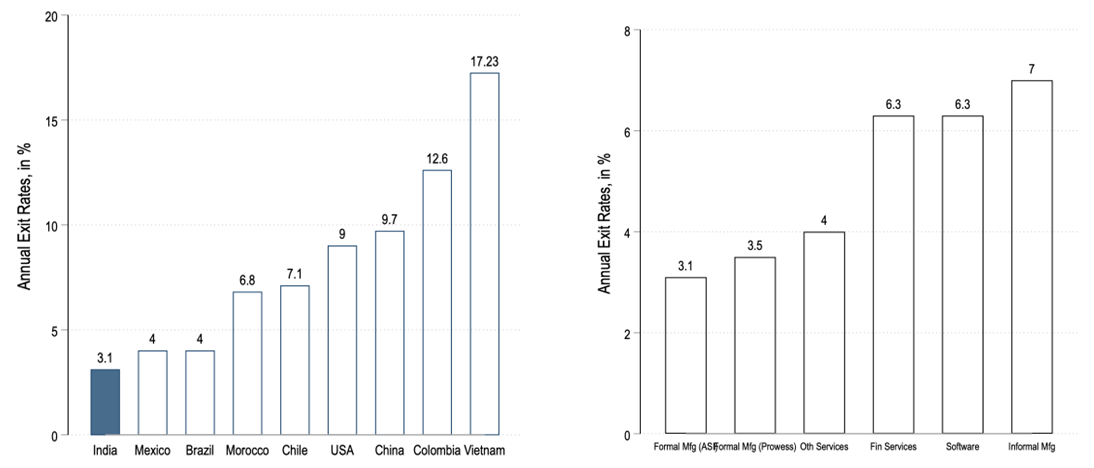
Notes: Left Panel: Exit rates of different countries have been calculated/taken from the following sources: India - calculated from Annual Survey of Industries dataset from survey years 2000-01 and 2015-16; Brazil and Mexico - taken from Bartelsman et al. (2009) averaged from 1990-1999; Chile, Colombia, and Morocco - taken from Roberts and Tybout (1996) for the year 1985; US - taken from figure 1 in ‘Business Exit During the COVID-19 Pandemic: Non-Traditional Measures in Historical Context’ by Crane et al. (2022) for 2006; China - calculated from Annual Surveys of Industrial Production for 2006; Vietnam - calculated from Vietnam enterprise census for 2007. Right panel: Exit rates of service sector firms have been computed from the Prowess database. Other services include accommodation & food services, transport & storage services, and administrative & support services. The annual exit rate of informal manufacturing plants has been computed from NSS data for 1994-95 and 2015-16. For more details on exit calculations, please see Chatterjee et al. (2025).
Institutional and regulatory constraints make it difficult for unproductive or distressed firms to shut down. Even in ideal cases – when firms are fully compliant and not involved in litigation – voluntary closure takes an average of 4.3 years (Economic Survey of India 2020-21). Nearly three of those years are spent navigating clearances and refunds from government departments such as the Income Tax office, GST administration, and Provident Fund authority. When complications arise – such as outstanding debts, worker layoffs, or tax disputes – exit becomes even harder. Two main institutional bottlenecks stand out:
- India lacks a well-defined bankruptcy framework. Until recently, firms facing insolvency had no clear legal route to liquidation. As a result, disputes often ended up in courts and remained unresolved for years due to judicial bottlenecks and inconsistent interpretation of laws. Attempts to improve this – via the SARFAESI Act (2002) and the Insolvency and Bankruptcy Code (2016) – have seen limited success due to enforcement problems and judicial backlogs.
- Labour laws – particularly the Industrial Disputes Act (IDA) – require government approval for firms in manufacturing, mines, and plantations with over 100 workers to fire even one worker. But it’s not just the law itself; its implementation is highly discretionary. Identical cases can receive different treatments depending on the official or court involved. Judicial outcomes vary widely, and political factors often influence administrative decisions. This uncertainty further raises the costs of exit, especially for larger firms.
Exit barriers vary across states, so does firm dynamism
Institutional environments differ widely across Indian states, and so do the barriers to firm exit. Some states have relatively business-friendly environments, while others have stricter institutions that make exit difficult. We exploit this variation to document several facts on how manufacturing firms respond to different institutional settings.
First, entry and exit are positively correlated at the state level (see Figure 2). It is clear that states with higher entry shares also tend to have higher exit shares, reflecting greater dynamism. In contrast, states with sluggish entry generally also see fewer exits. This pattern suggests that where exit is costly or uncertain, potential entrants may be discouraged by the prospect of being unable to close down if needed. Based on these patterns, we group states into high-performing and low-performing categories: high-performing states (denoted as red in Figure 2) have high entry and exit shares, while low-performing states (denoted as blue in Figure 2) have low shares of both.
Figure 2: Entry shares versus exit shares of states
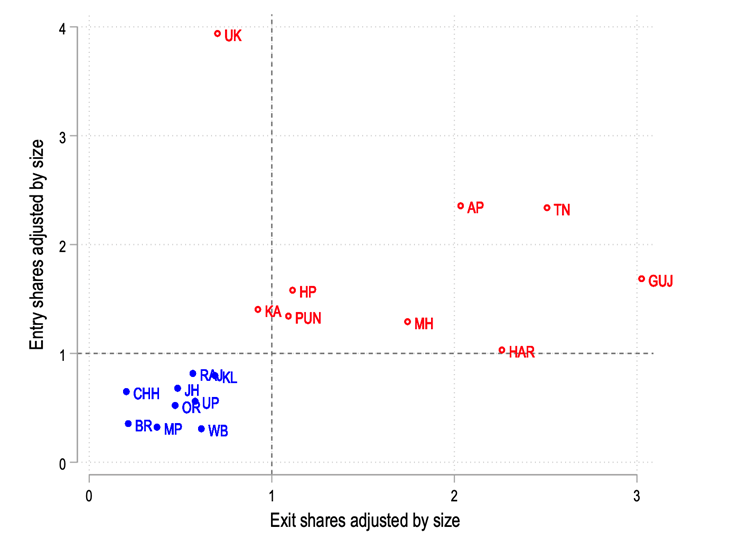
Second, misallocation, firm responsiveness to shocks, and the effects of bankruptcy reform vary between high- and low-performing states. Low-performing states have greater resource misallocation and a long tail of old and less productive firms, suggesting inefficient survival. Firms in low-performing states are also less responsive to negative shocks, particularly in adjusting their regular workforce. When the SARFAESI Act strengthened creditor rights in 2002, it led to significantly higher exit rates among highly leveraged and distressed firms in low-performing states. These patterns suggest that exit frictions are more binding in low-performing states.
Taken together, these facts suggest that in states where institutions make exit harder, misallocation is higher, new firms are discouraged from entering, and inefficient firms continue to operate longer than they should.
Modelling firm behaviour and policy trade-offs
In order to understand the consequences of exit barriers and evaluate potential reforms, we develop a dynamic structural model that incorporates key features of India's manufacturing sector. Firms in the model are ex-ante identical but become ex-post heterogeneous in productivity, operate under monopolistic competition, and face sunk entry costs.
Exit is costly, due to firing costs – especially for larger firms covered by the Industrial Disputes Act (IDA) – or due to direct institutional frictions, such as judicial delays and the absence of a bankruptcy procedure. We model these exit barriers flexibly to reflect both the costs embedded in the letter of the law and uncertainty arising from discretionary implementation. We also capture state-level variation in institutional quality by distinguishing between high- and low-performing states. Parameter estimates confirm that exit costs and labour firing costs are quantitatively more significant in low-performing states, consistent with the earlier descriptive evidence. Exit costs in low-performing states represent 173% of average annual firm sales, compared to 111% in high-performing states. Firing costs for regular workers in low-performing states represent 358% of their average annual wage, compared to 256% in high-performing states.
We use the estimated model to simulate a set of counterfactual reforms that would raise India’s firm exit rate to 50% of the US level. This target can be reached through either labour market reform (reducing firing costs) or lowering direct exit costs (e.g. having a well-laid-out path to bankruptcy).
Our results yield several key insights:
- Raising exit rates by reducing firing costs alone raises value-added by 16.4% but lowers employment by 14.6%. This is because large, unproductive firms that were previously constrained by high firing costs will exit following this reform. While this encourages more firms to enter the market, the entering firms do not fully absorb the workers displaced by large exiting firms. However, raising exit rates by reducing direct exit costs alone facilitates the exit of low-productive firms with smaller employment levels, encourages more firms to enter the market, and hiring by the new firms more than offsets employment losses from exiting firms. As a result, both value-added and employment increase by 14.3% and 8.1%, respectively, making this approach more politically feasible.
- Making capital supply more elastic (e.g. through foreign investment) significantly amplifies the gains from either reform. When capital is more elastic in supply, firm entry following either reform is less constrained by the availability of capital, leading to substantially larger increases in the mass of firms operating, value-added, and employment.
- There are strong synergies between the two policies. When labour and exit reforms are implemented together, employment losses from labour reform are reduced or even reversed. This suggests that sequencing matters – tackling direct exit costs (through bankruptcy reform) before reforming labour laws helps preserve jobs while improving efficiency.
We also examine the consequences of allocating reform budgets between promoting entry and facilitating exit. Governments in developing countries often focus on promoting entry through tax breaks, industrial parks, and start-up subsidies. Lowering entry barriers can indeed stimulate productivity and investment (Brandt et al. 2025, Schiffbauer et al. 2025). Our analysis shows that for a given budget, reducing exit costs generates much larger gains in value-added, especially at higher budget levels. If the objective is to maximise value-added, targeting exit costs is more effective. If the goal is to boost employment, entry subsidies will deliver better results.
References
Bartelsman, E, J Haltiwanger, and S Scarpetta (2009), “Measuring and analyzing cross-country differences in firm dynamics,” in Producer dynamics: New evidence from micro data, University of Chicago Press.
Brandt, L, G Kambourov, and K Storesletten (2025), “Barriers to entry and regional economic growth in China,” Review of Economic Studies, rdaf029.
Chatterjee, S and A Subramanian (2020), “India’s export-led growth: Exemplar and exception.”
Chatterjee, S, K Krishna, K Padmakumar, and Y Zhao (2025), “No country for dying firms: Evidence from India,” NBER Working Paper.
Crane, L D, R A Decker, A Flaaen, A Hamins-Puertolas, and C Kurz (2022), “Business exit during the COVID-19 pandemic: Non-traditional measures in historical context,” Journal of Macroeconomics 72: 103419.
Fan, T, M Peters, and F Zilibotti (2023), “Growing like India—the unequal effects of service‐led growth,” Econometrica 91(4): 1457–1494.
Hsieh, C T, and P J Klenow (2009), “Misallocation and manufacturing TFP in China and India,” Quarterly Journal of Economics 124(4): 1403–1448.
Padmakumar, K (2024), “Small by choice: Reassessing the aggregate implications of size-based regulations.”
Roberts, M J, and J R Tybout (1996), “Industrial evolution in developing countries: Micro patterns of turnover, productivity, and market structure.”
Rodrik, D (2016), “Premature deindustrialization,” Journal of Economic Growth 21(1): 1–33.
Schiffbauer, M, J Sampi, and J Coronado (2025), “Competition and productivity: Evidence from Peruvian municipalities,” Review of Economics and Statistics 107(1): 95–108.
Venugopal, V (2025), “Indian Supreme Court’s shock ruling against JSW Steel,” Financial Times.