

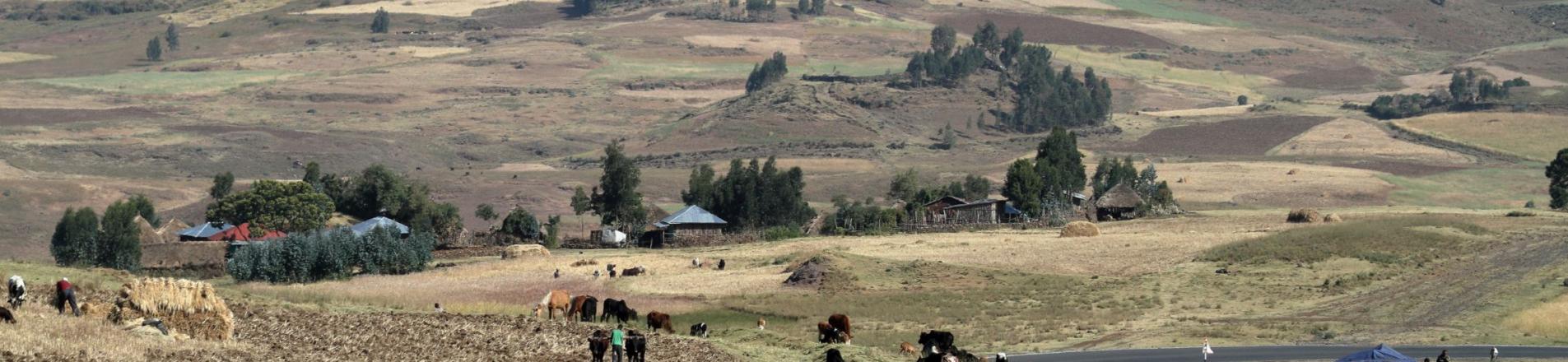


New evidence from Ethiopia reveals an unintended consequence of road construction: a sharp rise in infant deaths along key trade routes—which is potentially the result of hazardous waste dumping near roads.
Editor’s note: For a broader synthesis of themes covered in this article, check out our VoxDevLit on Land Transport Infrastructure.
Roads to prosperity—or risk?
Road networks in sub-Saharan Africa have significantly expanded over the past thirty years. According to the IMF, low-income developing countries invested around 3% of GDP in infrastructure from 2011 to 2015 (Gurara et al. 2017). These projects are often praised for their positive economic and social returns, confirmed by a large empirical evidence base (Redding and Turner 2016, Baum-Snow 2007, Dercon et al. 2009, Baum-Snow et al. 2016, Donaldson and Hornbeck 2016, Donaldson 2018, Duranton and Turner 2011). While the benefits of roads are well-documented—ranging from greater market access (Perra et al. 2024) to female empowerment (Nandwani and Roychowdhury 2024)—the potential downsides are less understood. Recent research has shown that roads can also facilitate the spread of infectious diseases such as HIV and COVID-19 (Djemai 2018, Li and Ma 2022), and contribute to pollution-related health risks (Anderson 2019).
In recent research (Gennaioli and Narciso 2025), we focus on another, often overlooked, aspect: the impact of roads on infant mortality. Ethiopia offers a particularly relevant setting. First, despite decades of progress, the country’s infant mortality rate remains high, 36 deaths per 1,000 live births in 2023 (World Bank n.d.), three times the target set by the UN Sustainable Development Goals. Second, significant regional disparities in infant mortality persist within the country (Ebrahim and Atteraya 2023). By analysing how road expansion affects infant health across different areas, we shed light on the uneven regional distribution of these outcomes.
The unintended health consequences of road construction
From 1997 onward, Ethiopia implemented one of the continent’s most ambitious infrastructure programmes, the Road Sector Development Program. With support from various donors, the government expanded and upgraded thousands of kilometres of roads across five phases. The programme aimed to enhance market access, increase agricultural productivity, and foster economic development.
Our research evaluates the impact of road expansion on infant health in Ethiopia using detailed birth histories from the Demographic and Health Surveys (DHS 2005 and 2011). We match these individual-level records with georeferenced data on roads constructed between 2000 and 2005, focusing on whether mothers lived within 5 kilometres of newly built roads. Since we cannot observe the exact year a road segment was built, we primarily focus on the increase in the road network between 2000 and 2005 and subsequent impact on health outcomes.
Estimating the causal effect of roads on health outcomes poses several empirical challenges. For example, road building initiatives may be targeted at poorer regions, which can confound analysis. To address this, we show that road construction was unrelated to pre-existing health or economic trends. We also account for local factors such as malaria and urbanisation, ruling out migration as a confounder. Importantly, our use of individual-level data allows us to control for unobservable, time-invariant individual characteristics. We consider a wide range of health measures, including haemoglobin level, severe anaemia, respiratory diseases, birth size, stunting, fever, and diarrhoea, to provide an overall assessment of child health.
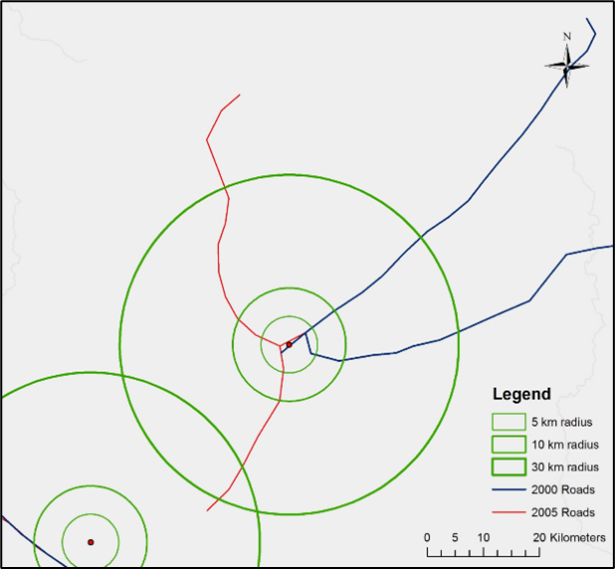
Figure 1 shows our measure of interest for a random DHS cluster, where the red dot represents the cluster’s centre. For each cluster, we are interested in the difference between the number of roads within the smallest circle (5 km radius) in 2005 (red lines) and 2000 (blue lines).
Figure 1: Increase in the road network for a random cluster
Roads increased infant mortality along key trade corridors
Our analysis reveals that proximity to newly constructed roads increases the probability of infant death by approximately 3 percentage points—a 34% rise relative to the sample mean—but only along routes linking the capital, Addis Ababa, to Somalia and Djibouti, Ethiopia’s two main ports of access to the sea.
Crucially, we do not observe this effect along other major corridors—such as those to Kenya, Sudan, or Eritrea—which are also busy primary roads, travelled by people and goods entering the country from abroad. Nor do we find similar increases in infant mortality among households located 10 to 30 kilometres from road construction sites (outer circle in Figure 1), which serve as a placebo group in our analysis.
Figure 2: Pre-trend analysis
Panel A: All roads Panel B: Somalia and Djibouti routes
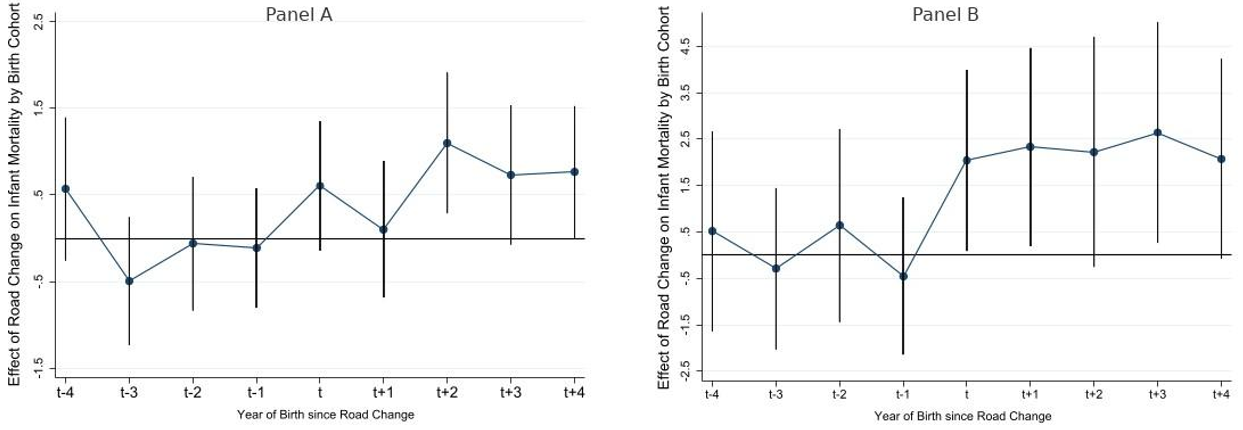
Notes: The figures plot the coefficients obtained by a panel regression at the mother level of infant mortality on the interaction between roads at time t and a complete set of birth cohort dummies for the period before and after t. Lines indicate 95% confidence intervals based on standard errors clustered at the cluster level.
Explaining the health impacts of road construction
We explore two possible explanations:
- New roads may increase traffic pollution, consistent with the empirical evidence provided by Anderson (2019). However, our data shows no rise in air pollution-related diseases, such as respiratory illnesses, and our results hold when we exclude highly polluted urban areas like Addis Ababa. This suggests air pollution is not the main mechanism explaining our results.
- Road construction may raise exposure to hazardous waste and potentially harmful chemicals. Several empirical studies show that illegal dumping sites are often located near roads (Biotto et al. 2009, Jordá-Borrell et al. 2014, Seror and Portnov 2018), and similar patterns have been documented in Ethiopia (Tadesse et al. 2008, Eshete et al. 2023). The African Development Fund (2011) also warns that road projects can increase the risk of hazardous waste being dumped near homes and farmland.
Our findings suggest this second mechanism is likely to be at play. First, when looking at a wide range of children’s health outcomes, we only observe an increase in outcomes associated with waste exposure, i.e. infant mortality, severe anaemia, and low haemoglobin (Ahamed et al. 2011, Azmi et al. 2009, Jain et al. 2005, 2023, Khan et al. 2013, Stillerman et al. 2008, WHO 2011, Lovo and Rawlings 2024). Second, these effects are consistently observed only along the primary routes departing from Ethiopia’s main ports of entry to the sea, Somalia and Djibouti. We do not observe negative effects from road construction elsewhere in Ethiopia or on other health conditions associated with endemic diseases, such as malaria.
If the effect of road construction on infant mortality is associated with hazardous waste dumping near roads, then we would expect roadsides in areas with more building sites to experience more dumping. Similarly, road works along major routes connecting inland cities to major ports could make new regions more accessible for waste disposal. The Somalia and Djibouti corridors are not only the ones that experienced more road construction during the study period, implying more potential dumping spots available in the region, but also key entry points into Ethiopia. While direct data on dumping is limited, this informal evidence offers one plausible explanation for the health impacts we observe along key trade corridors.
Infrastructure expansion requires environmental safeguards
Our findings suggest that the full benefits of road construction may not be realised when environmental and health risks are overlooked. While new roads can boost trade and access to services, they may also create unintended harms, particularly in areas that may be suitable for the movement and dumping of hazardous waste. Our results highlight the need for enhanced oversight and environmental monitoring, particularly along major trade corridors. Safeguards during and after construction are essential to ensure that infrastructure delivers inclusive and sustainable development.
References
African Development Fund (2011), “Environmental and social impact assessment summary.”
Ahamed, M, M J Akhtar, S Verma, A Kumar, and M K Siddiqui (2011), “Environmental lead exposure as a risk for childhood aplastic anemia,” Biosci Trends, 5(1): 38–43.
Anderson, M (2019), “As the wind blows: The effects of long-term exposure to air pollution on mortality,” Journal of the European Economic Association, 18(4): 1886–1927.
Azmi, M A, S N H Naqvi, K Akhtar, S Parveen, R Parveen, and M Aslam (2009), “Effect of pesticide residues on health and blood parameters of farm workers from rural Gadap, Karachi, Pakistan,” Journal of Environmental Biology, 30(5): 747–756.
Baum-Snow, N (2007), “Did highways cause suburbanization?” The Quarterly Journal of Economics, 122(2): 775–805.
Baum-Snow, N, J V Henderson, M A Turner, Q Zhang, and L Brandt (2016), “Roads railroads and decentralization of Chinese cities,” Review of Economics and Statistics, 99(3): 435–448.
Biotto, G, S Silvestri, L Gobbo, E Furlan, S Valenti, and R Rosselli (2009), “GIS, multi‐criteria and multi‐factor spatial analysis for the probability assessment of the existence of illegal landfills,” International Journal of Geographical Information Science, 23(10): 1233–1244.
Dercon, S, D Gilligan, J Hoddinott, and T Woldehanna (2009), “The impact of agricultural extension and roads on poverty and consumption growth in fifteen Ethiopian villages,” American Journal of Agricultural Economics, 91(4): 1007–1021.
Djemai, E (2018), “Roads and the spread of HIV in Africa,” Journal of Health Economics, 60(C): 118–141.
Donaldson, D (2018), “Railroads of the Raj: Estimating the impact of transportation infrastructure,” American Economic Review, 108(4–5): 899–934.
Donaldson, D and R Hornbeck (2016), “Railroads and American economic growth: A ‘market access’ approach,” The Quarterly Journal of Economics, 131(2): 799–858.
Duranton, G and M A Turner (2011), “The fundamental law of road congestion: Evidence from U.S. cities,” American Economic Review, 101(6): 2616–2652.
Ebrahim, N B and M S Atteraya (2023), “Inequalities of infant mortality in Ethiopia,” International Journal of Environmental Research and Public Health, 20: 6068.
Eshete, H, A Desalegn, and F Tigu (2023), “Knowledge, attitudes and practices on household solid waste management and associated factors in Gelemso town, Ethiopia,” PLoS One, 18(2).
Gennaioli, C and G Narciso (2025), “Toxic roads,” Environmental and Resource Economics, 88(6): 1773–1803.
Gurara, D, M V Klyuev, M Mwase, A Presbitero, X C Xu, and M G J Bannister (2017), “Trends and challenges in infrastructure investment in low-income developing countries,” Unpublished manuscript.
Jain, A, S Wadhera, P Malhotra, C Singh, D Pravinkumar Lad, A R Khadwal, G Prakash, N Varma, and P Reddy (2023), “Association between heavy metal exposure and idiopathic aplastic anemia in adolescents and adults: A case control study from Northern India,” Blood, 142(1): 7323.
Jain, N B, F Laden, U Guller, A Shankar, S Kazani, and E Garshick (2005), “Relation between blood lead levels and childhood anemia in India,” American Journal of Epidemiology, 161(10): 968–973.
Jordá-Borrell, R, F Ruiz-Rodríguez, and A L Lucendo-Monedero (2014), “Factor analysis and geographic information system for determining probability areas of presence of illegal landfills,” Ecological Indicators, 37(A): 151–160.
Khan, A A, M A Shah, and U R Saleem (2013), “Occupational exposure to pesticides and its effects on health status of workers in Swat, Khyber Pakhtunkhwa, Pakistan,” Journal of Biology & Life Science, 4(2): 43–55.
Li, B and L Ma (2022), “Migration, transportation infrastructure, and the spatial transmission of COVID-19 in China,” Journal of Urban Economics Insights, 127: 103351.
Lovo, S and S Rawlings (2024), “The health burden of e-waste: The impact of e-waste dumping sites on child mortality,” The World Bank Economic Review, lhae053.
Nandwani, B and P Roychowdhury (2024), “Rural road infrastructure and women’s empowerment in India,” The World Bank Economic Review, lhae048.
Perra, E, M Sanfilippo, and A Sundaram (2024), “Roads, competition, and the informal sector,” Journal of Development Economics, 171.
Redding, S and M Turner (2016), “Transportation costs and the spatial organization of economic activity,” in G Duranton, J V Henderson, and W C Strange (eds.), Handbook of Regional and Urban Economics, 5.
Seror, N and A Portnov (2018), “Identifying areas under potential risk of illegal construction and demolition waste dumping using GIS tools,” Waste Management, 75: 22–29.
Stillerman, K P, D R Mattison, L C Giudice, and T J Woodruff (2008), “Environmental exposures and adverse pregnancy outcomes: A review of the science,” Reproductive Sciences, 15(7): 631–650.
Tadesse, T, A Ruijs, and F Hagos (2008), “Household waste disposal in Mekelle city, Northern Ethiopia,” Waste Management, 28(10): 2003–2012.
WHO (2011), “Haemoglobin concentrations for the diagnosis of anemia and assessment of severity.”
World Bank (n.d.), “Mortality rate, infant (per 1,000 live births) – Ethiopia.”