


Transport policy in developing countries requires context-specific solutions grounded in evidence, as slow travel speeds, informal systems, gendered safety concerns, and institutional constraints mean that common fixes like congestion charging or BRT are not universally effective, though better-designed mobility systems can expand access to jobs, markets, and opportunity.
Editor’s note: For a broader synthesis of themes covered in this article, check out our VoxDevLit on Land Transport Infrastructure. This episode of VoxDevTalks is available on Spotify and Apple Podcasts.
In this episode of VoxDevTalks, Adam Storeygard speaks about what research tells us regarding transport policy in low- and middle-income countries. Drawing on his recent review paper, Storeygard helps separate evidence from intuition in a field often shaped by visible congestion, political pressure, and large infrastructure ambitions.
Transport is not just about movement – it underpins how cities function and how rural economies connect to markets.
“Cities exist for people to interact, for workers to find good jobs, for firms to find workers but also finance and other inputs, and then, more generally, for residents to find stores and restaurants, but also friends and parties and the countless ways that human interaction enriches our lives. But if it takes me three hours to get to the other side of my city, then everything over there isn’t very useful to me.”
In rural areas, limited transport constrains farmers’ access to markets and inputs, and reduces firms’ competitiveness. Transport, therefore, is fundamental to economic opportunity and inclusion.
Is congestion really the main problem?
For many policymakers, congestion appears to be the obvious target. Yet the research suggests a more nuanced picture. Storeygard’s work with co-authors finds that in many low- and middle-income cities, slow travel speeds are not primarily driven by peak-hour congestion.
“Our research suggests that vehicular transport in the cities of poor and middle-income countries is slower than travel in rich country cities more because of slow speed in the absence of traffic than because of congestion per se.”
The example of Dhaka is striking. While peak speeds are extremely low, off-peak speeds are not much better.
“In the trips we query in our work, we see speeds of around 15 kilometres an hour at peak hours, but it’s also only about on average, 20 kilometres an hour in the middle of the night.”
This suggests structural problems – road quality, traffic management, non-motorised traffic, weak enforcement – rather than congestion alone.
For policymakers, this implies that congestion charging or vehicle restrictions may only address a fraction of the problem. Improving baseline speeds may require attention to infrastructure quality and traffic systems, not just demand management.
Informal transport: Problem or solution?
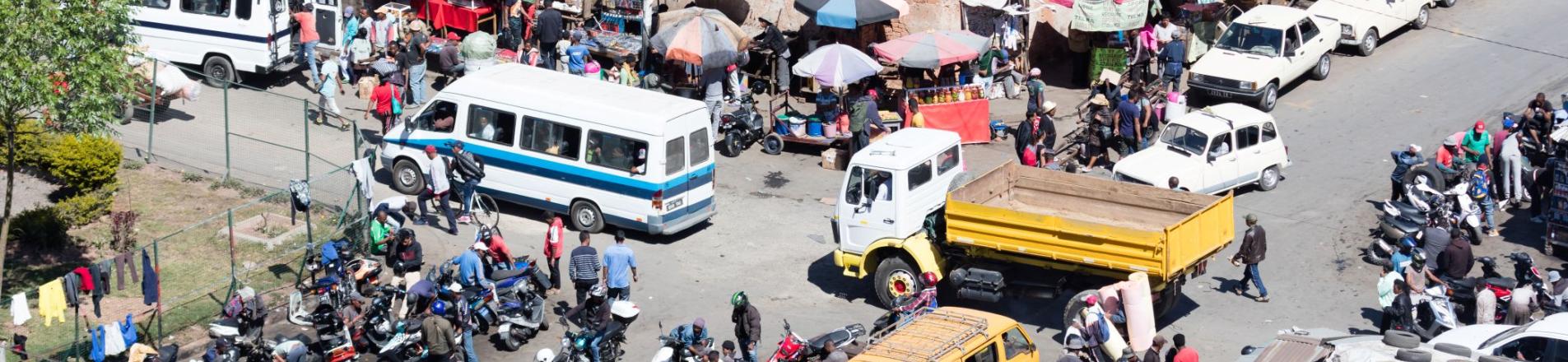
Informal transport – minibuses, shared taxis, and private operators – dominates mobility in many cities across Africa, Asia, and Latin America. Should governments replace these systems with formal public transport? The evidence is far from clear.
Storeygard notes that “the research is not very clear here, because it’s really hard to study this problem well”. Informal systems are heterogeneous and deeply embedded in urban mobility. Outlawing them would be politically and practically challenging.
Importantly, informality itself may not be the root of concerns about safety or congestion. Definitions vary: some operators may be registered but use unauthorised stops, while others may operate entirely outside formal regulation. The appropriate policy response differs accordingly.
Evidence from Lagos shows how formal and informal systems interact. When a new public bus system was introduced, informal drivers adjusted. Some exited affected routes, reducing frequency there, but increased service elsewhere, lowering prices on other routes. The aggregate effects included both winners and losers, including informal drivers harmed by new competition.
The lesson is clear: informal systems respond strategically. Policymakers must anticipate these adaptations rather than assume a static transport landscape.
Connecting people to jobs: Promises and limits
Transport is often framed as a tool for labour market inclusion. If people can reach jobs more easily, employment and incomes should rise. Evidence provides cautious support, but also caveats.
Research on transport subsidies for job seekers found short-term gains in formal employment, though these effects did not persist. In Mexico City, new transit lines appear to have increased formal job take-up. However, improved connectivity can also attract more migrants to cities, intensifying competition.
There are also concerns about displacement. When transit improves neighbourhood accessibility, rents may rise, potentially pricing out lower-income residents. Evidence from Bogotá suggests these effects may be limited, but the interaction between housing markets and transport remains complex.
The overarching message is that labour market impacts depend on context and complementary policies, particularly housing and land use regulation.
Gender, safety, and mobility
Transport policy is not gender neutral. In parts of South Asia, safety concerns significantly shape women’s mobility choices.
Research from Delhi shows that women attend less selective universities than similarly qualified male neighbours, despite gaining admission.
“[Girija Borker] makes the compelling case that women are making these different choices based on the physical safety of travel from their home to university.”
Policies such as women-only carriages have shown some labour market effects, and in rural settings, providing bicycles to girls increases school attendance. These findings highlight how safety and social norms interact with transport systems, influencing educational and economic outcomes.
Designing inclusive transport requires recognising these gendered constraints rather than assuming uniform mobility needs.
Bus rapid transit and the limits of big solutions
Bus rapid transit (BRT) has gained popularity as a lower-cost alternative to urban rail. Storeygard describes it as “trying to achieve the main advantage of rail, namely that it’s fast and impervious to road congestion, but to do so much cheaper”.
Evidence from Bogotá, Lahore, and Jakarta suggests BRT can reduce travel times. However, design and implementation matter enormously. If buses must frequently cross intersections without priority, they risk becoming “more like very expensive busses”, undermining speed and reliability.
Moreover, BRT often requires reallocating road space. If systems are underused, the removal of traffic lanes can create net negative effects. Success depends on ridership, enforcement, and integration with the wider network.
Similarly, congestion pricing and vehicle restriction policies show mixed evidence. Experimental evidence from Bangalore suggests that reducing a small number of cars may not substantially improve speeds. Licence-plate driving restrictions in Mexico City and Bogotá led households to purchase additional – often dirtier – vehicles, offsetting intended gains. In contrast, Beijing and Quito saw more positive pollution effects, partly due to complementary constraints on car ownership.
Historical legacies and rural roads
Transport networks often reflect colonial-era priorities, especially in Africa, where railways were frequently designed to connect mines to ports rather than integrate domestic markets. These patterns continue to shape trade flows and settlement patterns. Coastal-oriented infrastructure may encourage overseas trade at the expense of regional integration.
In rural areas, road building generally facilitates market access and enhances the effectiveness of complementary policies such as agricultural extension. However, there is evidence that certain roads can accelerate deforestation, highlighting environmental trade-offs.
Not all roads are automatically beneficial; their broader impacts depend on context and accompanying policies.
Data, big data, and the research frontier
Historically, transport research in low- and middle-income countries has been constrained by limited data. Household travel surveys are rare. The rise of mobile phone data and digital mapping has transformed the field, enabling researchers to track mobility patterns at unprecedented scale.
Yet these data bring new challenges: vast volumes, noise, and limited demographic information about users. Knowing where a phone travels does not reveal much about who is travelling. Linking mobility data to socioeconomic characteristics remains a key frontier.
References
Akbar, P, V Couture, G Duranton, and A Storeygard (2023), “The fast, the slow, and the congested: Urban transportation in rich and poor countries,” Unpublished manuscript.
Borker, G (2018), "Safety first: perceived risk of street harassment and education choices of women", Unpublished manuscript.
Garlick, R, E Field, and K Vyborny (2025), “Women’s Mobility and Labor Supply: Experimental Evidence from Pakistan,” Unpublished manuscript.
Pandey, V, S Pawar, and N Prakash (2025), “Pedalling towards gender equality and empowerment,” VoxDev.
Storeygard, A (2025), “Transport in low- and middle-income countries,” Unpublished manuscript.