





Introducing new public buses in Lagos improved commuter welfare through lower fares and better service, but also reduced driver incomes and increased wait times in the private sector – highlighting the distributional trade-offs of public transit expansion.
Editor’s note: For a broader synthesis of themes covered in this article, check out our VoxDevLit on Land Transport Infrastructure.
The world is urbanising at an unprecedented pace. By 2050, nearly seven in ten people will live in cities, and almost all of that growth will occur in low- and middle-income countries. Cities like Lagos, Nairobi, and Dhaka are growing faster than their transport systems can keep up. As congestion worsens and travel times rise, mobility issues may become a major brake on productivity.
In most developing cities, the majority of trips are made on privately operated minibuses, shared taxis, and motorcycle taxis. These systems are sometimes called ‘informal’ transit, though in many cases they are registered and pay taxes. According to the Sub-Saharan Africa Transport Policy Program (Kumar et al. 2021), these private systems carry over 70% of daily passengers in African cities, providing critical mobility for low-income and peri-urban residents.
As many cities grow and become wealthier, they have begun to invest in government-run public transit. The impacts of such systems have been studied in Jakarta (Kreindler et al. 2023) and Colombia (Tsivanidis 2022), showing that planning can improve accessibility and shape more equitable cities.
However, much of the existing evidence focuses on public transit in isolation. How do public and private transit networks interact? Despite the importance of private networks, they remain poorly integrated into planning and policy frameworks even as new research (Cervero and Golub 2007, Conwell 2024, Mbonu and Eaglin 2024, Storeygard 2025) shows that private systems are central to how cities move and to how future transit reforms will succeed.
New public transit systems for growing cities
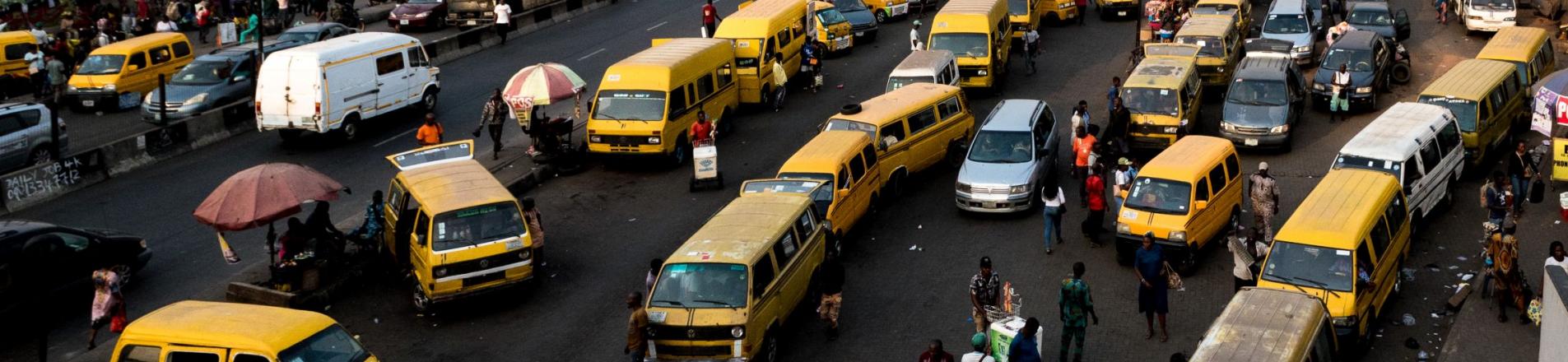
Lagos, Nigeria, the setting of our study, is representative of this modal split. With over 22 million residents, the city has long relied on a network of an estimated 75,000 minibuses, known locally as danfo. These vehicles are cheap and omnipresent, but they also contribute to congestion, pollution, and safety concerns.
Between 2019 and 2022, Lagos launched the Bus Reform Initiative (BRI), deploying 820 new public buses across 64 routes. The reform’s stated aims were to improve safety, comfort, and environmental outcomes while maintaining affordable fares for commuters.
Working with the Lagos Metropolitan Area Transport Authority (LAMATA), we collected data on both the private and public transit markets in order to have a holistic view of what happened to mobility and commuters (Björkegren, Duhaut, Nagpal, and Tsivanidis 2025). We mapped all the private transport routes in Lagos, tracked congestion, recorded minibus fares, frequencies, and wait times, and surveyed drivers and commuters. This rich dataset allowed us to measure how departure frequencies and fares changed as the system was rolled out, across three types of routes: directly treated (fully overlapping with new bus routes), connected (sharing one endpoint), and control (having no overlap).
What happens when public buses compete with private minibuses?
Competition leads to lower fares and more service on connected routes
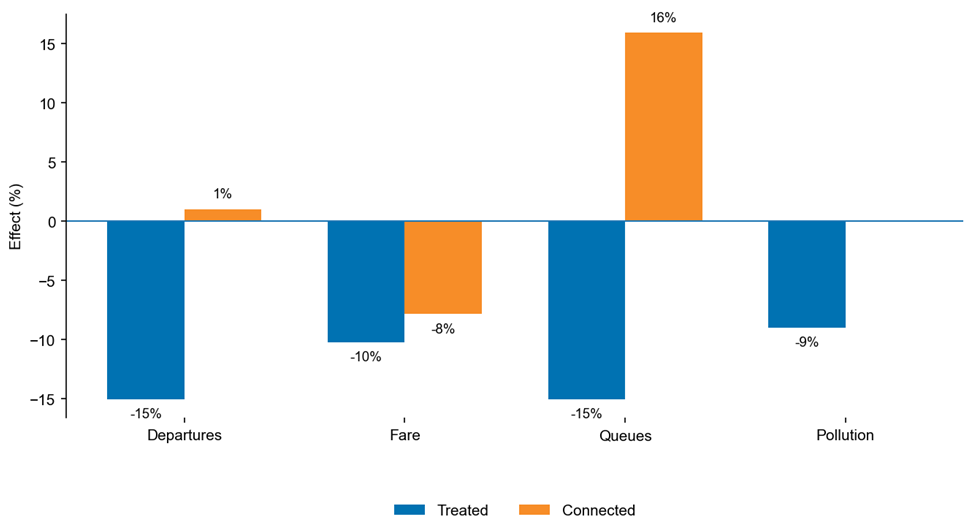
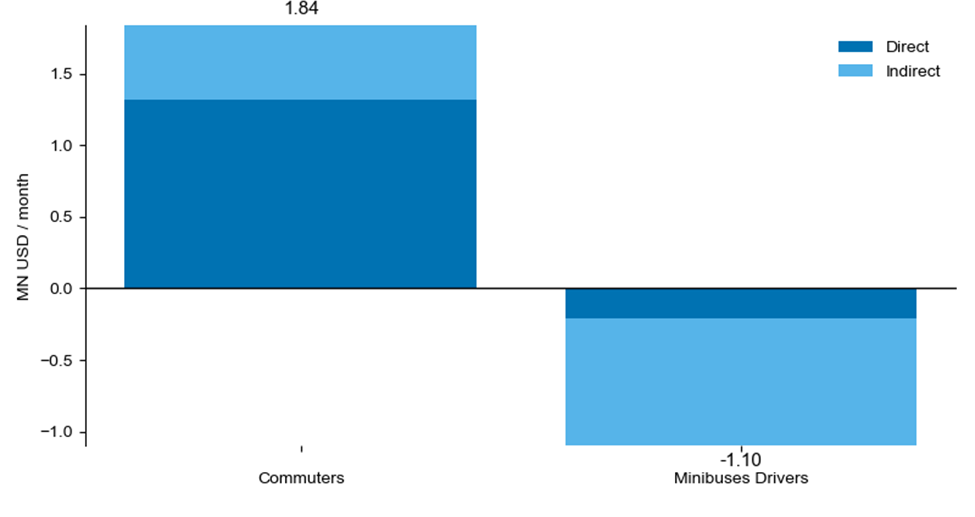
The new public buses generated substantial gains for commuters, around US$1.84 million per month. Why? Not only did passengers directly benefit from a new high-quality option, they also indirectly benefited: as passengers shifted to public buses, minibus drivers responded to competition by switching and offering their services to connecting routes, which was a net benefit for commuters on connected routes. Minibus drivers also lowered their fares by 8–11%, making rides cheaper even for those who continued to travel by minibus. Emissions accounting suggests that replacing older minibuses with newer, lower-emission vehicles reduced CO₂ emissions by around 9% along affected routes.
Figure 1: Effect of public transit rollout on treated and connected private routes
Sources: Authors’ calculations based on treated and connected routes regression model and COPERT model for pollutants emissions calculation.
Longer waits and lost incomes
But the reform also harmed others. Roughly 11,000 minibus drivers lost an estimated total of $1.1 million per month in income – about 60% of total commuter gains. How did this happen? When public buses entered certain routes, fewer commuters used minibuses on those corridors. Drivers then spent more time waiting in queues at terminals, completing fewer trips per day, and earned less per trip as fares fell. Daily profits fell as they faced competition from the public buses.
The impacts did not stop there – some drivers responded by shifting to adjacent, connected routes, which in turn increased queues and lowered earnings there as well. So, the losses were not only on routes where public buses entered, but also on routes connected to them. And because minibuses typically wait until full before departing, reduced demand also meant lower departure frequencies – increasing wait times for the commuters who continued using the private system. The reallocation of transport was not enough to meaningfully reduce congestion, and travel times remained the same.
Beyond direct costs and benefits
This exercise shows that, where the private market is large, understanding how private incumbents respond is important for cost-benefit analysis. Their reactions can indirectly shift consumer surplus through changes in prices, frequencies, and routes. Focusing only on direct gains for commuters using the public service would miss these indirect effects, which end up being key contributors to who wins and who loses from the reform.
Figure 2: Direct and indirect benefits and costs of introducing public transit
Source: Authors’ calculations.
Over the short-run horizon we study, commuter gains of $1.84 million per month were outweighed by the public sector’s operating costs of roughly $2.26 million per month. But this comparison excludes broader social benefits – such as lower emissions, improved safety, and long-term productivity gains from better connectivity. As noted in Kumar et al. (2021), judging transitions from private to public systems solely on short-term operating costs is misleading: public systems are often more expensive to run, but can deliver large social dividends over time.
Policy lessons: A hybrid system is here to stay
After the rollout of new buses, private minibuses still accounted for about 52% of trips. In many emerging cities, fully centralised public transit is unlikely to replace private transport anytime soon. Most cities will continue to operate hybrid public and private systems – where public investment raises standards and builds new modes (such as rail), while private operators continue to meet most daily demand.
We draw three policy insights from our findings:
- Build on private sector strengths. Where public transport has been inadequate, informal and private operators have kept cities moving. Reform should recognise and leverage their resilience and adaptive capacity.
- Manage the trade-offs. As seen across African cities, private transport provides affordable access, but workers often face inconsistent earnings and difficult working conditions. Follow-up research and policy should examine their incentives and business models, providing options for transition.
- Plan for complementarity between modes. As cities invest in cleaner, safer, and more efficient public transit, private operators will remain central for years. Policies should promote coordination and integration across modes in system design – not assume replacement.
Authors' note: This work would not have been possible without the tireless work of field managers Nuruddeen Umar and Segun Adebamiji and coordinators Festus Adeyemi and Salmat Alimi.
References
Björkegren, D, A Duhaut, G Nagpal, and N Tsivanidis (2025), “Public and private transit: Evidence from Lagos,” Unpublished manuscript.
Cervero, R, and A Golub (2007), “Informal transport: A global perspective,” Transport Policy, 14: 445–457.
Conwell, L (2024), “Privatized provision of public transit: Subways or minibuses?” Unpublished manuscript.
Kreindler, G, A Gaduh, T Graff, R Hanna, and B A Olken (2023), “Optimal public transportation networks: Evidence from the world’s largest Bus Rapid Transit system in Jakarta,” Unpublished manuscript.
Kumar, A, S Zimmerman, and F Arroyo-Arroyo (2021), “Myths and realities of ‘informal’ public transport in developing countries,” World Bank.
Mbonu, O, and F C Eaglin (2024), “Market segmentation and coordination costs: Evidence from Johannesburg’s minibus networks,” Unpublished manuscript.
Storeygard, A (2025), “Transport in low- and middle-income countries,” Unpublished manuscript.
Tsivanidis, N (2022), “Evaluating the impact of urban transit infrastructure: Evidence from Bogotá’s TransMilenio,” Unpublished manuscript.